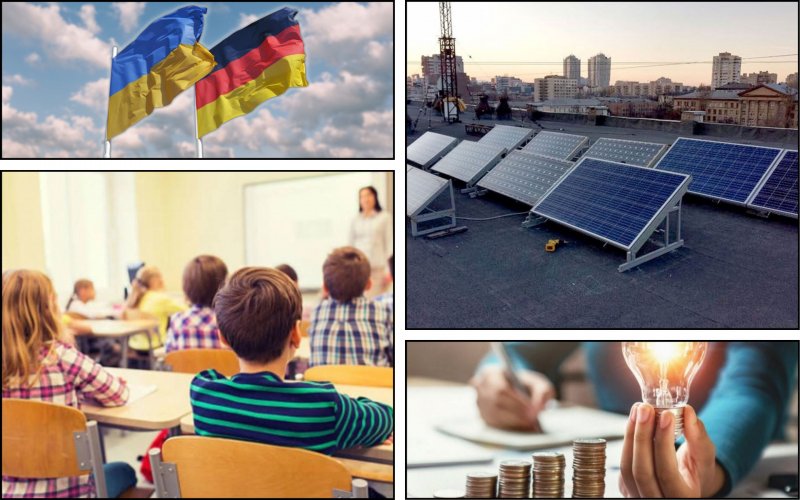
Germany, the European Investment Bank (EIB) and the Ministry of Reconstruction of Ukraine have agreed to sign a €20 million grant for the Renewable Energy Solution Program.
The grant will promote the implementation of renewable energy technologies in Ukrainian municipalities, including schools, hospitals and kindergartens, and increase the energy independence of public institutions, the EU Delegation to Ukraine reports.
This happened during the COP28 climate conference.
It is noted that through this contribution, the German government intends to support the transformation of energy systems and the green reconstruction of Ukraine on its path to EU membership. The initiative will help municipalities in synergy with other existing EIB framework loan agreements.
This will help to attract additional funds for climate action from the programs:
- "Energy efficiency of public buildings in Ukraine" (UPBEE) — for thermal modernization in Ukrainian communities € 300 million;
- "Ukraine Emergency Recovery Program" (UERP) and "Ukraine Recovery Program" (URP) — for de-occupied territories with a total cost € 540 million
The RES program is expected to support future similar EIB framework loan agreements.
The message emphasized that modernization of buildings will significantly reduce energy consumption. The program also provides for the integration of renewable energy technologies in public buildings, including solar power plants, storage batteries, the use of biomass and heat pumps. Thanks to this RES:
- will improve the energy autonomy of critically important public buildings;
- will ensure their stable operation even in conditions of power outages due to Russian attacks on energy infrastructure.
It is noted that the German Society for International Cooperation (GIZ) will provide technical assistance and consulting services necessary for the successful implementation of the program.
"Such decisions are an important contribution not only to the decarbonization of the energy system, but also to the restoration of the Ukrainian energy infrastructure due to the ongoing Russian aggression. With our own support, we also inspire further actions to create a more sustainable energy system and ensure the energy supply of critical infrastructure facilities. I I sincerely believe that the transition to climate neutrality can be integrated into all reconstruction efforts. I admire Ukraine's resilience and determination in the climate and energy transition in the face of military threats," said German Federal Minister of Economics and Climate Protection Robert Habeck.
Earlier, EcoPolitic wrote, that Ukraine, with the support of GIZ, has launched a grant competition for industrial and war-affected enterprises, the winners of which will receive €10,000 to improve energy efficiency.
As EcoPolitic previously reported, Lithuanian President Gitanas Nausėda said that Ukraine's environmental restoration should become a success story, as it is critical to ensuring energy independence from the aggressor state of Russia.