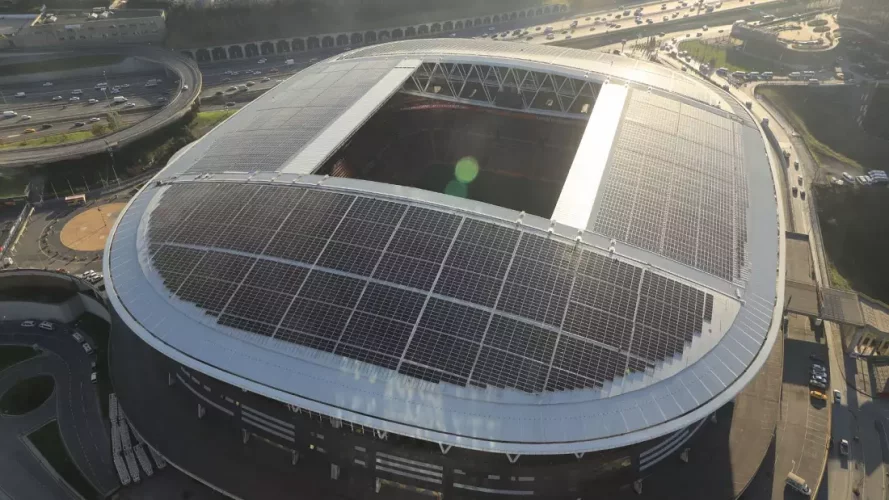
In Istanbul, Turkey, on the roof 10,404 solar panels with a capacity of 4.2 MW were installed at the Ali Sami Yen Spor Kompleksi Stadium of the Galatasaray football club.
Green energy provides 63-65% of the stadium's needs and made it possible to save €385,000 in 8 months of operation, reports Euronews.
The stadium buys the remaining energy from the municipal electricity supplier Enerjisa.
"The increase in energy prices, together with the official inflation rate, which is now over 80%, meant that the club started to save money just weeks after the system went live," the article emphasized.
In addition to reducing costs, solar energy also leads to a new source of income for the Galatasaray National Sports Club. The club buys all the energy produced from the panels from Enerjisa. Since the stadium only fully utilizes its lighting system for 150 hours during 25 matches a year, it receives more electricity than it needs, so the rest is sold to the municipality.
Stadium director Ali Chelikkiran noted that thus the club earns a lot of money, but did not disclose exactly how much.
He also said that the energy savings of the panels is equal to the energy use of 2,000 houses and will reduce 3,250 tons of carbon per year. This is equivalent to saving 200,000 trees for 25 years.
The material added that such a SES will help reduce Turkey's dependence on imported energy resources. After nine years, the contract of Galatasaray with Enerjisa ends, and full control passes to the club.
Chelikkiran said the project became viable because the stadium's retractable roof has the right shape to receive sunlight and can support the weight of thousands of panels.
Earlier, EcoPolitic wrote, that in Albania, the first stage of subsidization was launched solar panels for heating water for 2,000 low-income families to reduce energy costs.
As EcoPolitic previously reported, in the EU during May-August 2022, solar generation increased by 28%, which allowed to save 20 billion m3 of gas, the import of which would cost €29 billion.