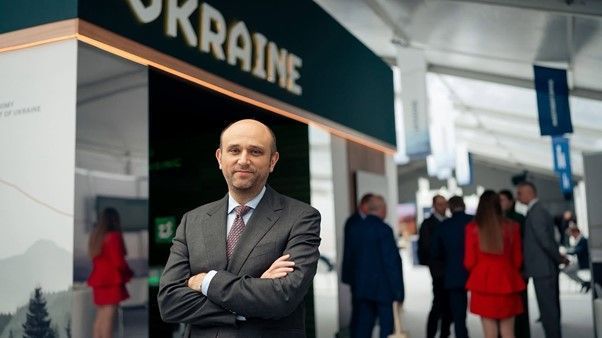
The Minister for the Economy and the Environment, Oleksandr Kravchenko, gave his first major interview, in which he outlined the ministry’s priorities: business insurance, attracting investment and deregulation. The only topics relating to the environment were the re-establishment of a separate Ministry of the Environment and efforts to work with EU bodies to ease the CBAM restrictions on Ukraine.
EcoPolitic analysed the interview given by the head of the department to Forbes magazine to determine whether the word ‘environment’ in the ministry’s name reflects its priorities.
The Fate of the Ministry of the Environment
The issue of separating the Ministry of the Environment into a standalone institution is quite obvious to the Minister for the Economy and the Environment, who has focused almost exclusively on the economy.
However, Oleksandr Kravchenko’s reply is extremely brief:
"We are operating in accordance with the framework approved by the Verkhovna Rada."
He also added that the environmental team within the department is being expanded. In particular, someone has been appointed to the post of a further deputy, who will “strengthen the environmental focus”.
The name Alexander Kravchenko is mentioned, but it is likely that the reference is to Olena Kramarenko.
Discussions on the CBAM are ongoing
Another issue relating to the environmental agenda is the European Carbon Border Adjustment Mechanism (CBAM).
The Minister for the Economy gave assurances that the government is continuing negotiations with the European Union to ensure that it takes into account the actual conditions under which Ukrainian businesses are forced to operate. He also emphasised that the European Parliament had provisionally backed the possibility of applying special measures. This is primarily due to the full-scale war.
"The final decision still depends on negotiations between the European Parliament, the Council of the EU and the European Commission. We are continuing our dialogue with our European partners to ensure that the realities of Ukraine are taken into account in the final CBAM rules", said Oleksandr Kravchenko.
The environment — somewhere on the periphery
These are the only references to environmental issues in an interview running to over 20,000 characters. Yet the Ministry of Economy and the Environment, when outlining the department’s priorities for 2027 with reference to this text, chose not to mention the environment at all.
The complexity of the economic situation in which Ukraine currently finds itself is evident and requires a tremendous amount of work to resolve problems that are only growing in scale. However, what, then, is the role of the environment within a ministry that has ‘environment’ in its name but by no means treats it as a priority? It is a rhetorical question.
As a reminder, the separate Ministry of the Environment was abolished in 2025, which sparked outrage amongst environmentalists and experts.
In July 2026, the agricultural sector was separated from the merged Ministry of Economy, Environment and Agriculture. Despite calls to grant autonomy to the environmental sector as well, it was left in the shadow of the economy.
As EcoPolitic previously reported, as of February 2026, only 126 staff members were responsible for environmental matters in the former ‘mega-ministry’, representing around 10 per cent of the workforce. By way of comparison, 214 people were employed at the Ministry of the Environment prior to its dissolution.
EcoPolitics has also analysed the new government’s plans with regard to environmental protection. In short, environmental issues are addressed, but only in passing and with very vague criteria for achieving the objectives. For more details, see the article.