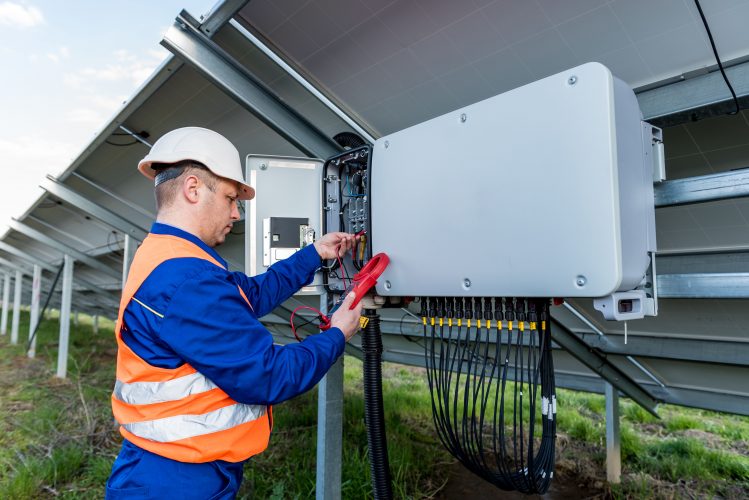
EU-funded green energy projects are set to ban the use of solar and battery inverters from China. China is considered a "high-risk" country. So the only option for energy companies now is to find more reliable alternatives. This could make renewable energy projects—and electricity in general—more expensive.
According to Euronews, 61% of inverters are imported directly from China to the EU. However, the European Commission has already banned the European Bank for Reconstruction and Development and the European Investment Bank from financing new projects that include Chinese components.
China controls the EU’s power grids
This type of equipment is the “brain” of green power plants. It converts the electricity generated by the panels into a form suitable for use in the general power grid. Solar power plants already provide 13.4% of the EU’s electricity, so their dependence on Chinese equipment is a serious concern.
Inverters are connected to the internet, which allows manufacturers to update the equipment’s “firmware” and perform maintenance. Among recently installed solar power plants, 80% operate on equipment from China. Thus, the Chinese government can control European power plants through manufacturers.
“In this way, China could indirectly control hundreds of gigawatts of inverter capacity, which in practice means it could control Europe's power grid. This poses a certain critical risk, which could destabilize the grid and cause power outages across the country,” – said Christoph Podewils, Secretary General of the industry association European Solar Manufacturing Company.
The expert refers to a cybersecurity study conducted by the Czech Technical University. It was found that researchers connected with China have been studying foreign power grids for years, paying particular attention to attacks using false data and to critical nodes, disruptions of which could cause large-scale failures.
Impact on the renewable energy sector
Project financing has already been frozen, so developers are urgently amending their procurement contracts. For this reason, construction timelines for new solar power plants are being postponed by 6–12 months.
The European Investment Bank alone supports the construction of 20% of the European Union's solar power plants, involving hundreds of large-scale projects. In addition, the Spanish Solaria Utility Portfolio program, worth €1.7 billion, is now at risk. The program covers construction of 100 solar plants in Spain, Portugal, and Italy.
Instead of Chinese equipment, energy projects are now seeking components from safer countries – Japan, the United States, or the EU’s internal market. At the same time, suppliers will still be required to certify that no components originate from China.
Preliminary estimates indicate that changing suppliers will increase procurement costs by about 2%. Moreover, rejecting Chinese services may reveal vulnerabilities – currently, China controls around 98% of the supply chain for solar energy and battery components.
Додаткові витрати енергетиків очікувано перекладатимуть на споживачів – ціни на електроенергію можуть несуттєво зрости. Проте у перспективі таке рішення ЄС має зменшити залежність від ризикованого ринку.
However, experts predict that between 2027 and 2030, domestic production of components for “green” energy projects will increase.
Total dominance of China in the “green” technology market is causing serious concern. The country produces 90% of all solar panels and over 80% of wind turbines. Calls to abandon Chinese equipment in clean energy have been reported earlier by EcoPolitic.
China also leads the electric vehicle market. In just the first two months of 2026, Chinese manufacturers exported more than half a million electric vehicles abroad. Even in Ukraine, where imports of new cars have significantly collapsed, 82% of the cars imported in April were of Chinese origin.