There is an issue in Ukraine’s climate policy that has so far remained overshadowed by discussions about CO₂ — namely, methane emissions. In their study, experts from the Green Deal Ukraine project state that, when assessing the climate impact over a 20-year horizon, this gas accounts for more than half of our country’s short-term climate impact. In other words, this is not a secondary environmental issue, but one of the biggest ‘blind spots’ in Ukrainian climate policy.
In this article, EcoPolitic will discuss a unique opportunity for Ukraine not only to swiftly fulfil its international climate commitments, but also to generate significant revenue and strengthen its own energy security at the same time.
A pollutant that can become a useful resource
Unlike many other emissions, methane has obvious practical value. It is the main component of natural gas and an energy source. This gas can already be captured, utilised and transformed from a climate problem into a resource. According to estimates by researchers at Green Deal Ukraine, the technical potential for methane utilisation in Ukraine stands at 2.15–3.08 billion m³ per year. This volume could cover 10–15 per cent of the country’s natural gas needs.
The only question is whether the state is finally ready to see methane not merely as a statistical entry in a greenhouse gas report, but as a real environmental, energy and economic opportunity.
Why methane is more dangerous than it seems
Although carbon dioxide remains the primary long-term driver of climate change, methane (CH₄) has a significantly stronger greenhouse effect in the short term. Over a 20-year period, its global warming potential more than 80 times exceeds that of CO₂.
This is why reducing methane emissions is considered one of the fastest ways to slow global warming in the coming decades.
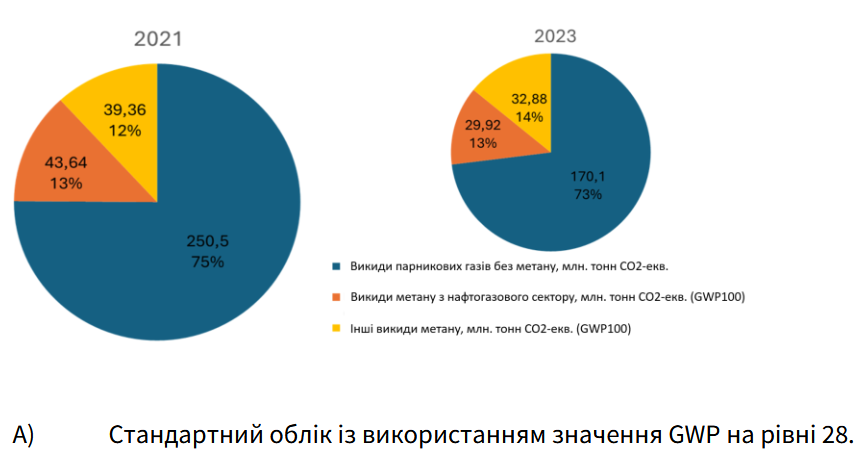
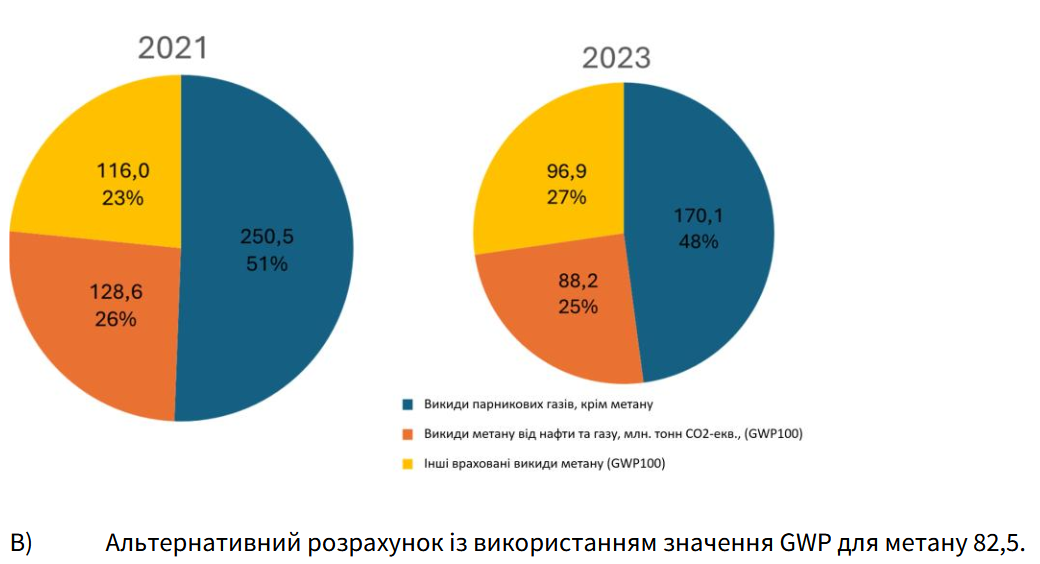
It is crucial not to get lost in the methodology here. Official climate reporting usually uses a 100-year assessment horizon. In such a system, methane in Ukraine accounts for about 27% of total greenhouse gas emissions. This is already a large share, especially when compared with the European Union, where methane’s share is noticeably lower.
However, if we focus on the next 20 years, the picture changes dramatically. Methane becomes not just one of the important gases, but virtually the key factor influencing our country’s short-term climate impact.
The share of methane in Ukraine’s total greenhouse gas emissions calculated using GWP100 and GWP20
Source: greendealukraina.org
What does this mean in practice?
In essence, each year of delay in reducing methane emissions is a missed opportunity to quickly decrease Ukraine’s climate impact. Not sometime in the distant 2050, not in an abstract “future generation,” but throughout a period that has already begun and will continue for the next two decades.
And in this, the solution to the methane issue differs from many other climate problems: humanity has already invented and refined technologies that would allow the elimination of a significant portion of its emissions. These include:
-
detection and elimination of leaks;
-
modernization of equipment;
-
collection of mine and landfill gas;
-
use of biogas from wastewater treatment.
Where Ukraine loses methane
The main source of methane in Ukraine is the energy sector, which accounts for approximately 71% of the country’s total CH4 emissions. Primarily, this concerns the oil and gas sector: extraction, transportation, storage, and distribution of gas.
Methane emissions in Ukraine in 1990–2023
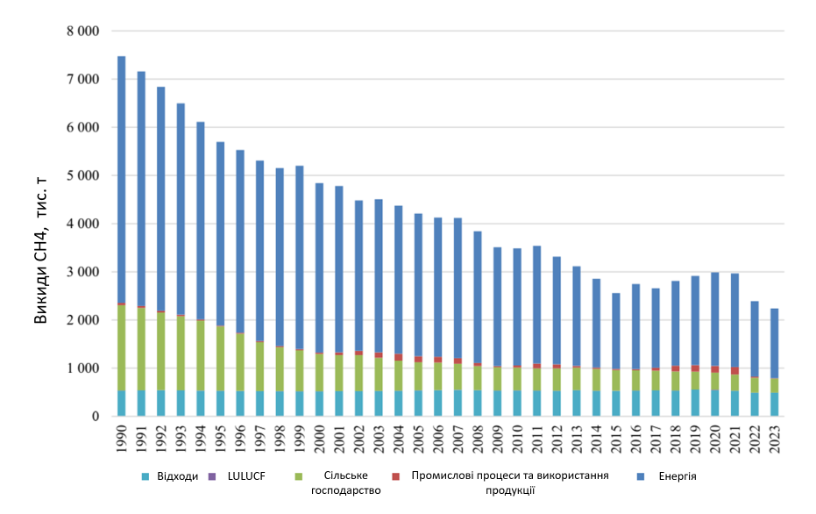
Source: greendealukraina.org. Data: National Inventory of Anthropogenic Greenhouse Gas Emissions in Ukraine for 2025
Ukraine’s gas infrastructure is vast, complex, and far from new. A significant part of it was built back in Soviet times. And where infrastructure is old, there are leaks, emergency losses, gas venting during repairs, suboptimal sealing of equipment, and insufficient monitoring.
The second major contributor is coal mines. Methane is released not only during their operation but also after closure. Even flooded or abandoned mines can remain sources of emissions. The war has only made the situation worse: some mines are now in occupied territories, some have been flooded. Environmental monitoring of such sites is currently limited or even impossible.
A third area is the waste sector. Municipal solid waste landfills and wastewater treatment systems also constantly produce methane. There are already projects in Ukraine for collection and use of methane for electricity or biomethane production-at present, about 30 installations are operating.
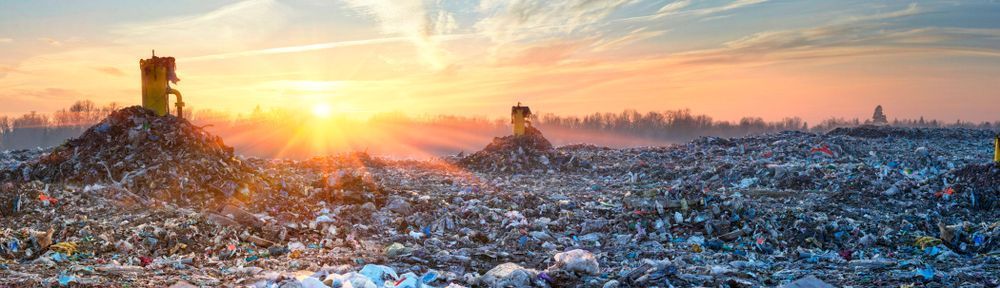
Yet despite progress in this area, a significant part of Ukraine’s methane potential still goes to waste.
The war reduced emissions but did not solve the problem
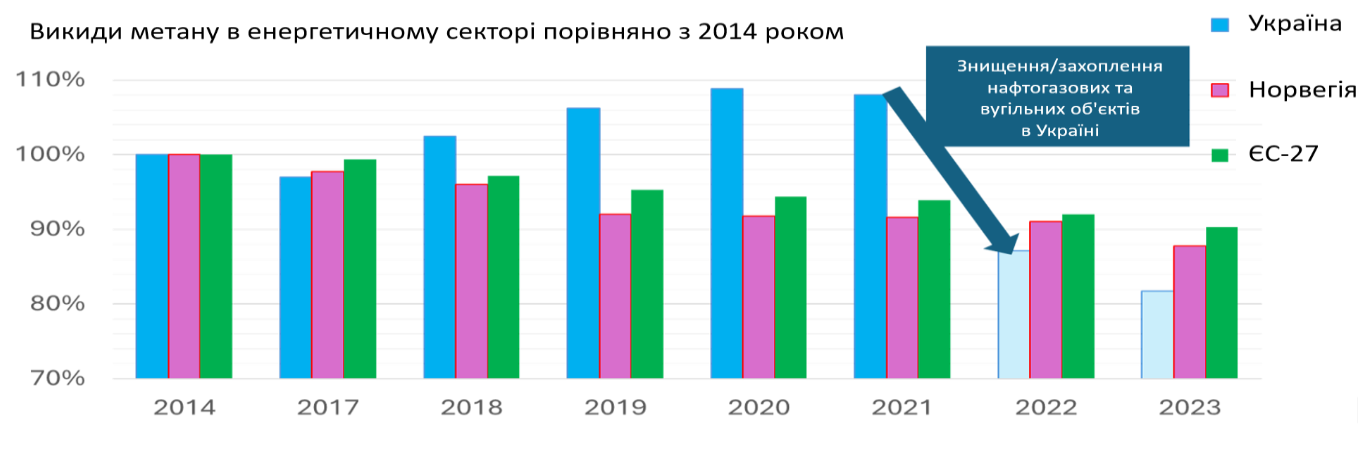
After 2022, Ukraine’s absolute methane emissions did indeed decrease, but there is little cause for celebration. This reduction was not due to successful climate policy, but a result of the war and deindustrialization: declining production, occupation of territories, destruction of industrial facilities, reduced coal extraction, and lower energy consumption.
Methane emissions in the energy sector of Ukraine, Norway, and the EU in 2014–2023
Source: greendealukraina.org
Moreover, the war has created new risks. For example, damage to gas infrastructure can result in emergency emissions.
Not Just to Reduce, But to Utilize
The Green Deal Ukraїna study estimates the technical potential for methane capture at 2.15–3.08 billion m³ per year. In terms of climate effect, this could result in a reduction of 60–85 million t of CO₂-equivalent annually, based on the standard 100-year methodology. If we assess the short-term impact, the effect would be even more significant.
According to researchers, the greatest potential for utilization lies in the oil and gas sector – 1.3–1.8 billion m³ per year. Next are coal mines at 0.5–0.8 billion m³. Landfills could contribute a further 0.3–0.4 billion m³, while biogas from wastewater accounts for 0.05–0.08 billion m³. Altogether, this is 10–15% of Ukraine’s natural gas demand. For a country living under wartime conditions and attacks on energy infrastructure, this is certainly not a trivial amount.
Paradoxically, while declaring a course toward energy independence and reduction of gas imports, Ukraine still tolerates the loss of a portion of its existing resources through leaks and uncontrolled emissions. As a result, the country is simultaneously seeking additional gas and allowing part of that gas to escape freely into the atmosphere.
Methane Economics: Not Costs, but Investments
No large-scale modernization occurs without funding. According to the authors of the study, the total investment needs for implementing methane solutions amount to €2.4–3.6 billion over 10 years, with annual average expenditures of €245–370 million.
At first glance, this sum seems substantial. However, it should be compared not to zero, but to the potential value of the resource that could be obtained.
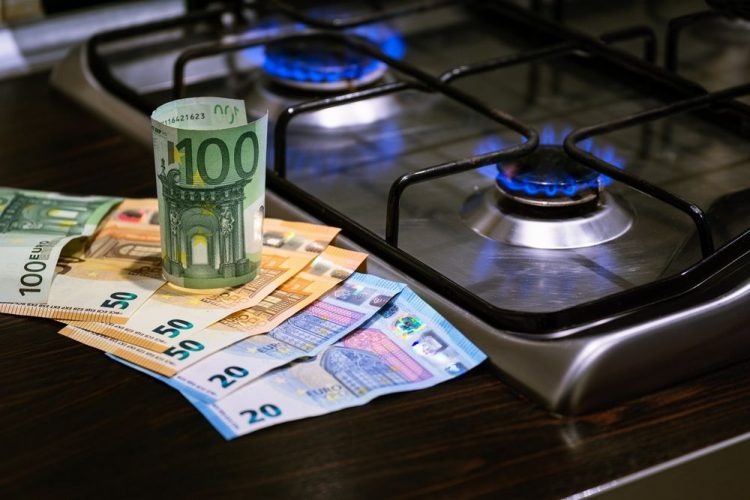
At current European gas prices, the value of captured methane could reach €750–1100 million per year. In other words, this is not an “environmental tax on business” but an investment with clear economic returns.
This is particularly relevant for the oil and gas sector. Detecting and eliminating leaks, modernizing equipment, and repairing problematic areas can pay off quickly, as the company essentially stops losing commercial gas. The payback period for projects in this sector is as short as 1 year.
In the waste and mining sectors, payback may take longer and initial costs may be higher. However, these projects offer other benefits: local energy generation, reduced environmental impact, and the resolution of longstanding infrastructure issues. The payback period in this sector can range from 1 to 4 years.
Analysts indicate that the internal rate of return (IRR) for these projects can range from 15% to 30%.
Capture as the Fastest Way to Achieve Environmental Results
In the oil and gas sector, the primary tool is LDAR (Leak Detection and Repair) – a program for detecting, measuring, and eliminating harmful gas leaks. Simply put, companies must regularly identify where gas is being lost, measure the volumes of leaks, and repair equipment. This is a basic practice of modern methane management.
In the coal industry, the focus is on capturing mine methane – both at operating and closed mines. Such projects are more complex, especially amid war and partial occupation of territories, but they are important both from a climate and a safety perspective.
In the waste sector, the solution is landfill gas collection. Ukrainian landfills have accumulated organic waste for decades. It continues to decompose and produce methane, which can and must be captured.
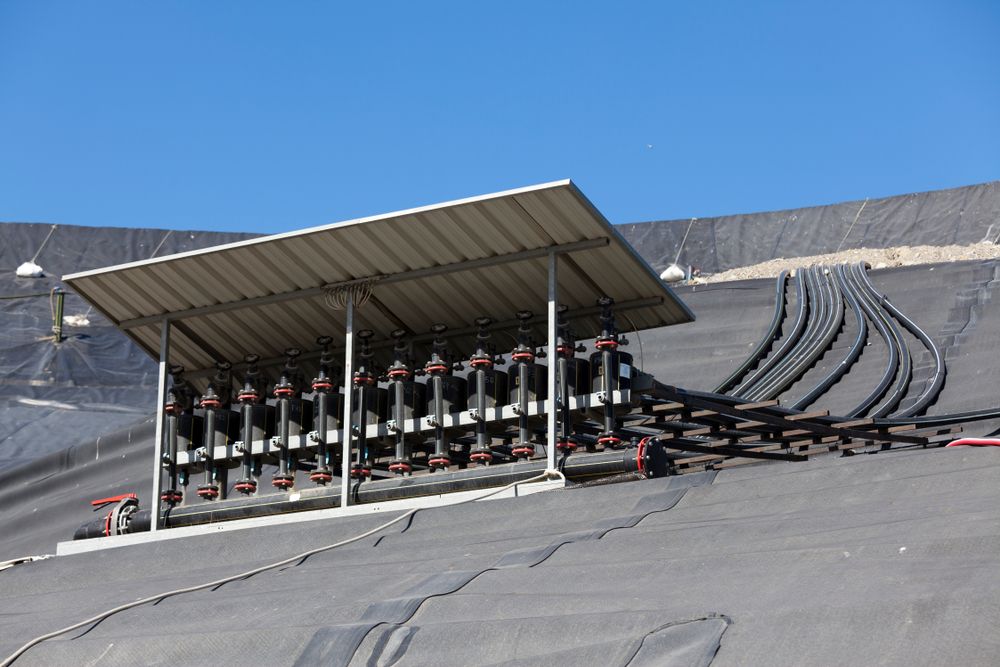
A separate direction is biogas from wastewater. This is a smaller-scale resource, yet it is an integral part of a comprehensive approach to reducing methane emissions.
Thus, our country not only has a problem but also has access to a set of practical solutions. What is needed are measurements, rules, investment, and political will.
Why Ukraine Still Doesn’t Profit from Methane
Problem No. 1 is monitoring. A significant portion of emissions accounting is still based on calculations and coefficients rather than actual measurements. This may be formally sufficient for international reporting, but it is inadequate for effective policymaking.
Problem No. 2 is weak economic incentives. If it is cheaper for a company to lose gas and pay minimal fees than to invest in modernization, it will not be in a hurry to change its behavior. If the rules do not encourage emission reductions, it is no surprise that reductions do not occur.
Problem No. 3 is outdated infrastructure. It requires substantial investment, but in times of war and funding shortages, priority is often given to patching holes rather than systematic modernization.
Problem No. 4 is war. Some sites are inaccessible, some are damaged, and others are in high-risk security zones. This is not an excuse for inaction, but a real factor that must be taken into account.
Problem No. 5 is the lack of a clear link between reconstruction and climate standards. In Ukraine, there is a lot of talk about “green reconstruction.” However, if restoration projects do not include specific requirements for methane monitoring and reduction, the “green” component risks once again remaining merely a nice presentation for international partners. Unfortunately, presentations do not reduce emissions.
The EU Is Already Changing the Rules of the Game
The methane issue is important for Ukraine also due to European integration. The European Union has already adopted a Regulation on the reduction of methane emissions in the energy sector. It provides requirements for monitoring, reporting and verification, regular identification and elimination of leaks, and restrictions on gas venting and flaring.
As a candidate country for EU membership and a party to the Energy Community, Ukraine will have to move toward alignment with European rules regardless. The only question is whether it will do so in time and to its own benefit, or if it will again be racing to meet deadlines in “turbo mode.”
Early harmonization can give Ukraine an advantage. It would increase trust in the Ukrainian gas sector, improve data quality, reduce risks to trade with the EU, and make methane projects more understandable for investors.
What Ukraine Should Do
The authors of the study recommend that the national authorities take the following steps:
-
Create a methane emissions accounting system based on actual measurements, providing for the creation of a transparent national emissions database and satellite monitoring for inaccessible territories.
-
Reform fiscal incentives and state support in the energy sector. Analysts, in particular, propose introducing a separate tax specifically for methane instead of the current vaguely defined rate under the 'Hydrocarbons' category, and allocating at least 60% of its proceeds to investments in methane emission reduction, since without clear financial incentives, such projects will not become widespread.
-
Prioritize the implementation of the most effective measures. LDAR implementation should become mandatory, not optional, practice for the oil and gas sector, while landfill gas capture should be required at all new and reorganized solid waste disposal sites.
-
Mobilize blended financing for methane reduction projects. Ukraine needs to access EU pre-accession and recovery funds, concessional lending from international financial institutions (IFIs), and issue “green” bonds. Methane is precisely an area where the environmental effect can be clearly calculated, thus allowing project justification for donors, IFIs, and private investors.
-
Integrate methane emission reduction measures into the economic development and recovery strategy. If gas networks, compressor stations, landfills, wastewater treatment facilities, or mine infrastructure are being restored, provisions for emission reduction must be included from the outset.
And most importantly, do not postpone everything until “after victory.” Recovery is already underway. Infrastructure decisions are being made right now. If they lack a methane component, the country risks perpetuating the old loss model for decades to come.
Methane as a test of climate policy quality
The case with this greenhouse gas vividly demonstrates the weak spot of Ukrainian environmental policy. We know how to say the right words: “decarbonization,” “European integration,” “green recovery,” “energy security,” “climate commitments.” Yet genuine policy begins where measurements, rules, responsibility, and funding emerge. Methane is exactly that kind of test.
Cutting its emissions can rapidly reduce Ukraine's climate footprint. Capturing methane will provide the country with additional gas, and monitoring and regulating leaks will help move closer to EU standards. This is that rare case when environmental action, energy security, and economic rationality not only don't conflict, but move in the same direction.
Time to turn the problem into an opportunity
While Ukraine seeks new energy sources and resources for recovery, a portion of the currently available valuable resource is simply being lost. Methane capture allows for simultaneous climate impact reduction, strengthening of energy security, and economic benefit. That is why methane management should become not just a secondary environmental topic, but one of the priorities of the country’s post-war modernization.