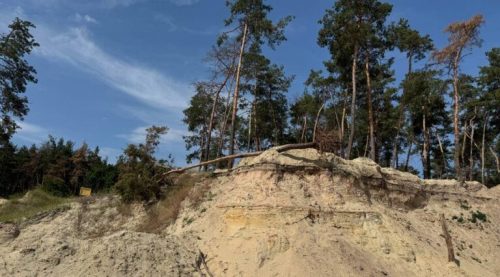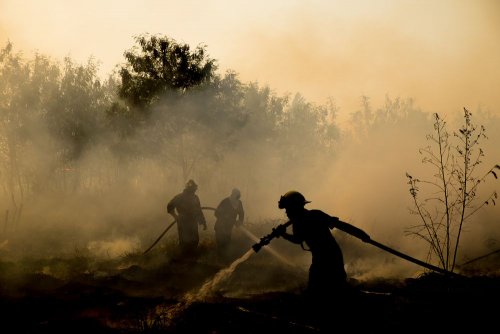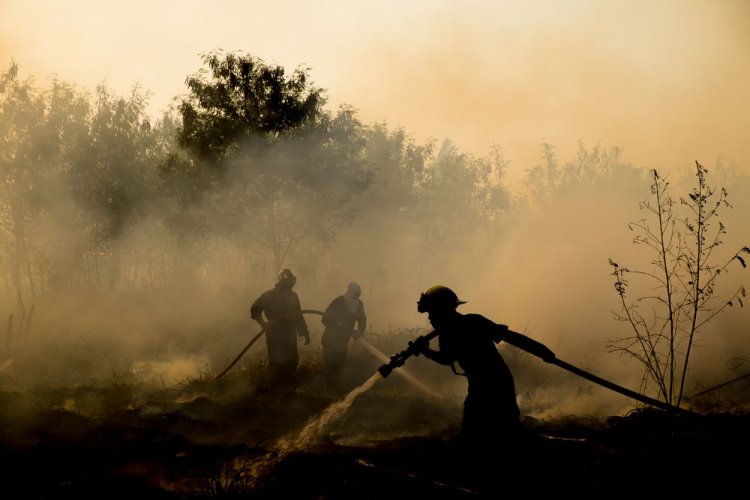
In the Kherson region, as a result of hostilities, fires are destroyed protected forest tracts, in particular the Flying Sands and Nedohirsky forest, which can cause the loss of the green lungs of the region and turn the soil into sand mounds and dunes.
The fire covered about 800 hectares of forest, according to the story of "Expert-KR" on Facebook.
On the territory of the Kherson region there are 79 objects of the nature reserve fund with a total area of 272 hectares, as well as 150 hectares of forest. Forests protect the region from droughts from the Oleshkiv sands, preserve soil fertility, water resources, and purify the air.
Russian troops use forests to deploy equipment and conduct military operations, which is why forests burned in the Black Sea biosphere reserve in April, and a fire lasted a week on the Kinburn spit. The fire also covered the northern part of the region on the right bank of the Dnieper.
At the end of March, russian shelling caused a fire in the Nedohirsky forest tract in the Velyko Oleksandrivska community, which rescuers and local residents began to extinguish the next day. On the same day, 3 shellings also caused a fire in the Flying Sands forest, but it was possible to start extinguishing the fire only 3 days later.
A resident of the village Velika Oleksiivka explained that Flying Sands is an inviolable forest, in which it is forbidden to cut down even dry and rotten trees. Locals often rested there.
She also said that when the residents saw the smoke after the explosions in the forest, they realized that the equipment (black smoke) and the forest itself (grey-yellow smoke) were on fire.
The rescuers explained that they did not have stable communication, because the day before the occupiers took away 10 portable radio stations, a sufficient number of people and equipment, and fuel.
Locals noted that the fire seemed to be the worst at night.
On the day when the fire began to threaten residential buildings, rescuers began to put it out. They extinguished the fire on an area of 3 hectares. It is currently impossible to determine the total area of the burn.
Yuliya Orekhanova, an environmentalist from the association "It's enough to poison Kryvyi Rih", said that destruction threatens the forests of the Kherson region, in particular the remains of the ancient hylea. And if we stop fighting fires, the green lungs will be lost, which will turn fertile soils into sand mounds and dunes. Pine forests with a thick layer of dry needles catch fire very easily.
She noted that fires have occurred before, but it was possible to fight them, but at the moment it is impossible due to mined areas and the ban of the occupiers.
We will remind in Ukraine during the 4 months of war shelling caused at least 37,867 large-scale fires in ecosystems and settlements, on an area of 100,662 hectares.
As EcoPolitic previously reported, under threat of destruction Kinburn spit was found.