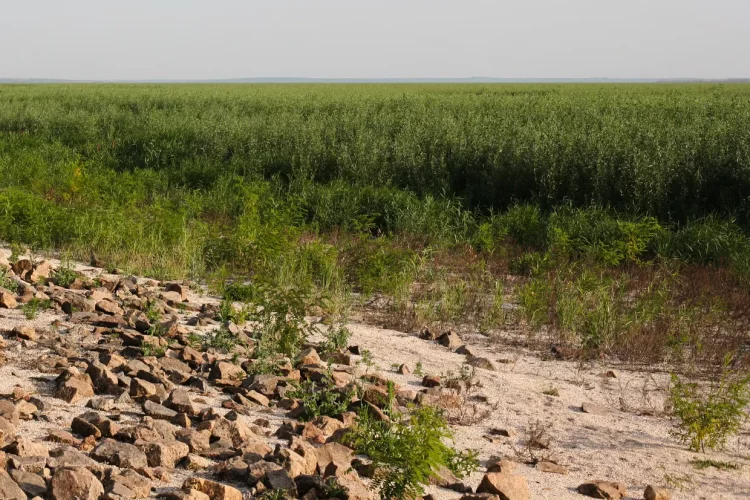
Within a year after the Russian occupiers blew up the Kakhovka dam, plants and wildlife returned to the territory of the former reservoir in volumes that had not been seen since the 1950s.
Mykhailo Mulenko, acting head of the Nature Protection Sector of the Khortytsia National Reserve, told Kyiv Independent about this and other environmental consequences of the destruction of the Kakhovka hydroelectric power station.
How the Kakhovsky forest came to be
According to him, over the past year, 1,600 square kilometers of poplar and willow trees have sprouted on the former reservoir. The landscape hasn't been this lush since the Soviets flooded the plain to build a dam in 1956.
Luckily, the expert says, the timing of the attack coincided with the May pollination of the willows and poplars, when the seeds were carried by the stagnant waters of the reservoir and sank into the silt. After the water went away, the seeds that were still stuck in the silt began to germinate and grow rapidly.
"If the Kakhovskaya Dam had been blown up in March or August, the situation would have been completely different and much worse," added Mulenko.
In just one year, the tallest seedlings reached 5 m in height and number 20 plants per square meter. The recent spring floods only contributed to their growth.
What biodiversity it has
Svitlana Okhrimenko, deputy director of the Khortytsia National Reserve, says that vegetation has also returned to the area around the island.
Under the trees on the northern side of the reservoir and on the island of Khortytsya, specialists of the Academy of Sciences of Ukraine identified at least 100 species of herbaceous plants and mosses that form a new ecosystem.
Mulenko predicts that in 5 years, if conditions remain unchanged, wild deer and wild boars may roam the forest at the site of the Kakhovsky Reservoir, which will resemble its pre-Soviet life, when it was part of the Great Meadow.
The results are promising for a region that experts have previously warned could suffer desertification as a result of the disaster.
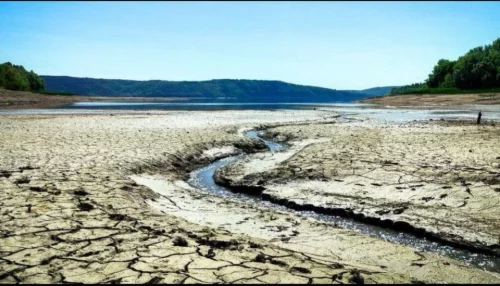
A sharp decrease in the water level in the Dnieper had a negative impact on nearby water bodies. Thus, the remaining lakes have shrunk and are no longer connected to the Dnieper, which causes overheating, which suffocates aquatic fauna.
Earlier, EcoPolitic wrotr, that for the anniversary of the tragedy EkoPolitika prepared a large material about ecological consequences of blowing up the Kakhovskaya HPP.
Also in May, we told that on the site of the former Kakhov reservoir restoration of the ecosystem of plavniv as a stable and self-sufficient natural system.