Dnipropetrovsk region became the largest payer of environmental tax in 2025. This is natural for a large region with developed industry and a huge number of mining and processing enterprises. In their environmental programs, its councils mainly rely on these same enterprises to carry out environmental measures at their own expense. At the same time, budget funds are allocated for greening, treatment of wastewater, and cleaning of water bodies in the region.
With this text, EcoPolitic concludes its series of materials on the use of the environmental tax in the regions of Ukraine.
Tax revenues
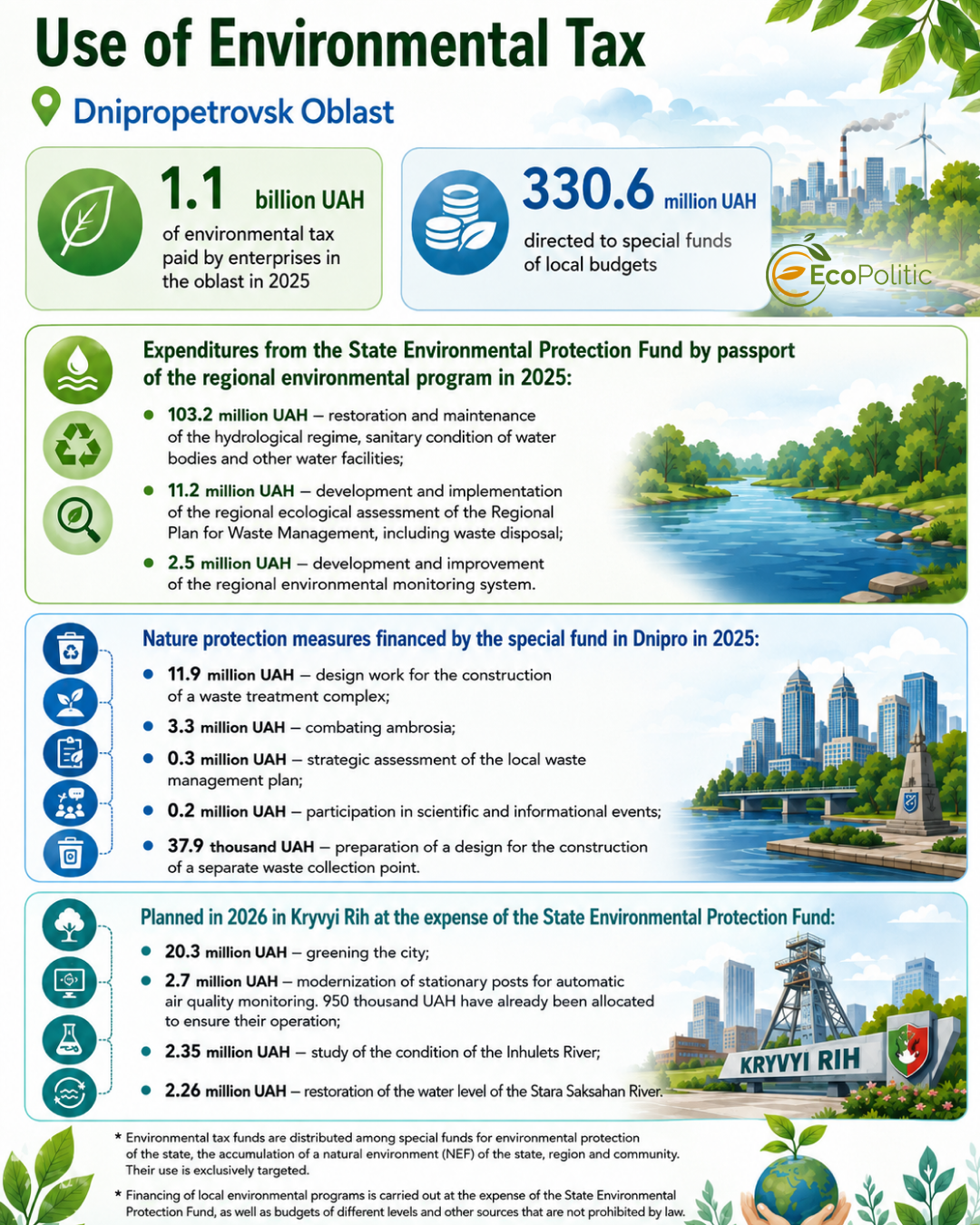
As previously reported by the State Tax Service, polluters from the Dnipropetrovsk region paid UAH 1.1 billion to the consolidated budget.
These funds are then distributed between the state budget and dedicated local special-purpose funds.
The regional local budgets received a third of this fiscal “pie” – UAH 330.6 million. As reported by the regional tax authority, this amount was UAH 19.4 million higher than during the previous year, 2024.
The State Tax Service even praised the businesses of Dnipropetrovsk region for their effective work supporting the country’s economic stability and noted the positive dynamics in budget revenues.
But what about environmental stability? And how exactly do these “dynamic” inflows to the budget serve it?
Let’s look more closely at the environmental protection programs of councils at various levels in Dnipropetrovsk region. The budget for the implementation of their measures is formed at the expense of special environmental protection funds, which are exactly where the environmental tax proceeds go. It should be noted that the local authorities also supplement these funds with money from other sources of financing.
Regional eco-program: the polluter pays… and pays again
Environmental protection at the regional level is defined by the Dnipropetrovsk comprehensive program for environmental safety and climate change prevention. It covers the longest period among all regions – from 2016 to 2028.
It was most recently updated recently – in May 2026. Let’s review this version. In clause 10, section I “Total amount of funding”, we see a colossal overall program budget – almost UAH 37.8 billion. But taxpayers need not be alarmed by this figure. In section VII “Resource provision of the program”, in the very first sentence, it is stated that “the implementation of the Program’s measures is mainly expected to involve the polluting enterprises’ own funds”.
All the region’s plans regarding how enterprises are to modernise their production are set out in the 245-page Appendix 1. In total, this amounts to 31.1 billion UAH – for the refurbishment of polluting facilities, environmental monitoring and greening initiatives. For example, PJSC ‘KAMETSTAL’ was to modernise the gas cleaning equipment of its rotary kiln at a cost of 35.9 million UAH; PJSC ‘INGZK’ was to spend 41.5 million UAH on landscaping and biodiversity conservation on the plant’s premises, whilst PJSC “TsGZK” was to spend 10 million UAH on an air quality monitoring system. We would like to emphasise that the amounts stated are indicative, and their allocation is subject to the consent of the enterprises.
So what were budget funds supposed to be used for? It is worth noting right away that, in the description of the funding sources, resources from the Environmental Protection Fund (ONPS) are not specifically mentioned, and many initiatives lack estimated funding altogether. However, here are several examples:
- Development of the air quality monitoring network – UAH 166 million, of which UAH 153.1 million comes from regional sources;
- Development of the surface water quality monitoring network – UAH 57.8 million from the regional budget;
- Afforestation. A 12-year budget of UAH 42.5 million has been earmarked. Of this amount, UAH 4.2 million comes from the state budget, UAH 3.7 million from the regional budget;
- Forest fire protection – UAH 33.5 million. The state budget provides UAH 6.1 million, the region – UAH 3.7 million;
- Delineation of protected area boundaries – almost UAH 18 million from the regional budget;
- Development of protected area expansion projects – another UAH 15 million from the region;
- Creation of a digital database for protected areas – UAH 300,000 from the regional budget.
In 2025, according to the report on the execution of the regional budget, the following can be noted:
- the revised budget for environmental measures from targeted funds amounted to UAH 274.9 million;
- actual spending for the year – UAH 150.9 million.
According to the passport of the regional programme, the amounts and scope of activities planned to be funded by the Environmental Protection Fund (ONPS) were revised during the year. The “latest” version provided for:
- restoration and maintenance of the hydrological regime and sanitary condition of rivers and other water bodies – UAH 103.2 million;
- development and strategic environmental assessment of the Regional Waste Management Plan, including waste from destruction – UAH 11.2 million;
- development and improvement of the regional environmental monitoring system – UAH 2.5 million;
- collection of debts for completed construction works – UAH 794,800.
Environmental programmes of the most polluted cities
Dnipro, Kryvyi Rih, and Kamianske may change their positions in the ranking of Ukraine’s most polluted cities year to year, but their presence on the list is constant. How are they addressing environmental concerns?
The Environmental Safety and Sustainable Development Program of the city of Dnipro was completed in 2025. The list of funding sources also mentions the Environmental Protection Fund, but in each specific measure, the fund's share is not specified. The list contains many measures assigned to enterprises for implementation. Among the budget-funded ones, the most expensive areas include:
- Air quality protection. Here, 20 million UAH is allocated for the purchase of mobile monitoring stations, 12 million UAH for the purchase and installation of stationary stations, 10 million UAH for services related to air pollution, and even data processing is allocated 5 million UAH;
- Protection of water resources. Construction of treatment facilities at discharge points of stormwater into the Dnipro River – 27 million UAH, construction of a drainage channel between sections of Lake Kuryache – 85.3 million UAH, protection against flooding of Zhytomyrska and Izhevska Streets – 10 million UAH.
- Rational use of land and plant resources. This includes 78 million UAH for the elimination of illegal dumps, 31 million UAH for the reclamation of land disturbed by them, and 8.2 million UAH for the engineering protection of territory.
It should be noted that this is the planned financing for the period 2021–2025.
In its report at the beginning of 2026, the city environmental policy department mentions that, according to Decision No. 7/72 of the Dnipro City Council dated November 19, 2025, it is now operating under a new environmental program for 2026–2030. However, we could not find the full text of this program in open sources.
However, we did find a report on the implementation of the budget program passport. Within the framework of the special fund in Dnipro in 2025, the following expenditures were documented, among others:
- 11.9 million UAH – design work for the construction of a waste processing complex;
- 3.3 million UAH – ragweed control;
- 0.3 million UAH – strategic assessment of the local waste management plan;
- 0.2 million UAH – conducting and participating in scientific and information events;
- 37.9 thousand UAH – preparation of a design project for the construction of a separate waste collection point.
In Kamianske, as well as at the oblast level, the city community’s environmental program also included measures that (optionally) industrial enterprises are expected to carry out. The program covers the period 2026–2030. Measures for companies are specified in Annex 2. Among them are major repairs of the coke oven battery at PJSC “Yuzhkoks”, the development of a waste management plan at PJSC “Kryvyi Rih Cement”, or road watering by several enterprises.
In the first annex, however, there are citywide measures. They are planned to be financed in part by special environmental funds. Here are several examples:
- improving the condition of the left-bank canal in Kamianske – 42.1 million UAH;
- collection and transportation of waste from unauthorized dumps – 25 million UAH;
- disposal of wastewater from the stormwater-melioration system – 20 million UAH;
- adapting to extreme heat: 2.5 million UAH is allocated for shading with gazebos and plants, 1.5 million UAH for installing special “umbrellas” and “artificial fog” systems;
- prevention of city flooding – 2 million UAH;
- measures for protection against radiation exposure in the tailings impact zone – 8 million UAH.
In Kryvyi Rih, the largest portion of the special ONPS fund in 2026 is planned to be spent on greening projects, amounting to nearly 20.3 million UAH. Other initiatives include:
- modernization of stationary posts for automatic air quality monitoring – 2.7 million UAH. An additional 950 thousand UAH is allocated for their operation;
- research on the condition of the Inhulets River – 2.35 million UAH;
- restoration of water capacity in the Stara Saksahan River – 2.26 million UAH.
Among other environmental protection measures planned by the community for 2025–2028 (outside the ONPS fund):
- 133.8 million UAH – activities for the protection and rational use of plant resources;
- 129 million UAH – design, construction, and reconstruction of sewage networks and facilities;
- 55 million UAH – implementation of measures to restore water capacity and improve the ecological health of the Inhulets and Saksahan rivers;
- 30.2 million UAH – construction of a municipal solid waste processing facility.