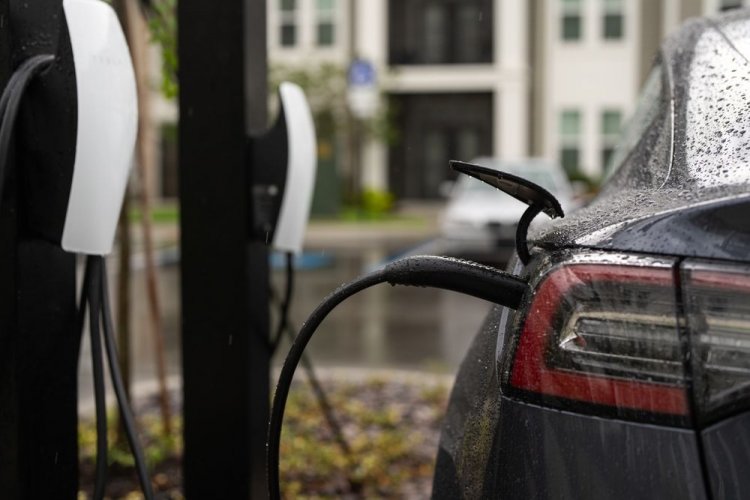
In August, for the first time in the history of the Ukrainian car market, the share of electric car sales accounted for about 50% of the total volume of passenger cars sold.
This is stated in an article published by Minfin.
The share of electric cars in Ukraine's car fleet already accounts for 28%, although a few months ago it did not exceed a quarter. According to experts' forecasts, the figures may grow even more by the end of September, as electric vehicles are being actively imported to Ukraine from China, the US, and Europe.
According to Stanislav Buchatsky, head of the Automotive Market Research Institute, at the end of August, a total of 11,500 electric vehicles (including passenger cars, motorcycles, trucks, and buses) were sold in Ukraine, which is 12.5% more than in July and 22.5% more than in the same period last year.
In his opinion, already in September, based on the results of the first nine months of 2025, sales of electric vehicles will exceed the figures for the whole of 2024 — a historic record for Ukraine.
Why has demand for electric vehicles grown?
1) Fuel savings
The savings are especially significant for residents of the private sector, who can install a charger at home and charge their cars at the residential electricity rate (4.32 hryvnia per kilowatt during the day and 2.16 hryvnia at night).
According to the Ministry of Finance, a full charge of a Nissan Leaf with a 40 kWh battery will cost only 86.4–172.8 hryvnia. Such a battery provides a range of 240-270 km. For comparison: a similar distance in a gasoline car with an average consumption of 8 liters per 100 km will require 19.2-22.3 liters of fuel, which will cost about 1,127-1,309 hryvnia.
2) Import privileges for electric vehicles
Import privileges for electric cars will end on January 1, 2026. However, such cars can currently be imported without paying VAT and import duties (which generally amount to 30% of the vehicle's cost); only a small excise tax of several hundred euros is levied (the specific amount depends on the battery capacity).
Therefore, it is expected that electric cars may soon become significantly more expensive. And this is now actively increasing demand.
We remind EcoPolitic readers that in August, Ukrainian drivers most often bought electric cars in the Lviv region and in the city of Kyiv.
1) In the Lviv region, almost 1,200 drivers became owners of electric cars, 89% of whom purchased used cars.
2) In the city of Kyiv, 959 electric cars were purchased, 55% of which are used.
3) The Kyiv region added almost 700 electric cars, 68% of which are used.
4) Dnipropetrovsk region ranks 4th with 640 electric cars, 71% of which are used cars.
5) In the Odesa region, 449 new and used electric cars were purchased. 69% are used cars.