The European Union in the first half of this year overcame the mark of 50% of energy received from renewable sources (RES).
This was reported on September 11 in Brussels by the European Commission on the results of the annual report "State of the Energy Union," Euroactiv writes.
For the first time in Europe, RES exceeded fossil fuels in terms of energy produced.
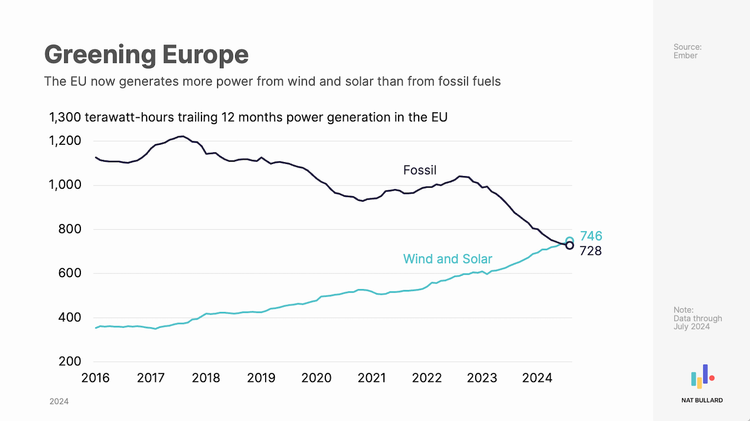
Source: @NatBullard, H.
"The EU is now well equipped to meet its climate neutrality goals," said EU Energy Commissioner Kadri Simson.
She said the EU produced more than half of its energy from renewable sources, ahead of fossil fuels, thanks to a strong year for hydro and wind power amid falling demand.
Despite this progress, a key issue of trust remains the lack of long-term climate plans (NECPs – National energy and climate plans) of EU countries. These plans are needed to track progress towards the EU's 2030 climate targets.
"I very strongly urge member states to submit their missing Final National Energy and Climate Plans (NECPs)," Simson said.
She said that to date the European Commission has received only 10 such plans, and this is already far beyond the deadline, as the deadline for submitting NECP was June 30.
Among the big EU countries, Germany and France have already presented their plans, while Spain and Poland are still latecomers. That is, Europe also has its "those who have fallen behind the train".
The other day we told that according to the executive director of Greenpeace International, Ukraine has potential switch to RES faster than other countries.
Also in July, EcoPolitic wrote about the forecasts of the International Energy Agency, according to which RES will overtake coal in terms of electricity production already in 2025.