In the first part of this article, we examined why Ukraine needs a greenhouse gas emissions trading system (ETS) and what stage the development of the national ETS is currently at.
The situation is rather grim: despite the approved Plan, most of the system’s key elements are only just beginning to take shape or remain at the starting line. The Ministry of Economy, Environment, and Agriculture of Ukraine needs more time to properly prepare a framework document outlining the main principles and parameters for the operation of the national ETS.
In this article, we will examine the progress of fulfilling commitments to the EU under the Ukraine Facility and whether Ukraine is truly moving toward launching the ETS within the stated timeframe.
Commitments to the EU
In the “Green Transition and Environmental Protection” section of the Ukraine Facility Plan, Reform 3 “Market-based Carbon Pricing Mechanisms” is highlighted separately. It comprises two components:
-
Approval of the Action Plan for establishing a national greenhouse gas emissions trading system (deadline – first quarter of 2025).
-
Restoration of the mandatory system for monitoring, reporting, and verification (MRV) of greenhouse gas emissions (deadline – second quarter of 2025).
Formally, both have been completed— the Verkhovna Rada and the Cabinet of Ministers managed to vote on and adopt the relevant documents. However, the question of how realistic their implementation is under the current circumstances remains open.
The mandatory MRV reporting, which was suspended in 2022 due to the start of the full-scale war, was restored by the Verkhovna Rada in early January 2025. However, company representatives report significant difficulties with reporting, caused by ongoing shelling, power outages, and other wartime factors. Stanislav Zinchenko also emphasizes the inevitability of such problems. According to the expert, any statistics during war and regular electricity supply restrictions for industry are highly questionable. Moreover, he notes, it is very difficult under current conditions to organize verification.
“If the state is unable to collect statistics from its own enterprises, how can it demand this be done at a higher level from private businesses? To me, any issues relating to mandatory reporting during wartime and other unprovoked force majeure events seem strange,” the expert says.
ETS configuration
In December 2025, representatives of the Ministry of Economy presented the results of an expert assessment and the recommended configuration of the national ETS. Specialists considered two possible options:
-
First: ensuring the ETS complies with EU standards solely through MRV and joining the European system immediately after obtaining EU membership.
-
Second: ensuring compliance with the EU ETS through MRV and creation of a National ETS. The continuation of the National ETS for a certain number of years after EU membership – subsequently joining the European system.
Following an expert assessment of the economic burden associated with each of these options, the Ministry of Economy selected the second one. Under this option, the national single market will operate for at least 12–15 years (until 2040–2042). However, the EU expects Ukraine to join the EU single market as early as 2034.
How sound is this decision? Stanislav Zinchenko noted that the choice between these two options is very difficult.
“Logically speaking, if we become EU members, we would need to build a similar system right away, but with different prices. However, the EU system itself is currently undergoing reform, and there are active discussions surrounding it. Therefore, the question of ‘what to build’ can wait a little while. This way, we can avoid repeating the mistakes of European practice,” the expert believes.
He noted that the option of having our own system is also understandable, but it distances Ukraine from the main goal—integrating systems to enable access to European funding for decarbonization projects.
“The main goal of the EU ETS is to raise funds for decarbonization. The Ukrainian emissions trading system will not be able to raise sufficient funds at any emissions price, so it is not, in and of itself, a valid mechanism for financing decarbonization. Therefore, the Ukrainian law on the ETS must be as framework-oriented as possible to allow us to be flexible,” Stanislav Zinchenko is convinced.
According to Andriy Glushchenko, ensuring compliance with the European system solely through the monitoring, reporting, and verification of greenhouse gas emissions system is insufficient.
“Ukraine is moving toward EU membership. Accordingly, the Ukrainian ETS must be established on the same principles as the European one. That is, the Ukrainian ETS must include all the same elements as the European one, but with Ukrainian realities in mind. Ukrainian companies need time to prepare for operating under the EU ETS, and for this, the Ukrainian ETS must be similar to it,” says the expert.
He warns that joining the EU ETS immediately after gaining EU membership would be a shock to the Ukrainian economy.
Targeted use of funds as the cornerstone of the entire system’s effectiveness
However, an equally important issue as the ETS configuration is the further allocation of financial resources accumulated through it. Experts emphasize that if the proceeds from quota sales are not directed toward decarbonizing industry, the ETS loses its main purpose and becomes merely an additional financial obligation for businesses. This fact has already sparked a heated debate in EU countries.
In Ukraine, the situation with the use of revenues from the environmental tax is no better: the existing system leads to the dispersal of funds across budgets at different levels, the “draining” of financial resources from enterprises, and the loss of the environmental function of this tax. The only sectoral fund – the Decarbonization Fund of Ukraine – spends its revenues on energy efficiency measures for the public sector and communities, rather than fulfilling its direct purpose, which is to finance the decarbonization of domestic enterprises.
Realistic timelines in question
The government has approved three phases for launching the ETS in Ukraine:
-
Preparatory (2025–2027) – development of the legislative framework and creation of the necessary tools for the ETS to operate.
-
First operational (starting in 2028) – launch of the greenhouse gas emission quota trading system, and exploration of improvement opportunities.
-
Second operational (no earlier than three years after the cessation or cancellation of martial law) – will allow the ETS to be implemented in conditions of stable economic recovery.
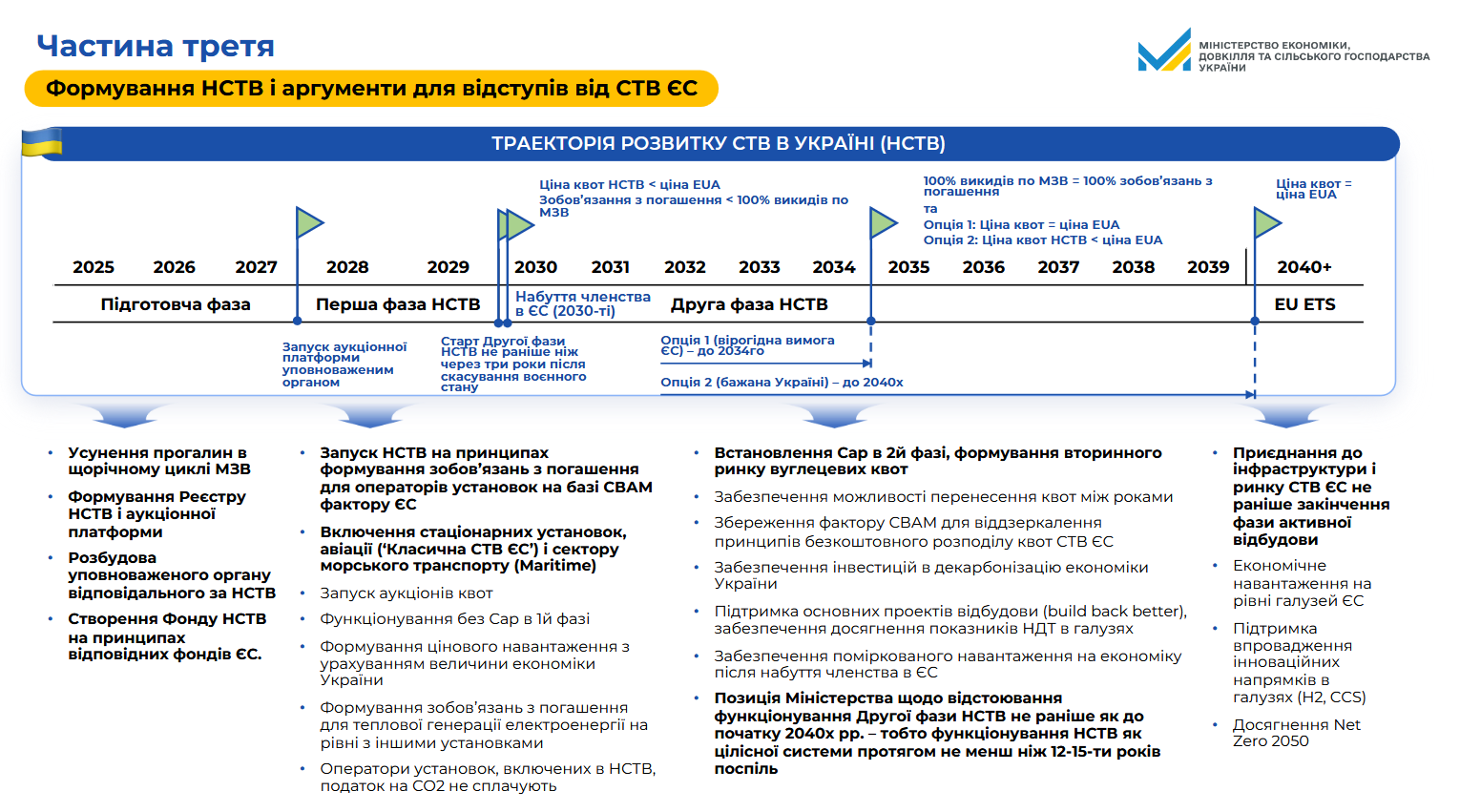
Source: Ministry of Economy, Environment, and Agriculture of Ukraine
We asked experts whether it is possible to meet the planned deadlines under the current circumstances.
“Given that the war is ongoing in the country and the launch of the DTT is not a priority under these conditions, I doubt that Ukraine will be able to launch a fully-fledged DTT system in 2028. Some kind of pilot phase with limited functionality and coverage is entirely possible,” says Andriy Glushchenko.
According to Stanislav Zinchenko, if the war ends in 2026, it will take at least three full years just to establish the collection and verification of emissions data. Another 2–3 years will be needed for a test launch to work out the procedures. Only after that can a full-scale launch be considered—in 2030 or 2031, the EBA Committee Chair is confident.
Many experts point out that the system relies on the results of emissions monitoring, reporting, and verification—processes that are extremely difficult to carry out under conditions of full-scale war for objective reasons.
“It is also important to understand that the operation of the ETS is a complex process that will involve hundreds of specialists. I don’t even see the beginning of training for such specialists. They need to be trained and mentored for 2–3 years, new institutions need to be built, and new mechanisms need to be developed. This challenge is the greatest for Ukraine—namely, building institutional capacity,” the expert emphasized.
There is a plan—but will there be results?
Despite the approved Plan, most of the key elements of the ETS—from legislation to institutions and the technical infrastructure—are either just beginning to take shape or have not even gotten off the ground yet. Therefore, the deadlines seem less and less realistic with each passing day. The war, problems with data collection and verification, and a lack of qualified specialists—all of this casts doubt on the possibility of a full-scale launch of the system as early as 2028.
In this situation, there is a very real risk: instead of an effective market-based decarbonization tool, the country may end up with a system that is formally launched but essentially “empty” and non-functional.
To avoid this, officials need to move from declarations and drafting polished documents to systematic work-with clear practical solutions, resources, and accountability. Otherwise, carbon pricing risks becoming just another box ticked on paper, rather than a functioning tool.