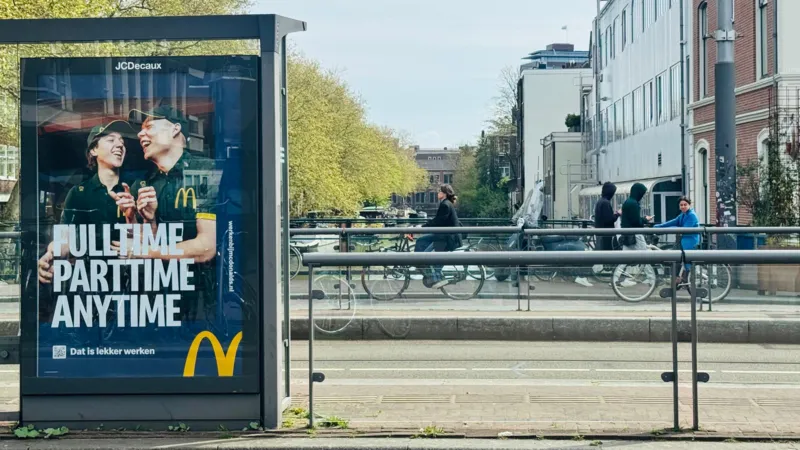
As of May 1, street advertising for meat products, gasoline-powered cars, or air travel has disappeared from Amsterdam. The municipal authorities have decided to align the city’s public space with its environmental policy, which includes key goals such as reducing meat consumption and the use of fossil fuels.
This was reported by the BBC.
Amsterdam has become the first capital in the world to implement such restrictions on public advertising. For example, at tram stops where there used to be posters for nuggets, budget travel, and SUVs, there are now advertisements for local museums and cultural events.
The local authorities took this step to ensure the city’s space reflects its values. In particular, Amsterdam aims to achieve climate neutrality by 2050, and by that time, meat consumption should also be halved.
“If you want to be a leader in climate policy and you lease your walls to the very opposite, what are you doing? Most people do not understand why the municipality should make money by renting out our public space if we have an active policy against this,” – said Anneke Veenhof from the Green Left party.
Reducing harmful triggers
Politicians are convinced that reducing visual reminders will also decrease the number of cues that encourage environmentally harmful behavior. At the same time, the disappearance of such advertising signals that its content is undesirable to society.
“Everyone can make their own decisions, but in reality, we are trying to get big companies not to constantly tell us what we need to eat and buy. In a sense, we are giving people more freedom because they can make their own choices, can’t they?”, – noted Anke Barker from the Party for the Animals.
Combining the ban on meat and fossil fuel advertising demonstrates that personal dietary choices are, in fact, a climate issue.
Criticism
Of course, this decision by the authorities was criticized by industry associations. The Dutch Meat Association indignantly called it “an undesirable way of influencing consumer behavior.” The Dutch Association of Travel Companies described the ban on advertising air travel tours as “a disproportionate restriction on companies’ commercial freedom.”
Amsterdam is not a pioneer
In fact, similar bans have been implemented in other cities. In Haarlem, advertising meat in public spaces has been prohibited since 2022. Utrecht and Nijmegen have introduced their own measures. In France, the ban on meat advertising is even national in scope.
There is currently no direct scientific evidence confirming the positive impact of such advertising bans. However, some scientists remain optimistic.
“If we see fast food advertising everywhere, it normalizes fast consumption behavior. Therefore, if we remove such signals from our public environment, it will also affect these social norms,” – said epidemiologist Joreintje Mackenbach.
EcoPolitic previously reported that to protect food service workers in Spain, the terraces of cafés and bars have been banned from operating during extreme heat unless otherwise a fine of €50,000 will be imposed.