The blockade of the Strait of Hormuz pushed global oil prices up by more than 30%. The car market reacted immediately: sales of electric cars grew, while vehicles with internal combustion engines are being bought less and less. This made it possible to save about $20 billion. The largest share of the savings went to China, with the European Union in second place.
This was reported by the media outlet "Euronews".
Brent crude, the global price benchmark, cost $67 per barrel the day before the war in Iran began. In October, its price rose to almost $100 per barrel.
Against this backdrop, sales of electric cars, which make it possible to get rid of dependence on fossil fuels, are growing. Globally, this figure increased by 11% year on year, while purchases of internal combustion engine cars fell by 6% in the first eight months of 2026.
A report by the think tank "Ember" shows that the electric car boom displaced about 200 million barrels of oil worth $20 billion. This refers to the period from March to August 2026. The study covered data from 56 countries, which account for 90% of electric car sales and more than 80% of total car sales.
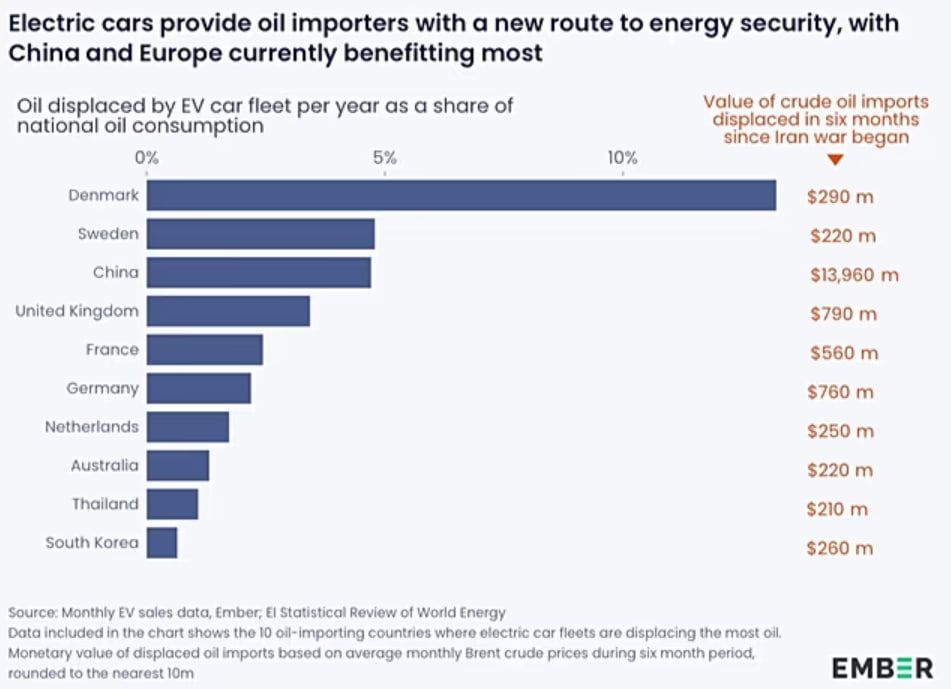
China saved the most. Its electric fleet amounts to about 44 million electric vehicles. Savings on crude oil purchases totalled almost $14 billion.
EU member states accounted for $3.1 billion of oil savings over the same period.
European electric leaders
In absolute terms, Germany and France saved the most thanks to electric cars – $760 million and $560 million respectively.
However, in percentage terms, Denmark is the undisputed leader: as of August, its electric vehicle fleet displaced 6.4 million barrels of oil per year, equivalent to 13% of the country's oil consumption in 2025.
Source: Ember
Six European countries (Denmark, France, Germany, the Netherlands, Sweden and the United Kingdom) together saved almost €2 billion by reducing oil imports.
"Countries that invested in electric vehicles before this crisis are now better protected, and more and more of them are following their example. Every electric vehicle on the road reduces exposure to volatile oil markets, and as fleets grow, so does protection against future supply shocks," noted Euan Graham, senior energy analyst at "Ember".
Overall, the transition to electric transport has long gone beyond the environmental agenda. It provides countries with energy and economic resilience in times of instability.
EcoPolitic reported that in Ukraine the share of petrol cars in sales is also falling, while electric vehicles are being bought more often.
In the EU, the share of electric cars in exports and imports is growing in parallel. In 2025, EU countries produced 12.6 million cars. Of these, 4.8 million (almost 40%) were hybrid or electric.