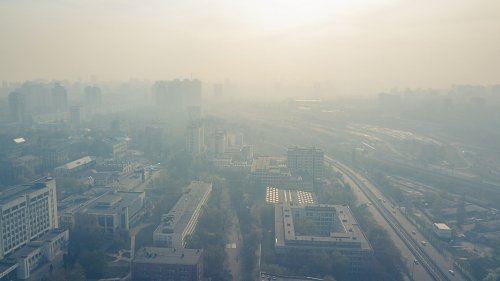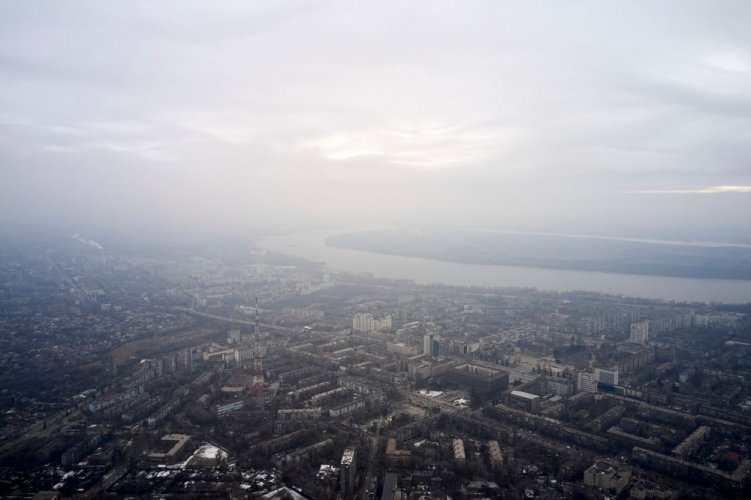
As of the morning of 15 October, Ukraine’s major cities are not experiencing any critical exceedances of harmful substance concentrations. On average, air quality fluctuates between the ‘green’ and ‘yellow’ pollution levels.
This is evidenced by data from the IQAir monitoring platform.
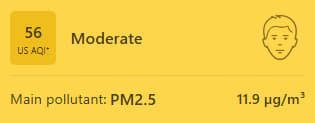
In Kyiv, based on average figures, pollution levels are moderate. The concentration of the main pollutant – fine particulate matter PM2.5 – is more than twice the upper limit set by the World Health Organisation: 11.9 µg/m3 compared with 5.5 µg/m3.
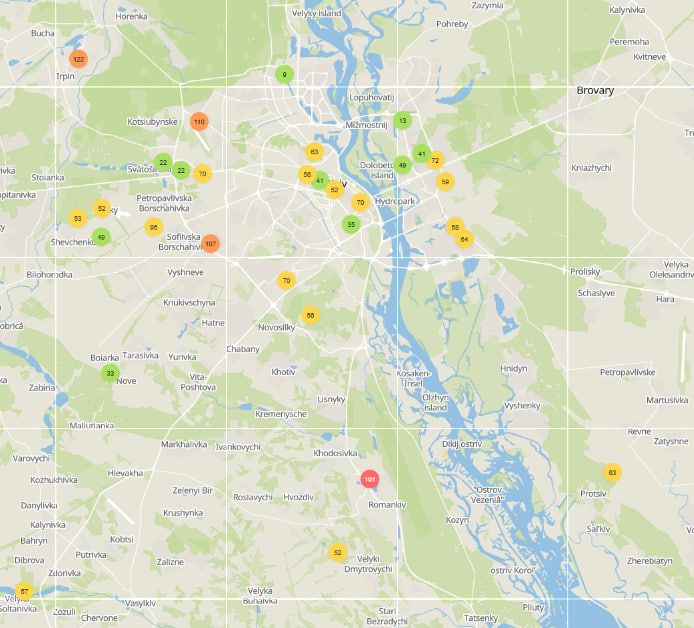
Among the locations with the highest concentrations of particulate matter are Kyrylivska Street (15.8 µg/m3), Myropilska Street (21 µg/m3) and Trostyanetska Street (15.9 µg/m3).
In some towns near Kyiv, pollution levels are higher. For example, an ‘orange’ danger level has been recorded in Kotsyubynske and Irpin. There, dust concentrations stand at 39.3 and 46.4 µg/m3 respectively. The air here is hazardous for people with sensitive respiratory and cardiovascular systems. In Velyki Dmytrovychi, pollution levels are extremely high and the air is unhealthy for everyone – dust levels reach 130.4 µg/m3.
In these regional centres, pollution levels are currently moderate:
- Odessa – 12 µg/m3;
- Rivne – 11 µg/m3;
- Vinnytsia – 10.5 µg/m3.
The remaining regional centres generally have good air quality:
- Kharkiv – 8.8 µg/m3;
- Lviv – 8.3 µg/m3;
- Dnipro – 8.1 µg/m3;
- Kherson – 8.1 µg/m3;
- Zhytomyr – 7.8 µg/m3;
- Lutsk – 7.4 µg/m3;
- Chernivtsi – 6.2 µg/m3;
- Zaporizhzhia – 5.8 µg/m3;
- Ternopil – 5.1 µg/m3;
- Ivano-Frankivsk – 5.1 µg/m3;
- Khmelnytskyi – 4.2 µg/m3;
- Poltava – 3.9 µg/m3;
- Chernihiv – 2.7 µg/m3;
- Uzhhorod – 2.7 µg/m3;
- Cherkasy – 2.3 µg/m3;
- Mykolaiv – 1.4 µg/m3.
High levels of harmful compounds in the air pose a threat to public health. Indeed, this can lead to the exacerbation or even the onset of diseases of the respiratory and cardiovascular systems. Find out more about the impact of the environment on the body in the article.