The construction of yet another wind farm in Ukraine poses a threat to the preservation of valuable ecosystems. This is the view held by environmental activists regarding a project that involves installing wind turbines directly within a nature conservation area – within the ‘Podilski Tovtry’ National Nature Park in the Khmelnytskyi region. Work has been ongoing since spring, and what is more, without an environmental impact assessment.
This situation was reported by the media outlet ‘Espreso. Zakhid’.
A brief overview of the project
The future wind farm will have a capacity of up to 10 MW and will be built in the Chemerivtsi community. The construction project is being prepared by Eco Wind Tovtry Ltd.
Initially, the plan is to construct two wind turbines. The power station complex will therefore include its own transformer substation and power lines, which are to be laid.
Value on an international scale
This project would not have attracted so much attention from campaigners were it not for its location. The ‘Podilski Tovtry’ National Park is not just a protected area, but one of Ukraine’s seven natural wonders. Since 2017, certain parts of the park have even been listed as a UNESCO World Heritage Site.
Furthermore, the national park’s status is reinforced by its membership of the Emerald Network. This network is of pan-European significance in terms of nature conservation. Such areas are protected under the Bern Convention for the Conservation of European Wildlife and Natural Habitats.
A total of 143 taxa of bryophytes and vascular plants have been recorded in this area, as well as fragments of a natural complex comprising perennial calcephytic herbaceous and steppe plant communities. All of this is of value to the Emerald Network.
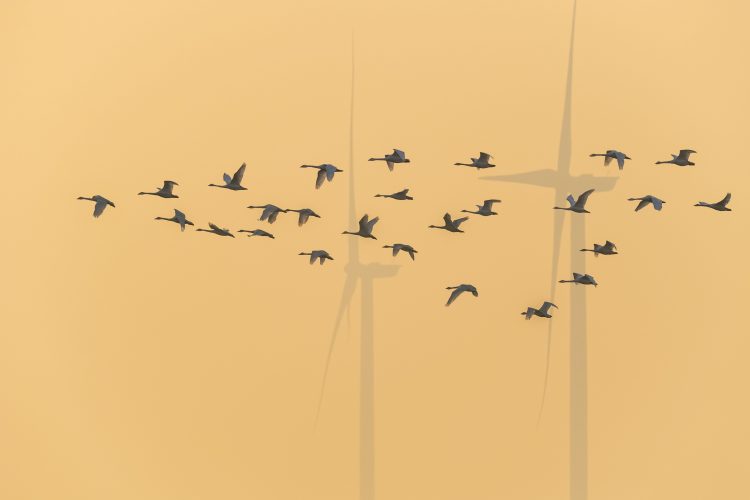
However, there is another important aspect – the national park lies along the migration routes of bats and birds. These include the red-backed shrike, several species of bat, the white stork, the black kite and the honey buzzard. For all of them, the rotation of the turbine blades is life-threatening due to the risk of collision. All this is set out in the EIA documents.
“Bird migration routes pass through the park, as it is situated in the valley of the Dniester and its tributaries. And so the question arises as to whether it would be better not to build national parks at all, but if we are to build them, then they should be built in fields, away from migration corridors and away from river valleys,” said Petro Testov, head of the UNCG’s analytical department.
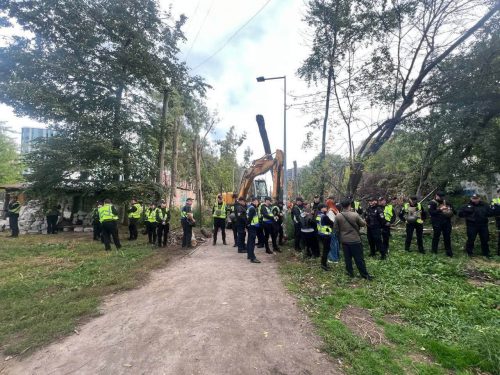
Without the police and behind closed doors
So what is the national park’s position? According to Petro Testov, despite the environmental risks, the bureau of the institution’s Scientific and Technical Council has approved the wind farm construction project. One particular point to note is that the matter was considered solely by this bureau, without the involvement of the national park’s full Scientific and Technical Council.
However, the organisation has set out a number of requirements for the project. Specifically, these include funding for a long-term programme to manage meadows and steppes, regulated haymaking, and the clearance of unauthorised rubbish dumps. To ensure the safety of animals during migration, the turbines must be switched off automatically.
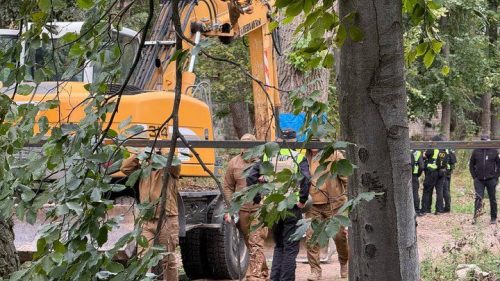
Environmentalists are concerned about the activity already being observed in ‘Tovtry’. According to the Ukrainian Nature Conservation Group (UNCG), heavy machinery has been operating there for several months now. Satellite images are being shown as evidence of this.
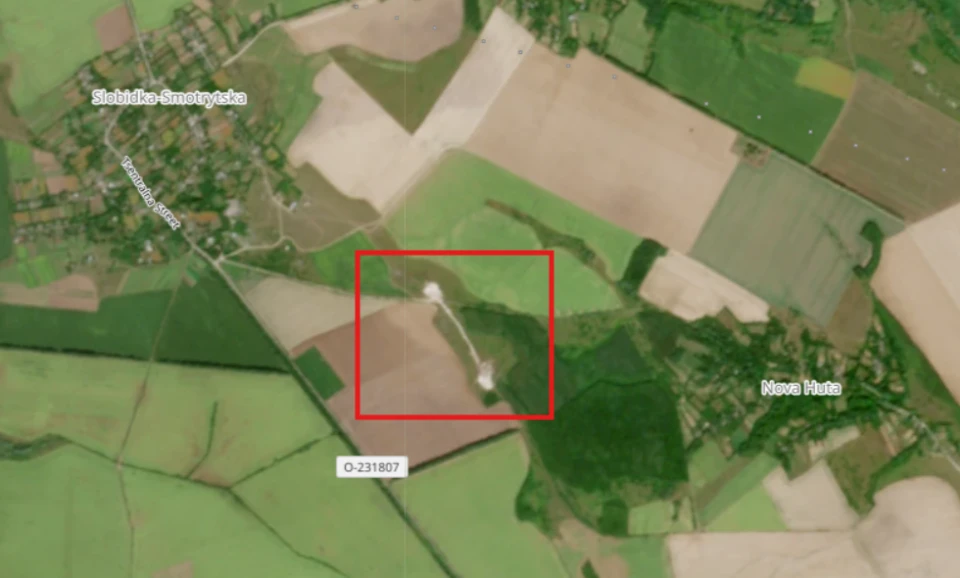
What makes the situation all the more controversial is that the environmental impact assessment procedure has still not been completed. In other words, not only is the work being carried out within a protected area, but it is also proceeding without an environmental impact assessment report.
The State Inspectorate for Architecture and Urban Planning has also confirmed, in response to a request from UNCG, that work has commenced. In particular, entries in the register of construction activities regarding the specified plots, indicating the start of preparatory work, date back to 30 March.
During the public hearings, the works were apparently described as ‘landscaping’ and preparatory work. According to Testov, representatives of the project developers argued that landowners have the right to carry out landscaping on their plots.
Consequently, the vegetation at the site of the future wind turbine development has already been destroyed. It is now impossible to assess what condition it was in prior to the start of works, which poses an obstacle to the EIA procedure.
Activists see parallels with the situation on the Runa mountain pasture in Zakarpattia Oblast. There, the developer also laid the foundations without an environmental impact assessment, arguing that this was not part of a wind farm but a separate project. Subsequently, this decision was ruled unlawful, but construction continues and the Ministry of Economy has stated that there is nothing they can do.