Attracting green investment for reconstruction requires a clear understanding of whether the funded sectors of the economy are genuinely sustainable. The Ministry of Economy has therefore presented a draft law ‘On the Taxonomy of Sustainable Economic Activities and Sustainable Investment’, which aims to establish a clear classification in line with European approaches.
The Ministry of Economy and Environment presented the document on 17 July. EcoPolitic has therefore analysed the main provisions of the new draft law.
The new document is, first and foremost, about clear rules for investors. The Ministry of Economy noted that Ukraine’s economy will require international funding, including for the implementation of sustainable development projects. However, current legislation lacks a definition of environmentally sustainable economic activity. This could become a serious barrier to accessing capital, whilst simultaneously increasing the risks of greenwashing.
Who is the law aimed at?
The scope of the document covers banks and financial institutions, businesses and public authorities. That said, each has its own specific role to play.
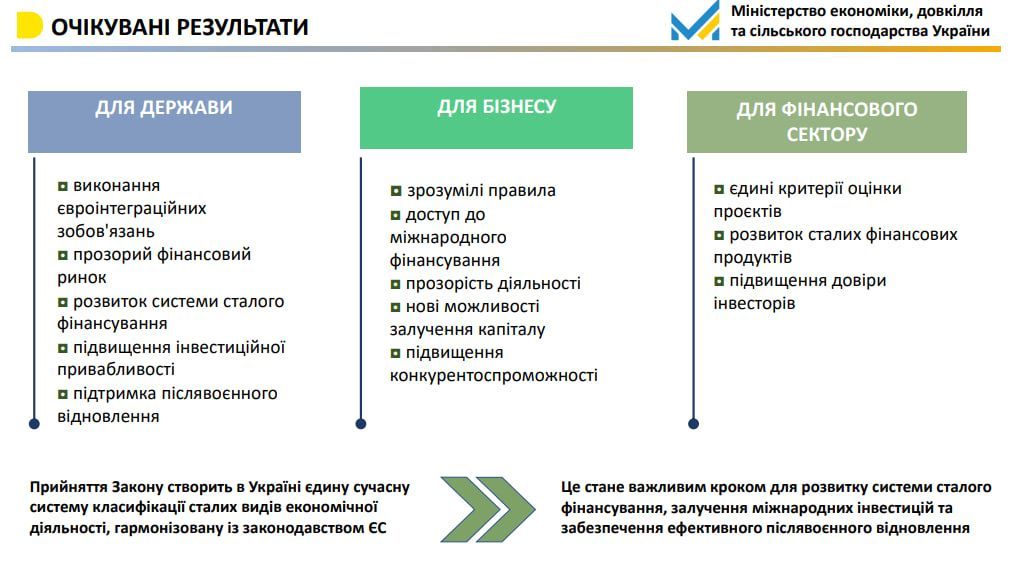
Source: presentation by the Ministry of Economy
Main terms
Taxonomy as defined by the document: “This is a classification system for economic activities that sets criteria for assessing economic activity in terms of its compliance with environmental sustainability goals and the promotion of sustainable investments.”
Meanwhile, sustainable investments are considered to be those directed towards one or more types of economic activities which this draft law designates as environmentally sustainable.
Sustainability criteria
For an economic activity to be considered “green,” it must meet four criteria at once:
- make a significant contribution to achieving environmental goals;
- do no significant harm to any of the goals;
- comply with technical criteria;
- comply with social guarantees.
An important detail: this concerns not only the production process itself but also the entire life cycle of the manufactured product.
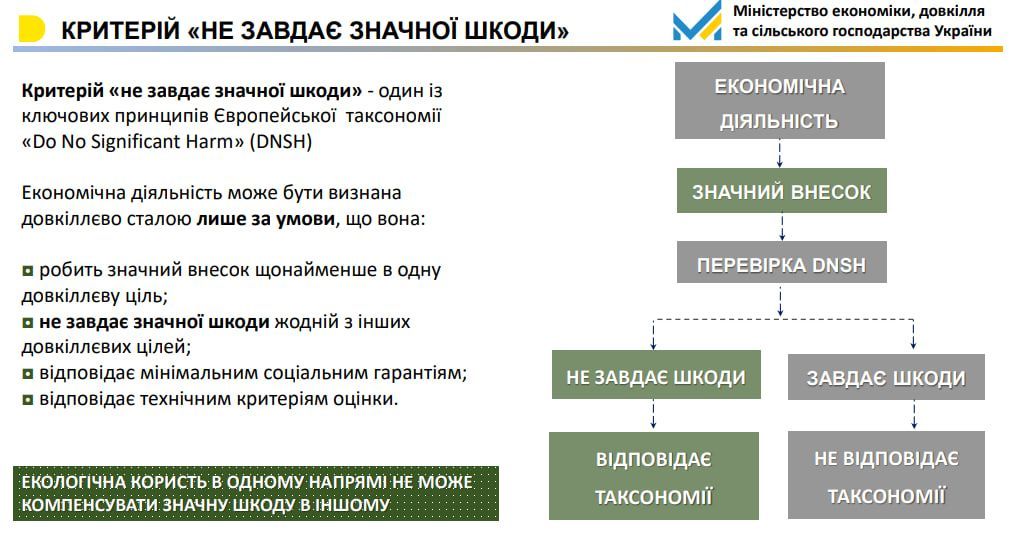
Source: presentation by the Ministry of Economy
Environmental objectives
So, what are these objectives that sustainable economic activity must advance rather than hinder? They are defined in Section III of the draft law.
- climate change mitigation;
- climate change adaptation;
- sustainable use and protection of water and marine resources;
- transition to a circular economy;
- prevention and control of pollution;
- restoration and conservation of biodiversity and ecosystems.
The draft law details each of these. For instance, climate change mitigation includes a transition to renewable energy use, improving energy efficiency, shifting to clean modes of transport and renewable materials, etc. Concerning pollution, it calls for minimizing or entirely eliminating emissions, improving air quality, removing litter, and so forth.
Technical criteria and social guarantees
Їх у законі немає – за визначення та затвердження критеріїв відповідають центральні органи влади. Документ передбачає, що, відповідно до змін у законодавстві в ЄС та розвитку науки, їх періодично переглядатимуть.
However, the draft law stipulates that technical criteria must be scientifically justified and technologically neutral, preferably include quantitative indicators where possible, be easy to verify, and be uniform for all.
Overall, the technical criteria should determine the most appropriate contribution to achieving each goal as well as the minimum requirements that enterprises must comply with in order not to cause significant harm.
The draft law also mentions the need to limit global warming to 1.5°C. Hence, activities for electricity generation using solid fossil fuels should not be considered sustainable.
The Ministry of Economy added that the Cabinet of Ministers’ resolution on technical criteria for types of sustainable economic activity is currently 30% complete.
Regarding social guarantees, the document refers to the necessity of complying with the provisions of the Organisation for Economic Co-operation and Development (OECD) Guidelines for Multinational Enterprises, the United Nations (UN) Guiding Principles on Business and Human Rights, the International Labour Organization (ILO) Declaration on Fundamental Principles and Rights at Work, and the International Bill of Human Rights.
Information Disclosure
Enterprises are required to disclose sustainability reporting on their environmental activities in sustainability documentation. This applies to all business entities subject to the obligation to publish sustainability reporting according to the Law "On Accounting and Financial Reporting in Ukraine".
Failure to disclose or improper disclosure of this information, or dissemination of information about the sustainability of an investment or product without appropriate confirmation, will entail liability.
Recall that in Ukraine, draft law No. 15386 "On the National Greenhouse Gas Emissions Trading System" was recently registered. This document did not undergo public discussion and emerged as a genuine “Trojan horse” for the environmental community, businesses, and experts.