A number of frontline regions in Ukraine are subjected to shelling on a daily basis. It is clear that environmental issues cannot take precedence over safety, so we did not expect large-scale environmental programs in the Sumy region. However, essentially two aspects have been identified – fragmented access to information and billion-hryvnia plans approved already during the full-scale war.
EcoPolitic has studied the environmental programs of Sumy region for its series of materials on the use of the environmental tax.
Lull at the regional level
A separate environmental protection program for Sumy region could not be found. Information on the use of the special fund, filled from the environmental tax, can only be inferred from separate reports by the Regional Military Administration (RMA).
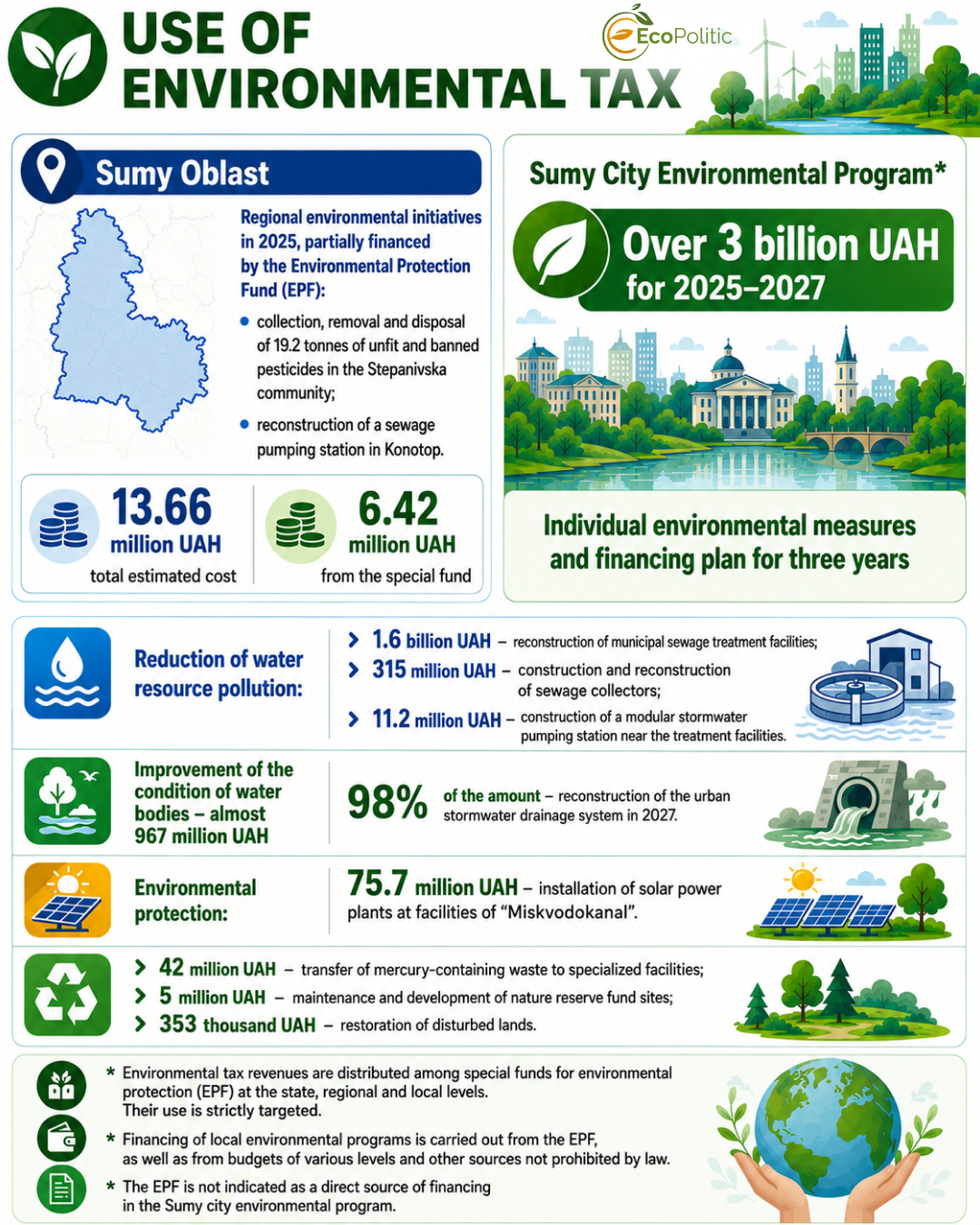
For example, in 2025, with funds from the Regional Environmental Protection Fund, it was planned to implement the following measures:
- collection, removal, and disposal of 19.2 t of unusable and banned pesticides in the Stepanivka community;
- reconstruction of a sewage pumping station in Konotop.
The RMA emphasized that the cost of environmental measures is UAH 13.66 million, of which only UAH 6.42 million are from the special fund.
Environmental program of the regional center
The environmental program of the city of Sumy was approved in January 2025. It covers the period from 2025 to 2027. In total, over this three-year period, they plan to spend more than UAH 3 billion on environmental protection measures. It should be noted that the Environmental Protection Fund is not included as a source of financing. Only the city budget, the regional budget, and "other sources" are mentioned.
The most expensive task for Sumy is to reduce water pollution. Over three years, almost UAH 2 billion are to be allocated to this area. The single most expensive project is also in this section: the reconstruction of the city’s sewage treatment facilities with costs exceeding UAH 1.6 billion. Unspecified funding sources are to cover the bulk of this spending – UAH 1.52 billion. The construction of a modular drain station is set at another UAH 11.2 million, while construction and reconstruction of sewage collectors comes to over UAH 315 million.
Nearly UAH 967 million is planned to be spent over three years to improve the condition of water bodies. Of this, more than 98% is allocated for the reconstruction of the urban stormwater drainage system, which is planned to be implemented in 2027 using "other sources" of funding.
The environmental protection program also includes the installation of solar power plants at the “Miskvodokanal” municipal utility facilities, budgeted at UAH 75.7 million, of which UAH 60.5 million is expected from non-budgetary sources.
Among other areas:
- maintenance and development of nature reserves with just over UAH 5 million;
- transfer of mercury-containing waste to specialized facilities – UAH 42 million;
- restoration of disturbed lands – UAH 353,000.
Ми б хотіли дізнатися результати виконання попередньої екопрограми. Однак документ зі звітом на the website of the Department of Finance is missing.
Smaller communities
In small territorial communities, ecological plans are, as expected, less ambitious.
The Stepanivka village council for the years 2026–2028 plans just three activities with total funding of UAH 69,000:
- greening of the community including the purchase of seedlings and flowers, landscaping of settlements, and preservation of the natural environment;
- elimination of illegal dumps and improvement of legal ones;
- collection and disposal of hazardous waste.
The Andriyashivka village council also has three environmental activities, but with somewhat different focus:
- Solid municipal waste management: elimination of illegal landfills and preparation of land management documentation for dumpsites;
- Protection and rational use of water resources: restoration of a favorable sanitary and environmental condition of bodies of water and sanitary cleaning of the coastal zones;
- Protection and rational use of natural plant resources: removal of hazardous, dying, and dry trees, crown pruning, procurement and planting of tree and flower seedlings, setting up flower beds and gardens.
As for the cities in the region, the arbitrary navigation on official websites and the freedom of communities in shaping their own programs did not allow us to find specific environmental plans. In most cases, these are “embedded” within other documents.
In particular, in 2025, Konotop presented a Comprehensive Territorial Recovery Program. And although the community profile contains a general ecological assessment, which spans as many as seven points, the natural environment is not mentioned among the priority areas (p. 97).
Nonetheless, there are separate projects that other communities would readily categorize as ecological. For example, the construction of a solar power plant for the municipal water supply and sewerage system, reconstruction of the water treatment plant, or the cleaning of water bodies within the community. Among the proposed funding sources (p. 214), both the state budget and European funds are mentioned.
In Okhtyrka, a dedicated environmental protection program is also not listed in the program catalog. The city has separate programs for the functioning of water supply and sewerage networks, sanitary cleaning and management of household waste, landscaping, and population control of stray animals. However, appendices with activities, funding amounts, and sources are either missing from the website or posted in such a way that internal search mechanisms cannot retrieve them.