The world’s developed economies have managed to reduce industrial emissions primarily by relocating their own carbon-intensive manufacturing to Asian countries.
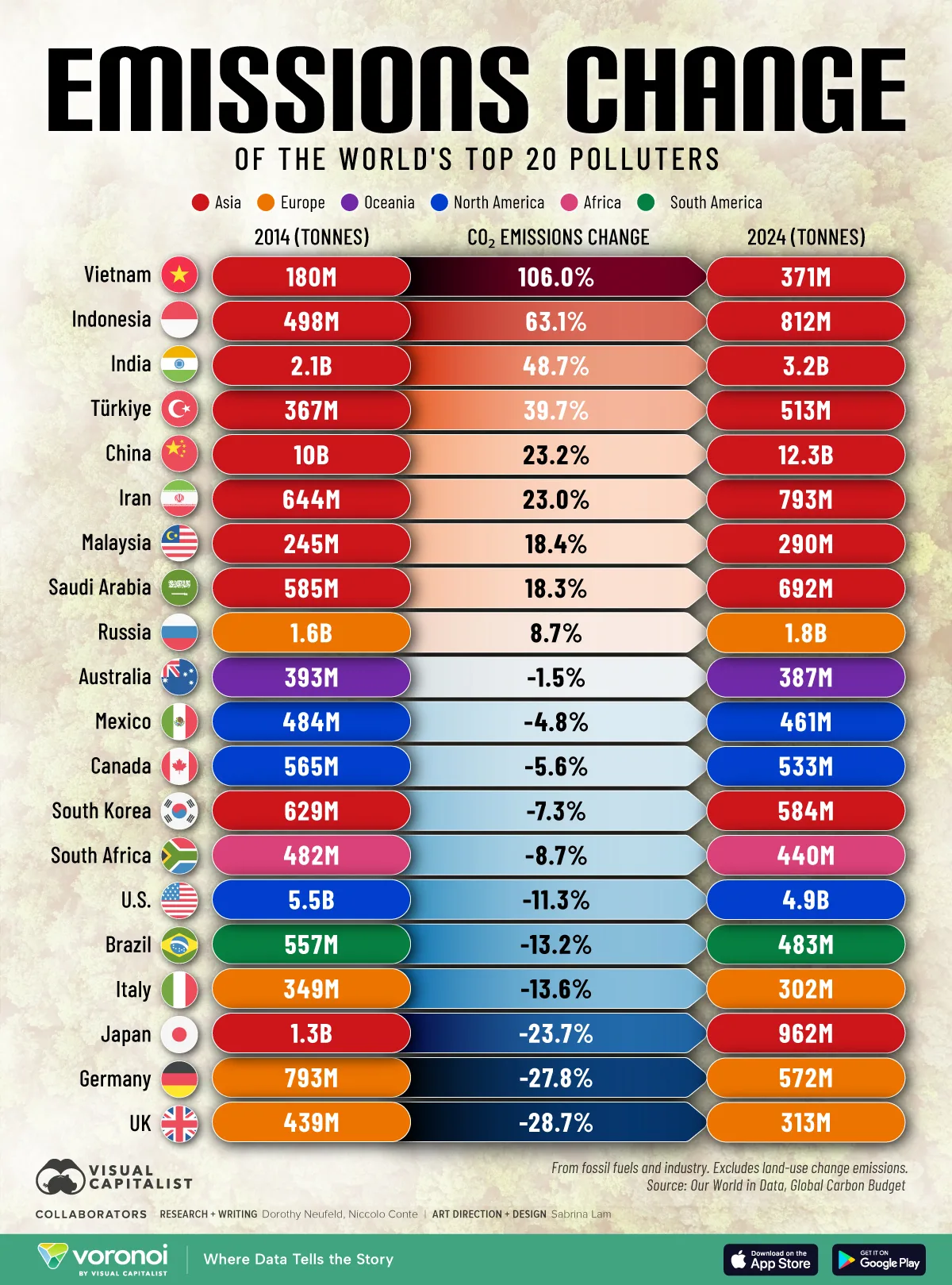
These findings come from the Canadian media platform Visual Capitalist, which tracked changes in emissions from the world’s 20 largest polluters between 2014 and 2024.
Fake сhampions
At first glance, developed countries appear to be the leaders in terms of reducing industrial pollution:
- The United Kingdom has reduced emissions by nearly 29%;
- Germany – by 28%;
- The United States – by 11%.
The secret, in particular, lies in the fact that they have effectively phased out domestic coal but have quietly moved their heavy, carbon-intensive industries abroad.
Who took up the baton
Over the same ten-year period, Vietnam’s emissions skyrocketed by 106%. Indonesia’s rose by 63%. India’s increased by nearly 49%. These countries have become the industrial base for the production of goods that the “decarbonized West” continues to consume relentlessly.
In percentage terms, China’s growth was significantly lower—only 23.2%. But in absolute terms, given the scale of Chinese industry, this adds up to 2.3 billion tons of CO₂. For comparison: China’s emissions growth over the past decade exceeds the total annual production of nearly all other countries in the world.
Source: visualcapitalist.com
“The much-publicized emission reductions in the West are mathematically offset by industrialization in the East. We have created a global economic system where wealthy countries clean up their internal ledgers simply by outsourcing work to emerging markets,” said ESG strategy consultant Felix Hawkings.
In his view, it is impossible to solve the global problem of air pollution through regional accounting.
As EcoPolitic previously reported, since 1990, the European Union's greenhouse gas emissions have declined by 40%. The largest reductions occurred in sectors such as electric and heat energy production, manufacturing, housing, construction, and ferrous metallurgy.