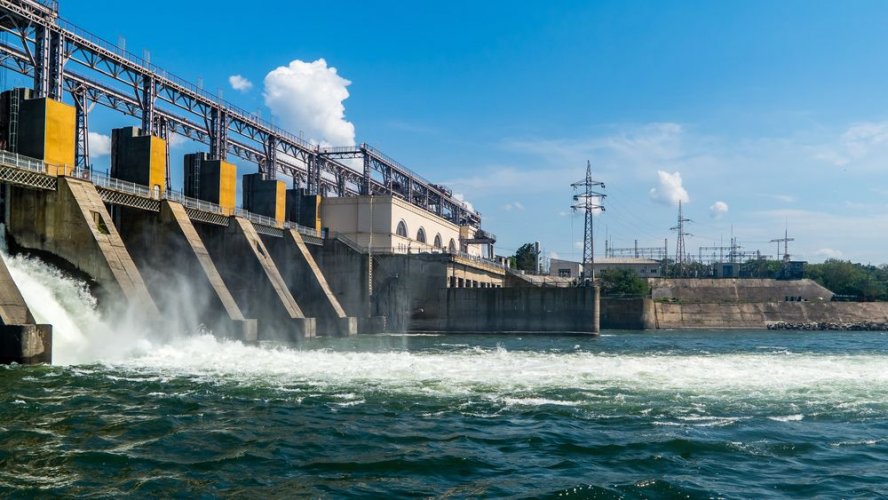
The head of the All-Ukrainian Environmental League, Tetyana Tymochko, believes that the government's decisions on the pilot project to restore the Kakhovka HPP are made too hastily and without sufficient justification, Ukrinform reports.
"When we talk about the Kakhovka HPP and the future of the region, we must first of all talk about the real. Fantastic things are beyond our power. Due to global climate change, there is simply no place to get 18 billion cubic meters of water for the future Kakhovka HPP to start working," Tymochko said.
Environmentalists note that no EU country would support a project similar to the construction of a new hydroelectric power plant. The costs required for such a project are absolutely not rational compared to the opportunities that can be provided by using the reservoir. On the contrary, most focus on reducing the volume of reservoirs, as their environmental inappropriateness is recognized, and no new ones are being built.
In June 2023, a working group was set up, headed by Andriy Yermak, Head of the Office of the President of Ukraine, and Margot Wallström, former Deputy Prime Minister of Sweden. This group developed an Environmental Treaty for Ukraine, which contains all the positions and recommendations on the economy, social policy, ecology, infrastructure, and security, including the Kakhovka HPP.
Tymochko emphasizes that one of the 50 recommendations set forth in the Treaty from the international community reads as follows: to take into account the opinion of scientists and the public regarding the future of Kakhovskaya HPP, regarding the possibility of restoring it or not. And this is a very important message.
Ecologists of the All-Ukrainian Environmental League emphasize that according to Article 82 of the Water Code of Ukraine, the construction of reservoirs and ponds in river basins is prohibited if their total capacity exceeds the flow of the river during the estimated low-water period, which occurs once every 20 years. The cascade of Dnipro reservoirs accumulated 43.7 cubic km of water before the moment of destruction, of which Kakhovskoe holds 18.2 cubic km of water, which exceeds the established limit.
In many countries of the EU and the USA, the trend of dismantling dams in order to restore the free flow of rivers is gaining momentum. More than 6,000 such structures have already been dismantled in the European Union, and more than 2,000 in the USA. Experts believe that Ukraine should also join this movement in order to give our rivers the opportunity to restore their natural self-cleaning functions, which will improve the quality of river water.
Earlier, EcoPolitic wrote, that the Cabinet of Ministers approved a resolution on an experimental project to rebuild the Kakhovskaya HPP, which was blown up by the occupiers.
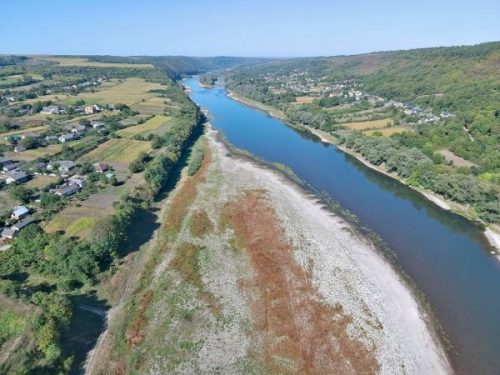
Previously, EcoPolitic analyzed what is currently happening at the shallow Kahovsky Reservoir and what its future could be.
A large part of the territory of the Kakhov reservoir was filled with water again, which led to the flooding of many areas. Despite this, such a situation will have a positive effect on local ecosystems.