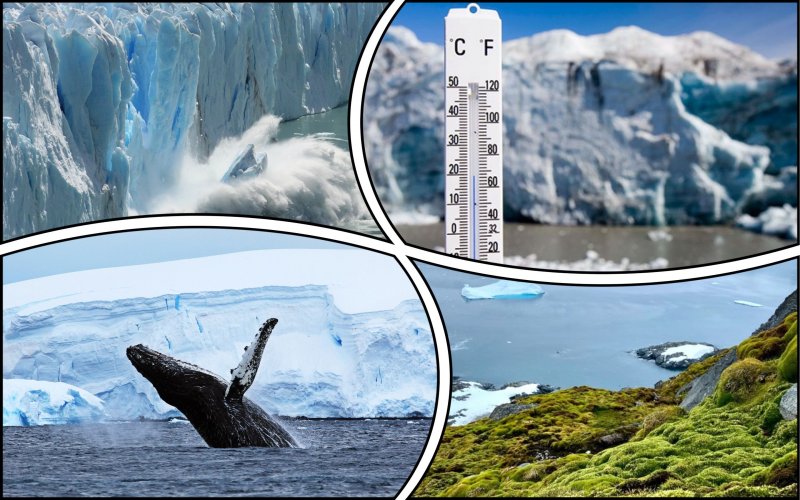
A study by the British Antarctic Survey found that no matter how much the world cuts carbon emissions, the West Antarctic Ice Sheet will inevitably melt within what is likely to be several centuries.
This will lead to a rise in sea levels of 1.8 meters, which will significantly change the lives of future generations, reports the Independent.
It is noted that reducing emissions will have a limited effect on ocean warming.
A computer modeling study has shown that it is the western part of Antarctica, especially near the Amundsen Sea, that is most at risk of melting from ocean warming. It is in this part that the Thwaites Glacier is located, which is melting so fast that it was called the "Doomsday Glacier".
"This part of Antarctica is doomed," said UCLA ice scientist Eric Rignot, who was not involved in the study. "The damage has already been done."
The study's lead author, Caitlin Noten, emphasized that the world has already warmed by about 1.2°C since pre-industrial times. In addition, during most of the summer of 2023, warming exceeded the 1.5°C mark.
She noted that in 100 years, the world can not only stop emissions, but also change the level of carbon in the air and the trends of global warming. But what is happening on the planet now is a slow collapse that cannot be stopped, at least in this century.
In her opinion, it will not be possible to save the western part of Antarctica. This will lead to a rise in sea level by 1.8 meters. This is a slow process that will continue for the next few hundred years until 2300-2500 years. However, if the melting of the ice can be slowed down for 2000 years, humanity can adapt.
"When it comes to climate change, we need courage, not hope. Courage is the determination to succeed without the certainty of a happy ending," Noten quoted former NASA scientist Kate Marvel as saying.
Earlier, EcoPolitic wrote, that scientists studying Antarctica have found that ice-free areas will potentially increase by 17,000 km2 by 2100, which will lead to plant colonization.
As EcoPolitic previously reported, in Antarctica the area of sea ice is shrinking at an unprecedented rate and, despite the middle of winter, some areas have become bare in places where this had not been observed before.