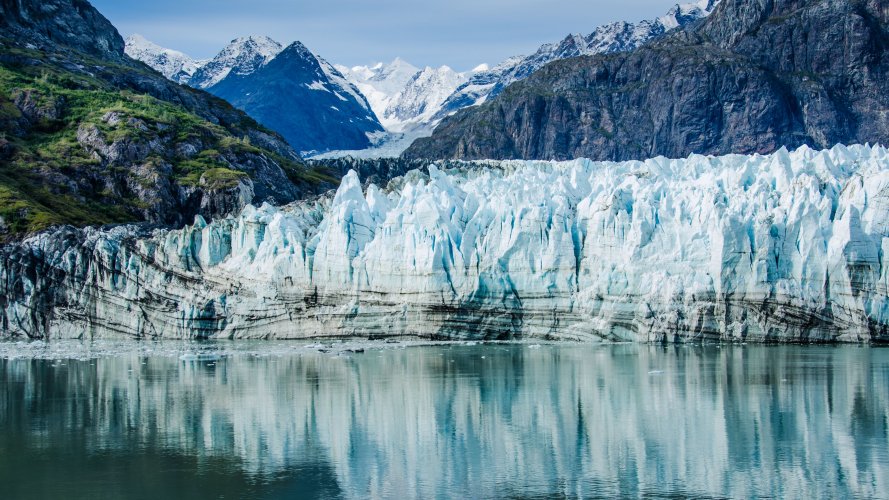
Global warming is leading to alarming changes in the world’s oceans. The most significant of these are the melting of glaciers and the relentless rise in sea levels. Since 2012, sea levels have been rising by approximately 4.2 mm each year, which has direct consequences for coastal communities and global economies.
This was reported by the European Commission, citing a new report from the Copernicus Marine Environment Monitoring Service.
The destruction of the Arctic
The Arctic ice cap is melting at an alarming rate. The report states that, every ten years between 1979 and 2025, the area of sea ice shrank by approximately 490,000 km2. This is almost equivalent to the area of the whole of Spain.
The melting of ice is a problem in itself, but it also triggers a further chain of negative effects. For instance, it leads to stronger winds and higher waves. As a result, around 60 per cent of all infrastructure located on Arctic coasts has become more vulnerable to rising sea levels and erosion.
This is an incredibly rapid pace, given the region’s strategic importance not only for climate security but also for economic and geopolitical stability.
"Changes in the polar oceans are not a collection of isolated environmental trends, but an interconnected transformation of physical systems, ecosystems and societies, requiring comprehensive observations and coordinated action on climate, biodiversity and ocean governance," the report emphasised.
Warming of the seas
Like the land, Europe’s regional seas have fallen victim to heatwaves of extreme intensity. In particular, such events affected the Mediterranean and Black Seas in 2024. Temperatures during these heatwaves exceeded the norm by as much as 4.6°C in some places.
Threats to countries
Small island states are in the high-risk category due to rising sea levels. The report states that, since 1999, 65 per cent of their economic zones have faced this threat.
EcoPolitic previously reported that rising sea levels threaten to submerge cities and UNESCO cultural sites.
At the same time, global warming is already having an impact on food security and food prices. This is due to crop failures caused by droughts and high temperatures.