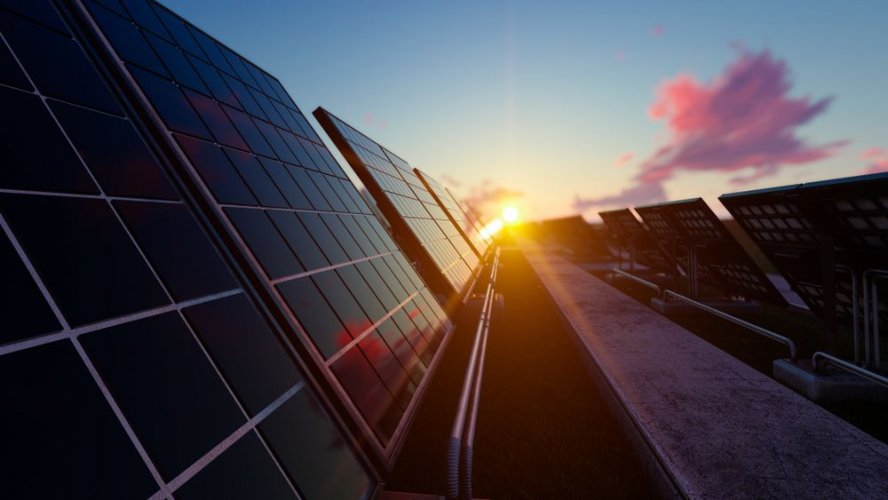
The European Commission has officially launched the EU Solar Photovoltaic Industry Alliance to restore its own production of solar power plant cells.
This is reported by the publication Euractiv.
The goal: to promote investment in large-scale plants, aiming to achieve 30 GW of annual production for each key solar energy component by 2025. This is more than six times the current capacity of about 4.5 GW per year.
"Through this alliance, we want to create complete PV value chains in Europe to reduce our dependence and create value in the European Union," said European Internal Market Commissioner Thierry Breton at the alliance's launch ceremony.
The publication notes that Europe has a lot of catching up to do. Among the 450 GW of PV modules that were produced worldwide in 2021, less than 9 GW were produced in the EU.
The 27-nation bloc is expected to install nearly 40 GW of solar PV this year, a new record. However, this will be achieved by doubling China's solar PV exports.
"We have lost our market share and we are trying hard to use the potential of jobs in this sector," Breton emphasized.
According to a European official, Europe is currently almost completely dependent on China for the production of SES elements. After all, Beijing controls 80% of the world's production capacity for the production of solar photovoltaic systems.
The industry alliance is part of the EU's solar energy strategy, unveiled in May. It was presented alongside wider EU plans to end Europe's dependence on Russian fossil fuels following Russia's invasion of Ukraine. The goal is to deploy nearly 600 GW of solar PV capacity by 2030, with an interim target of 320 GW by 2023, more than doubling the unit's current capacity.
As EcoPolitic reported earlier, on December 13, EU negotiators reached an agreement on carbon import adjustment mechanism (CBAM), which, among other goods, will apply to the import of hydrogen.