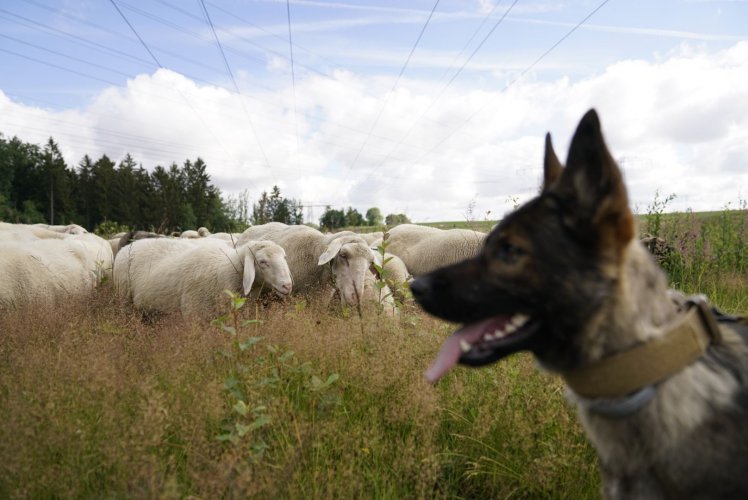
In Germany, in Thuringia and Saxony, sheep and cows help power workers clear areas near overhead power lines of grass and bushes.
In the country, the projects Sheep and Electricity and Livestock Instead of Machines were created, within the framework of which they plan to use the territories under power lines as pastures, reports Ukrenergo on Telegram.
They were created by transmission system operator 50Hertz together with distribution system operator MITNETZ STROM and environmental organizations.
Usually, unwanted vegetation is mowed every summer by machines, and in difficult places by hand.
Animals eat grass and bushes, thus clearing the area under and near high-voltage power lines. This must be done every year according to safety rules, so that a sudden electric discharge does not ignite a tree or bush and start a fire.
It helps to create and maintain unique green environments that are home to many species of insects, birds and animals.
Currently, in Saxony, 300 sheep and goats maintain order under the high-voltage network, and in the territory along the line between Saxony and Thuringia, five cows of the Dexter breed are responsible for safety and environmental protection.
As EcoPolitic reported before, in Bavaria (land of the Federal Republic of Germany) ecologists discovered boars infected with Chernobyl radiation.