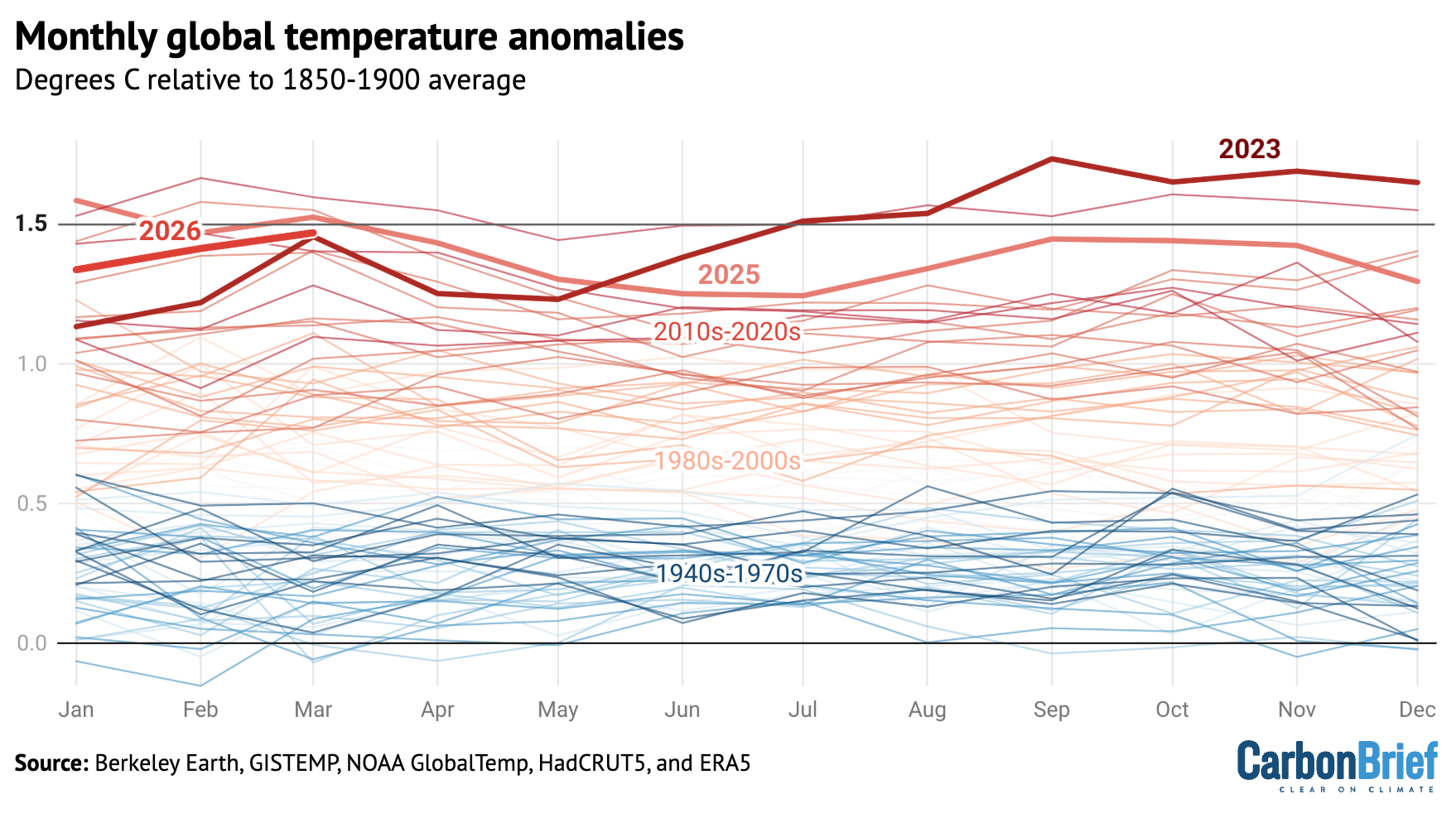
The first quarter of 2026 ranked fourth among the warmest on record. Each month, the deviation from average temperatures grew larger. As early as the second half of the year, a powerful El Niño could make 2026 the second warmest year on record since meteorologists began collecting climate data. And the chances of it becoming the warmest year on record are 19%.
This was reported by Carbon Brief.
For its quarterly report, the organization analyzed data from five research groups—NASA, NOAA, the Hadley Centre/UEA, Berkeley Earth, and Copernicus/ECMWF. All of them confirm that 2026 has entered the top five “leaders” right from the start.
Джерело: Carbon Brief
Even the La Niña phenomenon, which typically lowers global temperatures, did not prevent the high temperatures. Since the phenomenon began to weaken, the months have become increasingly hotter compared to average levels.
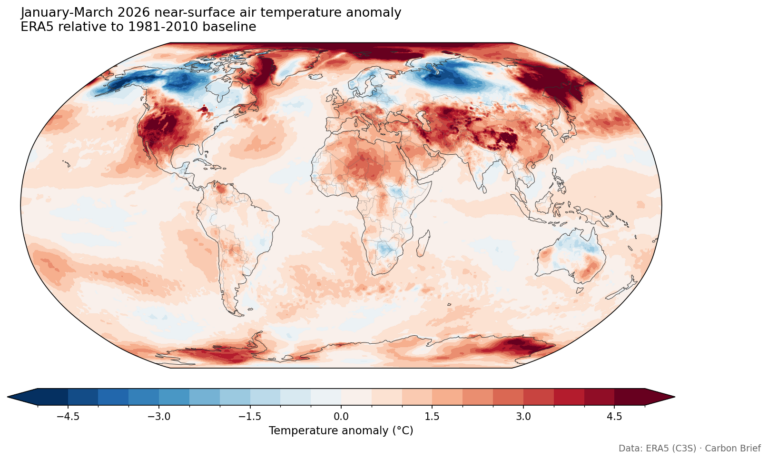
Temperature anomalies were observed in a number of regions around the world. Unseasonably warm weather swept across the western United States and western China.
Джерело: Carbon Brief
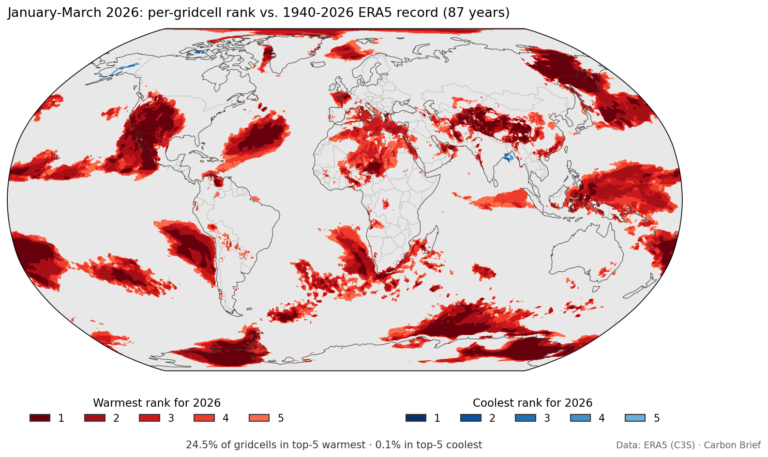
Temperatures have broken records in many parts of the world. The map shows the locations where the first quarter was one of the five warmest on record.
Джерело: Carbon Brief
In fact, record-high temperatures were recorded across more than 5% of the planet in early 2026. 24.5% of the planet ranked among the five hottest on record.
"Super" El Niño
According to forecasts, temperatures will only rise throughout the year, and El Niño will begin in the fall; moreover, this phenomenon is expected to reach unprecedented intensity.
"The average global temperature in 2026 will range from 1.37°C to 1.58°C, with a best estimate of 1.47°C. This puts 2026 on track to become the second-warmest year on record," Carbon Brief concludes.
EcoPolitic previously reported that for Kyiv, March 2026 was the driest in 135 years of observations.