There are currently 1.8 million jobs in the European Union that are directly or indirectly linked to green energy. In this respect, the EU is second only to China, where 7 million people are employed in the renewable energy sector. However, there are several obstacles to the future growth of ‘green’ employment, the key one being a shortage of skilled workers.
This is evidenced by data from the report published by the European Environment Agency (EEA).
Employment in the energy sector is growing faster than the economy as a whole. In 2024, for example, total employment rose by 1.3 per cent, whilst employment in the clean energy sector rose by 2.2 per cent.
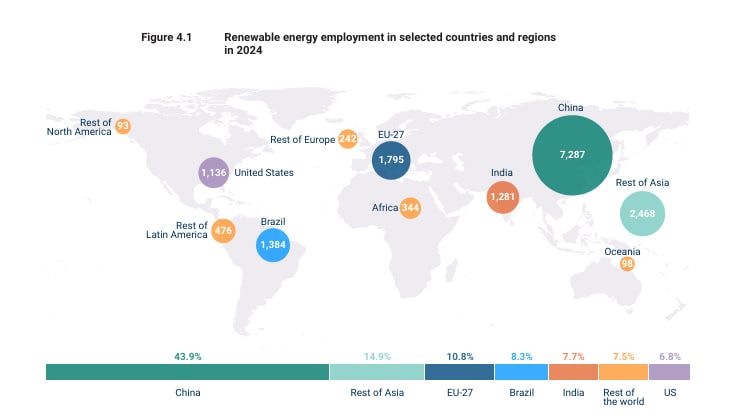
Source: EEA
The labour market by renewable energy sector
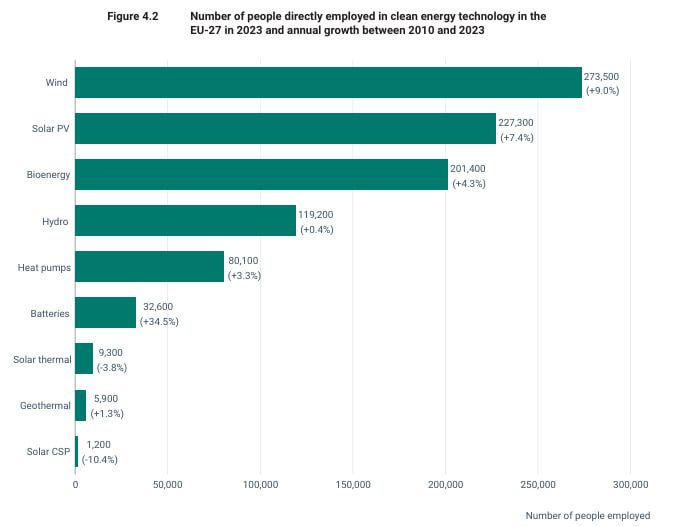
The largest employer is wind energy. As of 2023, it employed 273,500 people. Manufacturing ranks only second in terms of the number of jobs, as 77 per cent of staff are involved in operational activities — maintenance and management.
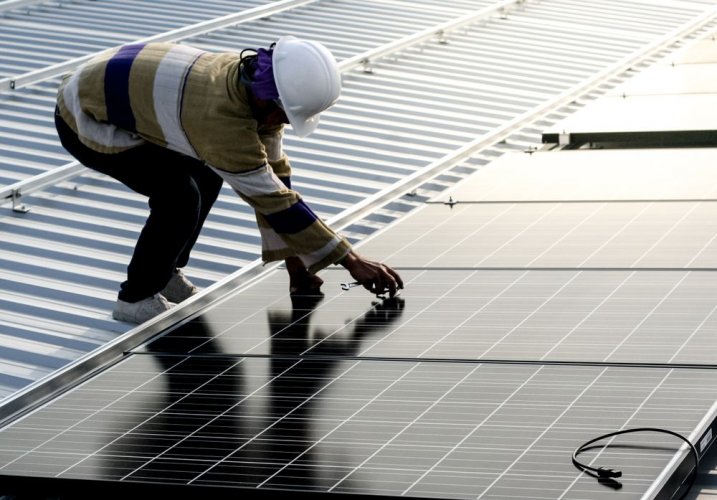
Solar energy is lagging slightly behind. There are 227,000 workers in this sector. Around half of them were involved in operational activities. Around 36 per cent worked in the construction value chain – from site preparation to grid connection. The figures for manufacturing are not spectacular, as solar panel production in the EU remains extremely limited to this day.
In the heat pump sector, 80.1 thousand people were employed as of 2023. The vast majority, 65 per cent, were employed in the construction sector.
Employment is lowest in the energy storage systems sector. Only 33,000 people were employed there, yet the growth rate between 2018 and 2023 proved to be the highest. Most jobs are concentrated in battery manufacturing, whilst research and development remain vital for next-generation technologies.
Source: EEA
Geographical distribution
Employment in the ‘green’ energy sector varies significantly from country to country. Germany has the largest workforce: 125,000 in wind power, 84,000 in solar power and 12,300 in battery manufacturing.
Italy, Portugal and Spain are among the leaders in terms of the number of jobs in the heat pump sector. Poland and Hungary are seeing the fastest growth in employment in the battery sector.
Threats to growth
The main obstacle is a shortage of skilled workers. Many countries report that they lack specialists for key technical tasks relating to construction and installation. The authorities must therefore focus on supporting training and retraining programmes for the relevant specialisms.
Another issue is the significant difference in salaries. For example, in the heat pump sector, employees earn around 40 per cent less than those in the wind energy sector. At the same time, jobs in the operation and maintenance sector are more stable, whereas employment in the construction of new projects is more precarious in terms of job security.
Physical and environmental risks are also significant. For example, workers are more likely to be exposed to extreme heat whilst installing solar panels, and the production of batteries poses a risk to the environment.
Previously, EcoPolitic reported that the ‘green’ economy provides Europeans with around 5.8 million jobs. Eurostat’s data covers not only renewable energy but also the environmental protection and natural resource management sectors.