The first application for an integrated environmental permit (IEP) and the required supporting documents have been submitted to the Unified State Register of Integrated Environmental Permits.
This was announced by Oleksandr Krasnolutskyi, Deputy Minister of Economy, Environment, and Agriculture of Ukraine, during the roundtable discussion “Reform of Industrial Pollution Prevention and Control: Introduction of Unified Permits.”
The application and attached documents are available on the "EcoSystem" platform.
Who is this pioneer?
It is the "Torgtekhnika" pulp production plant, located in Vinnytsia. It processes waste paper and cardboard.
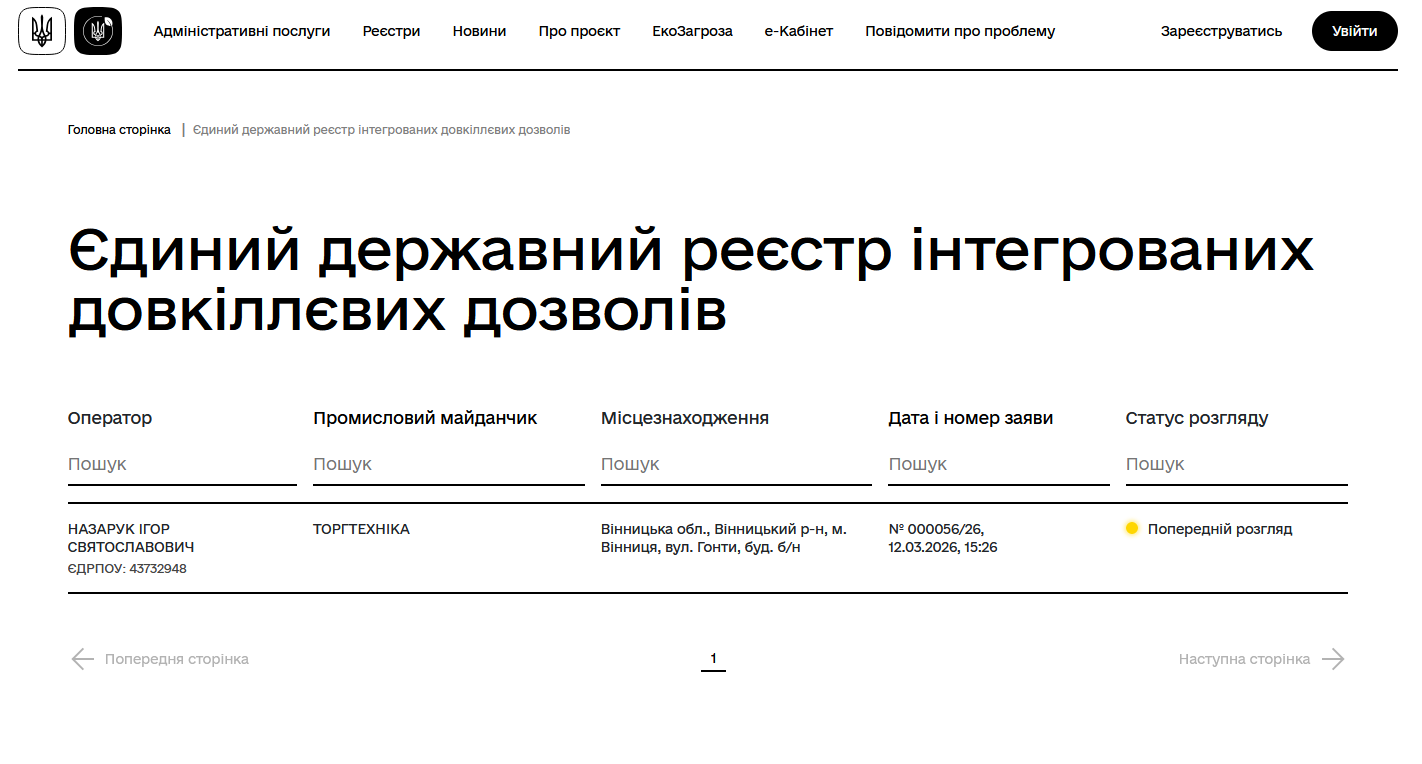
Source: screenshot from eco.gov.ua
The application itself alone comprises 126 pages. The manufacturer attached three documents to it:
- a technical report for the determination of geodetic coordinates,
- a situational map-diagram,
- a document regarding the establishment of the facility’s sanitary protection zone size.
Separately, under the "Installations" section, the manufacturer uploaded another 31 supporting documents.
At what stage is the application being reviewed
The application is currently under preliminary review, but the timeline is unclear. The application is dated March 12, and its preliminary review only began on April 21. According to the Law "On Integrated Prevention and Control of Industrial Pollution," the Ministry of Economy has 30 working days to review this application. Therefore, next week the agency should provide its conclusion: whether the application is acceptable or if certain deficiencies need to be addressed.
What is an IEP
At the beginning of August 2025, Law No. 11355 on industrial pollution entered into force. This euro-integration document requires Ukrainian enterprises to obtain permits under a fundamentally new procedure.
The integrated environmental permit (IEP) essentially combines all the permits that enterprises previously obtained. In addition, under the new law, the IEP must be issued not for the entire facility, but for each specific installation that impacts the environment.
In early July, the government published a list of requirements and documents that the enterprise’s IEP application must include. Information is also already available on the form and content of the baseline report for obtaining the IEP and the reports that the operator of the installation is required to submit annually.
In December of last year, EcoPolitic reported that, despite the launch of the Integrated Environmental Permit Register in September, not a single application had been submitted as of that moment.