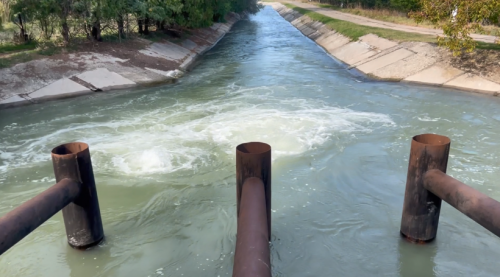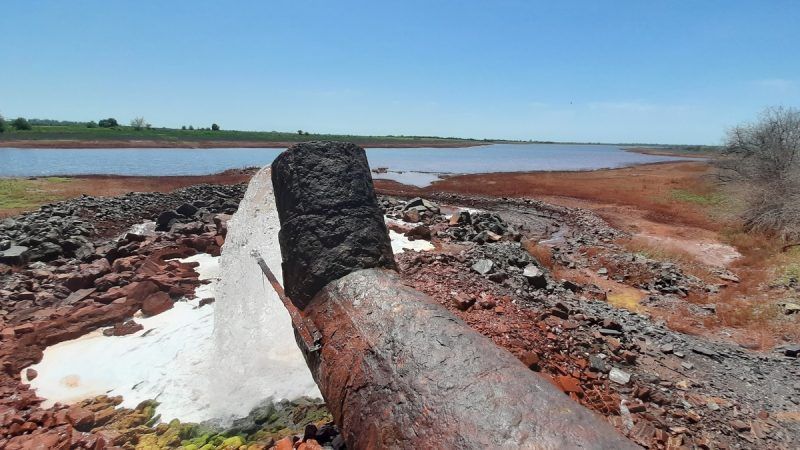
The situation regarding mine water discharges in Kryvyi Rih poses the risk of a man-made environmental disaster. Preventing this requires comprehensive solutions – both technical and financial. A dedicated inter-ministerial working group has been set up to develop these solutions, and it recently held its first meeting.
According to the Committee on Environmental Policy and Natural Resource Use, the group comprises not only parliamentarians but also representatives from the State Environmental Inspectorate, the State Geological and Subsurface Resources Service, the State Water Agency, the State Property Fund, local authorities and the business sector.
The financial factor
Problems surrounding the Svistunova ravine have been building up for over 40 years. Highly mineralised mine water from industrial enterprises in the Kryvyi Rih basin is discharged here. After dilution, it flows into the Ingulets river basin.
One of the largest volumes of ‘heavy’ water comes from the Kryvyi Rih Iron Ore Combine. However, the company is currently in bankruptcy proceedings and is unable to pay for the pumping and discharge of the water.
Overall, the financial situation of the state-owned enterprise ‘Kryvbas Shakhtozakryttia’ was a key focus of the discussion. In particular, the issue of debts owed to it by mining companies.
Ways forward
In addition to issues concerning compliance with environmental protection laws, permitting procedures, EIA, and the results of supervisory authorities, the meeting also addressed possible ways to solve the problem.
Authorities are convinced that only comprehensive, long-term solutions can prevent an environmental disaster. One-off measures will only postpone the catastrophe.
One such solution could be a fundamental change in how mine water is handled. After preliminary treatment, it is proposed to inject it through a system of special wells into deep and isolated aquifers.
However, this instrument alone will be insufficient, given the huge volumes of mine water.
“We need to shift from reacting to consequences to formulating a long-term state policy for mine water management. This concerns the environmental safety of the Inhulets river basin, the protection of community interests, and the creation of conditions for attracting international support to implement modern environmental projects,” said Member of Parliament of Ukraine Olena Kryvoruchkina.
In the future, members of parliament promise to keep the mine water issue in Kryvbass under continuous oversight and to seek more effective mechanisms to prevent a man-made disaster.
EkoPolitic wrote five years ago that in Kryvyi Rih, they studied changes in the technology of discharging highly mineralized waters. At the same time, the State Environmental Inspectorate promised to develop a roadmap for the rehabilitation of the Inhulets river.