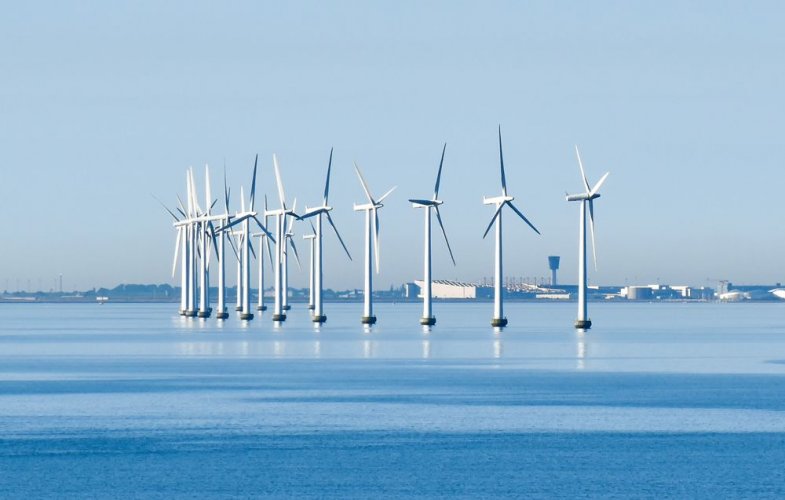
An unprecedented wind farm will be built on the North Sea coast, providing green energy to several European countries. Ten countries signed a declaration to this effect on Monday, January 26.
The British government calls this agreement a historic pact on clean energy security.
A shared energy reservoir
The Hamburg Declaration brings together the energy efforts of the UK, Germany, France, Denmark, Belgium, Ireland, Iceland, Norway, the Netherlands, and Luxembourg.
By 2050, wind turbines with a total capacity of 100 GW will be installed in the North Sea, supplying energy to European countries via interconnectors. In this way, European states want to "end Europe's dependence on unstable fossil fuel markets controlled by oil states and dictators."
Three years ago, following Russia's invasion of Ukraine, the North Sea countries committed to creating a wind energy hub in the North Sea. By 2050, they plan to build 300 GW of capacity. The Hamburg Agreement adds a unique touch to this decision: thanks to joint projects, one-third of the energy will be transmitted directly to countries via multi-purpose interconnectors (MPIs).
In their statements, representatives of RenewableUK and National Grid Ventures add that this project will reduce the amount of transport infrastructure, thereby reducing the impact on the environment and coastal communities.
A counterbalance to Trump
A few days before the declaration was signed, the American president criticized Europe’s climate and energy ambitions, as well as its targeted shift away from dirty fossil fuels.
Therefore, the signing of the Hamburg Declaration, as Euronews writes, appears to be a public response to condemnation from the United States.
“We are defending our national interests by seeking clean energy that can take the UK out of the fossil fuel crisis and ensure us energy sovereignty and prosperity,” emphasized the UK’s Secretary of State for Energy Ed Miliband.
A step towards a "green" goal
EU countries currently have 236 GW of capacity in the wind energy sector, mainly onshore. So the North Sea project could be a major breakthrough. The EU aims to increase offshore wind power capacity to 300 GW by 2050, which is entirely realistic following the signing of the Hamburg Agreement.
EcoPolitic previously reported that 47.5% of the European Union’s energy consumption already comes from renewable energy sources.