
The extraterrestrial location does not make the problem of space debris any less significant. Debris from old spacecraft can damage satellites and communication systems and reduce global GDP by almost 2%. Therefore, the world needs to agree on a kind of space debris management program.
CNN reported on how to clean up space, citing research by a group of scientists from the University of Surrey in the UK.
The danger of debris in space
While debris on Earth gradually poisons living organisms, in space it can lead to rapid death. For example, it is not uncommon for the Hubble Telescope to encounter debris—once, it even pierced its antenna. A collision with debris left bullet-like cracks on the windshield of the Challenger space shuttle.
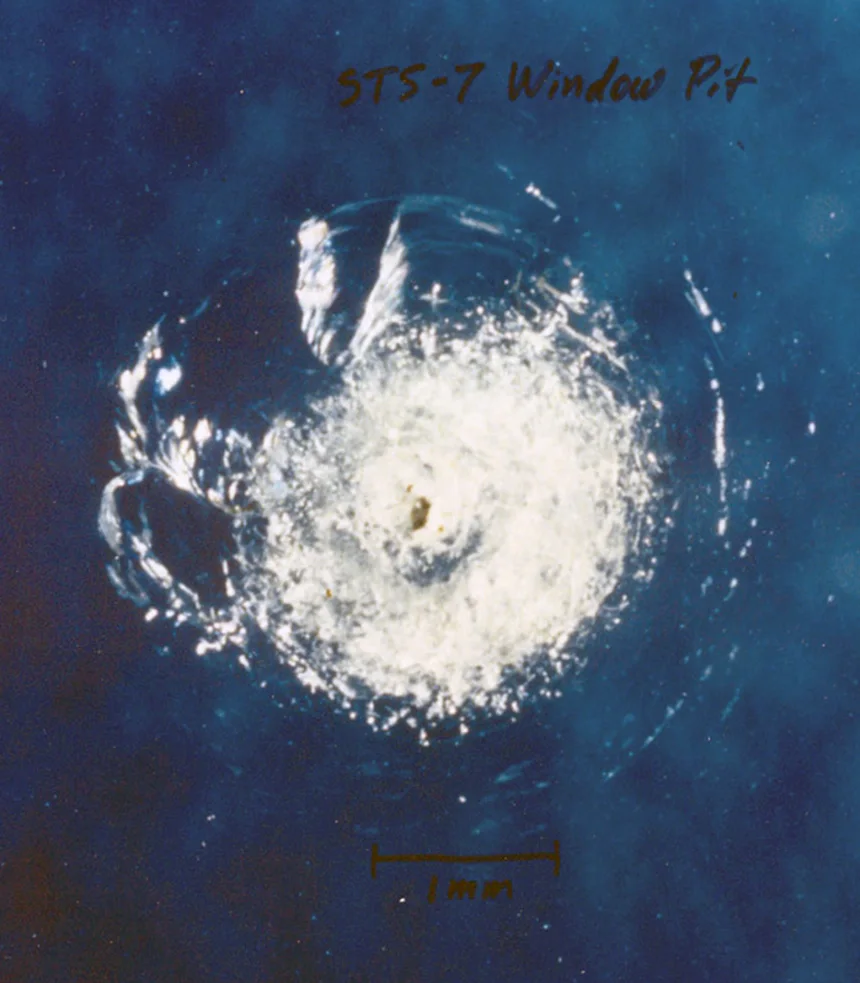
Damage to the Challenger’s windshield (1983). Source: NASA
At any moment, space around Earth could become unusable. This risk is described by Kessler syndrome—when enough objects "gather" in Earth's orbit, a single collision could cause a chain reaction.
Incidentally, a third of all Earth-origin debris orbiting the planet is the result of two major satellite collisions in 2007 and 2009.
Space waste management
The rules for combating space debris are simple: reduce the amount of materials used to manufacture extraterrestrial machines, repair old ones instead of building new ones, and recycle existing debris. However, their practical implementation requires a review of the priorities of all countries that are exploring space.
“The space industry has focused on safety and economic value, but sustainability has not been a priority. Now there is an opportunity to learn from other sectors.” – said Jing Xuan, Deputy Dean for Research and Innovation at the University of Surrey.
Sustainable space exploration requires a combination of existing technologies and new ideas. For example, by changing or expanding the functionality of space stations to recycle waste and repair equipment in orbit.
Earth laws against space recycling
The problem with combating space debris is the ownership rights to that debris. All debris was once part of someone's satellites, rockets, or stations. According to the Outer Space Treaty, ownership rights are permanently vested in the states or companies that launched them.
For example, Astroscale, a company that develops tools for space cleanup, wanted to pick up a British object for testing. However, it turned out that, according to the law, the company's equipment also had to be launched from British territory.
So until humanity resolves the bureaucratic issue of rights to debris, cleaning it up from space will be virtually impossible.
EcoPolitic previously reported that Starlink satellites from SpaceX could harm the planet’s ozone layer.