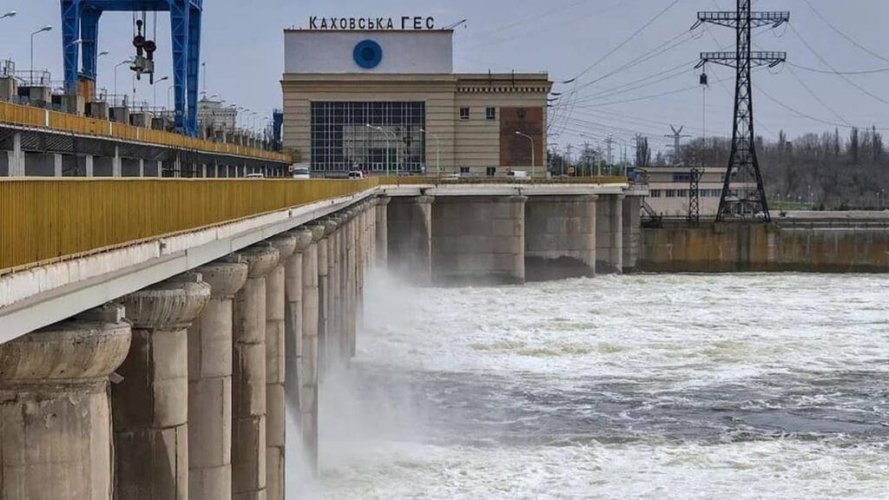
The discharge of water from the Kakhovskaya HPP by the Russian occupiers may violate the rules for the operation of reservoirs on the Dnieper, which will cause a threat to 70% of the population of Ukraine.
This was stated by the director of the Institute of Water Problems and Reclamation of the National Academy of Sciences, Mykhailo Yatsyuk, on the air of the national telethon, reports UNIAN.
"The discharge of water from the Kakhovsky Reservoir has consequences in that there are 6 reservoirs on the Dnieper, which are interconnected by the rules of operation. And you need to understand that the 2 largest reservoirs of these, Kremenchutsk and Kakhovsky, in which 44 cubic kilometers of water are concentrated. These are the largest reservoirs, in which 2/3 of the water is concentrated," the expert emphasized.
He agreed with Prime Minister Denys Shmygal's statement about the risks for 70% of the population of Ukraine in connection with the discharge of water from the Kakhovskaya HPP. According to him, it is necessary to understand how to minimize the consequences of such actions of the occupants.
"Even in order to secure the Zaporizhzhia nuclear power plant, we need to think about how to either stabilize the water level, or regulate or minimize this damage with certain discharges from the reservoirs located above. Because here there is another context - international. Because the consequences of water discharge from Kakhovsky reservoirs - they will be negative for the entire Black Sea basin, for all countries. Our neighbors can also suffer here, because the toxins that will appear after the aquaculture in this reservoir dies - it has already started to die, we can see - about that pollution transfer processes will take place, they will threaten neighboring countries," Yatsyuk concluded.
Earlier, EcoPolitic wrote, that Vice-Prime Minister-Minister for Reintegration of Temporarily Occupied Territories Iryna Vereshchuk reported on February 12 that the occupiers are draining the Kakhov reservoir. This harms the environment and poses a threat to water supply and agriculture in the southern regions of Ukraine.
General Director of Ukrhydroenergo Ihor Syrota said on February 14 that the water level in the Kakhovsky Reservoir is still above the critical mark, although the occupiers have already opened three sluices.
On February 16, the Prime Minister of Ukraine called on international partners to put pressure on Russia to close the floodgates and restore hydrotechnical structures at the Kakhovskaya HPP.