The European Union is confidently demonstrating its environmental and climate achievements – pollutant emissions are steadily falling, whilst the share of renewable energy is rising. This is attributed to the effectiveness of the bloc’s internal policies, which are constantly being refined. However, this showcase of achievements is taking place against the backdrop of a deadly heatwave that has already claimed the lives of over 1,000 people.
EcoPolitic offers readers an overview of key news from the EU – from successes to disasters.
Steady improvement in air quality
Year on year, the EU has seen a reduction in emissions of key pollutants. Citing a report by the Copernicus monitoring service, Euronews reported that over the last 10 years, emissions of sulphur oxides (SOx) and nitrogen oxides (NOx) have fallen by approximately three to five per cent annually.

Source: Copernicus
The largest reductions in emissions have been recorded in industry and motor transport. In the industrial sector, sulfur oxide emissions fell by 59%, while nitrogen oxides dropped by 39%. In road transport, nitrogen oxide emissions decreased by 40% and PM2.5 fine particulate pollution by 34%.

Source: Copernicus
The only sector emitting more air pollutants than in 1990 is transport. Currently, it accounts for about one-third of all EU emissions. However, even here, a decline is observed, albeit at a slower pace. In 2019, the sector produced 1.1 billion t of CO2, while in 2024 – 1.05 billion t.
A key factor in reducing emissions in transportation is the shift to electric vehicles; in energy, it is the move to renewables.
Renewable energy boom
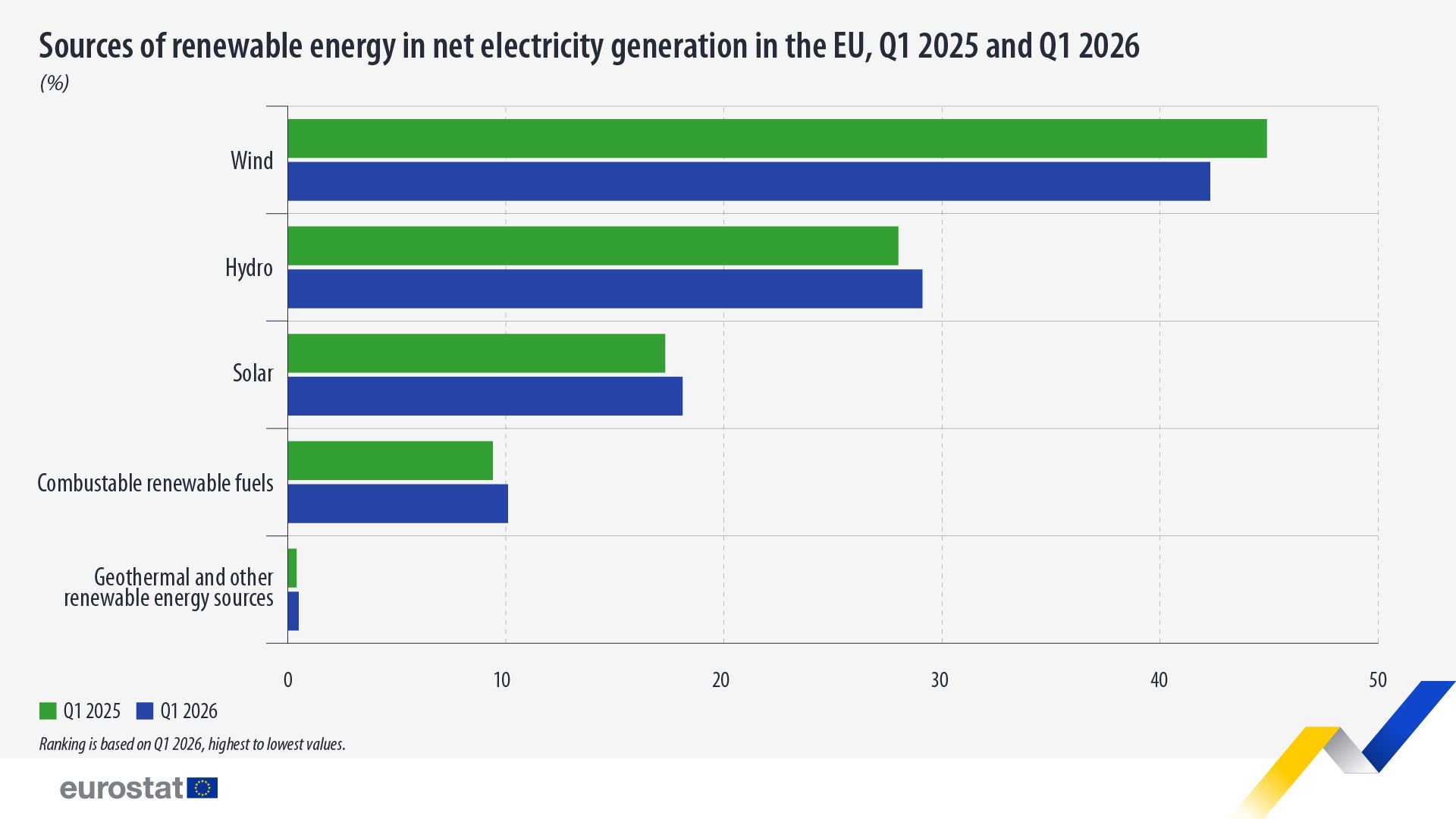
The share of electricity generation from renewable sources in the European Union continues to rise. According to Eurostat, in the first quarter of this year, renewables supplied 45.5% of the European power grid’s energy. Compared to the same period in 2025, this figure increased by 2.8%.
Wind power ranked first in generation, accounting for 44.9% of the total “green” volume. In the first quarter of 2025, this segment accounted for 42.3% of generation.
The top three also include hydropower (28%) and solar energy (17.3%). The share of renewable combustible fuels amounted to 9.4%, with geothermal and other sources making up 0.4% of clean generation.
Source: Eurostat
In terms of the share of “green” energy in total generation, Denmark leads (90%), followed by Portugal (82.9%) and Lithuania (75.7%).
At the bottom of the list are the Czech Republic, Malta, and Slovakia, with shares of 12.7%, 13%, and 17.2%, respectively.
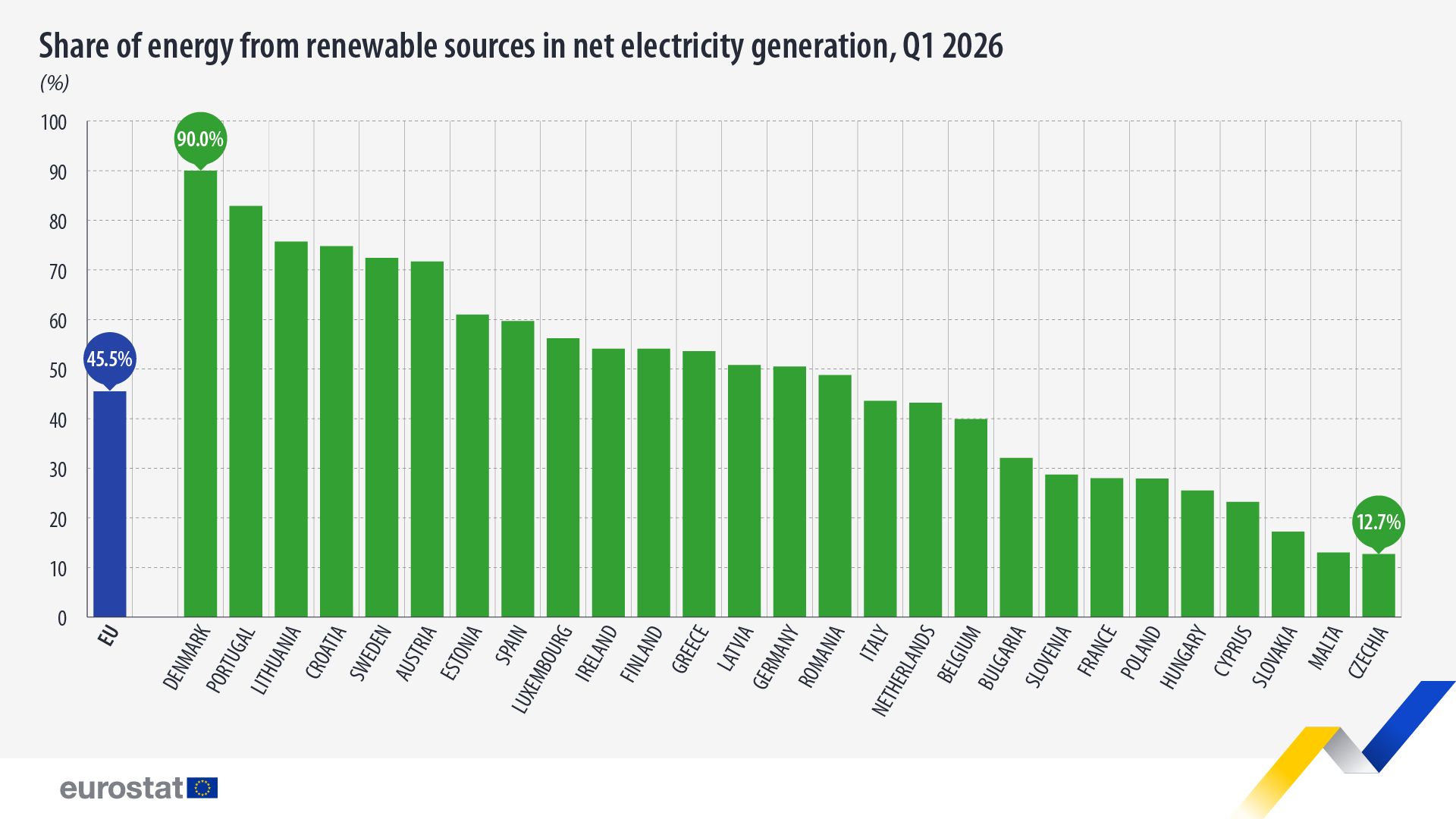
Source: Eurostat
Update to plastic bottle recycling regulations
At the same time, the EU continues to refine its policy on plastics. Recently, the European Commission announced the adoption of new rules for the recycling of single-use PET bottles. These rules are fairly universal and can be applied to various recycling technologies.
Overall, the new requirements clearly establish the methodology for calculation, reporting, and verification regarding the content of chemically recycled materials. The European Commission considers this step important for the investment security of the recycling sector and for creating transparent and fair market conditions.
While the mechanical method remains the primary one for clean plastic waste, chemical recycling is seen as an additional tool for more complex materials, particularly packaging with food residues or mixed components. This should help return more plastic into the production cycle and bring EU countries closer to achieving their targets for recycled content.
At the initial stage, only recycled materials from the EU and the European Economic Area, where their compliance with eco-standards can be fully verified, will be included in calculations. Starting from November 2027, the list will be expanded to include OECD countries and, in the future, other states, provided equivalent environmental requirements are met.
Killer heatwave
However, all of Europe's environmental and climate efforts cannot stop global warming here and now. The continent has once again been hit by a heatwave that has already claimed hundreds of lives and led to economic and political upheavals.
This episode is already being called the strongest in the entire history of observations. All-time high temperature records have been broken across the continent. Meanwhile, the heatwave is gradually moving eastward to the Balkans and Ukraine.
In a number of countries, the red alert level is in effect. For example, in Portugal, it has been declared until Sunday-with temperatures in some regions expected to remain at up to 44°C. In EU countries, some public events have been canceled, outdoor work has been prohibited, and rail traffic has been halted. In Berlin, people were sprayed with water cannons to help them cool down; in Paris, alcohol consumption was banned; in Belgium, the annual reenactment of the Battle of Waterloo was canceled.
France topped the list for heat-related deaths. The country’s National Public Health Agency recorded around 1,000 more deaths than expected since June 24. Most of the heat victims were people over 65 years old. The country was also shaken by the deaths of two children, aged two and four, in a locked car.
The public was so outraged by the authorities’ unpreparedness for the heat that the opposition Green Party decided to take advantage of the situation. Accusing Prime Minister Sébastien Lecornu of a deadly failure, they even threatened to introduce a vote of no confidence.
Over 1,000 additional deaths due to the heatwavewere also reported in Spain. This refers to the entire month of June 2026. The average temperature last month in the country was 3.2 degrees higher than normal.
Overall, Europe has proven to be quite vulnerable to high temperatures. Only one fifth of European homes are equipped with air conditioning, and a significant share of the housing stock was built to retain heat, not dissipate it.
Heat also provokes forest fires. This year, Spain has already lost 50,000 hectares of forest, and in Greece, a network of satellites and artificial intelligence is being deployed for continuous monitoring of the situation.