In Ukraine, the requirements for an environmental impact assessment (EIA) apply to a very wide range of facilities across various sectors that are being built, rebuilt or expanded. Consequently, this procedure applies both to companies launching new projects and to enterprises planning changes to existing sites.
So how should a business prepare for the EIA, what tasks should it entrust to a consultant, and how should it choose a service provider? Today, EcoPolitika will discuss the practical challenges of the procedure and the companies that help businesses navigate it.
At stake are the launch of the project, money and reputation: what does an environmental impact assessment entail?
Are you planning to build, expand or refurbish a business? If the project is subject to an environmental impact assessment, this must be taken into account in advance. Without a report approving the planned activities, you risk encountering obstacles when obtaining permits and commissioning the facility.
Environmental due diligence is also important when you are seeking funding. Banks, investors and international financial institutions assess not only a business’s profitability but also its environmental risks, particularly against ESG criteria. If a company fails to comply with mandatory environmental due diligence, it may be denied investment even if its financial performance is strong.
A high-quality report will help you understand in advance how the project will affect the environment and what measures need to be put in place to minimise harm. Implementing these measures can reduce the risk of non-compliance, fines and conflicts with the local community.
However, errors in documentation, failure to comply with legal requirements or a superficial environmental impact assessment could cost you extra months of work, unplanned expenses and delays to the launch. In more serious cases, the very feasibility of the project could be called into question.
However, if you have connections in the highest echelons of power, then the requirement to obtain an EIA report before construction begins does not apply to you. The most striking example is the construction of a wind farm on the Runa mountain pasture. Work began as early as the start of 2025, yet the project did not receive the Ministry’s approval until a year later — in February 2026. Despite widespread publicity, numerous petitions, appeals to the Ministry of Economy and the involvement of MPs, the construction of the wind turbines continued throughout this period.
Eco Wind Tovtry Ltd followed suit, having begun construction of a wind farm within the Podilski Tovtry National Nature Park this spring, without having obtained an EIA report.
It is very regrettable that reputable businesses may be refused an EIA report due to technical shortcomings and are forced to abandon their projects, whilst unscrupulous businesses begin work even without the necessary approved documentation.
The procedure for carrying out an environmental impact assessment is shown in the diagram:
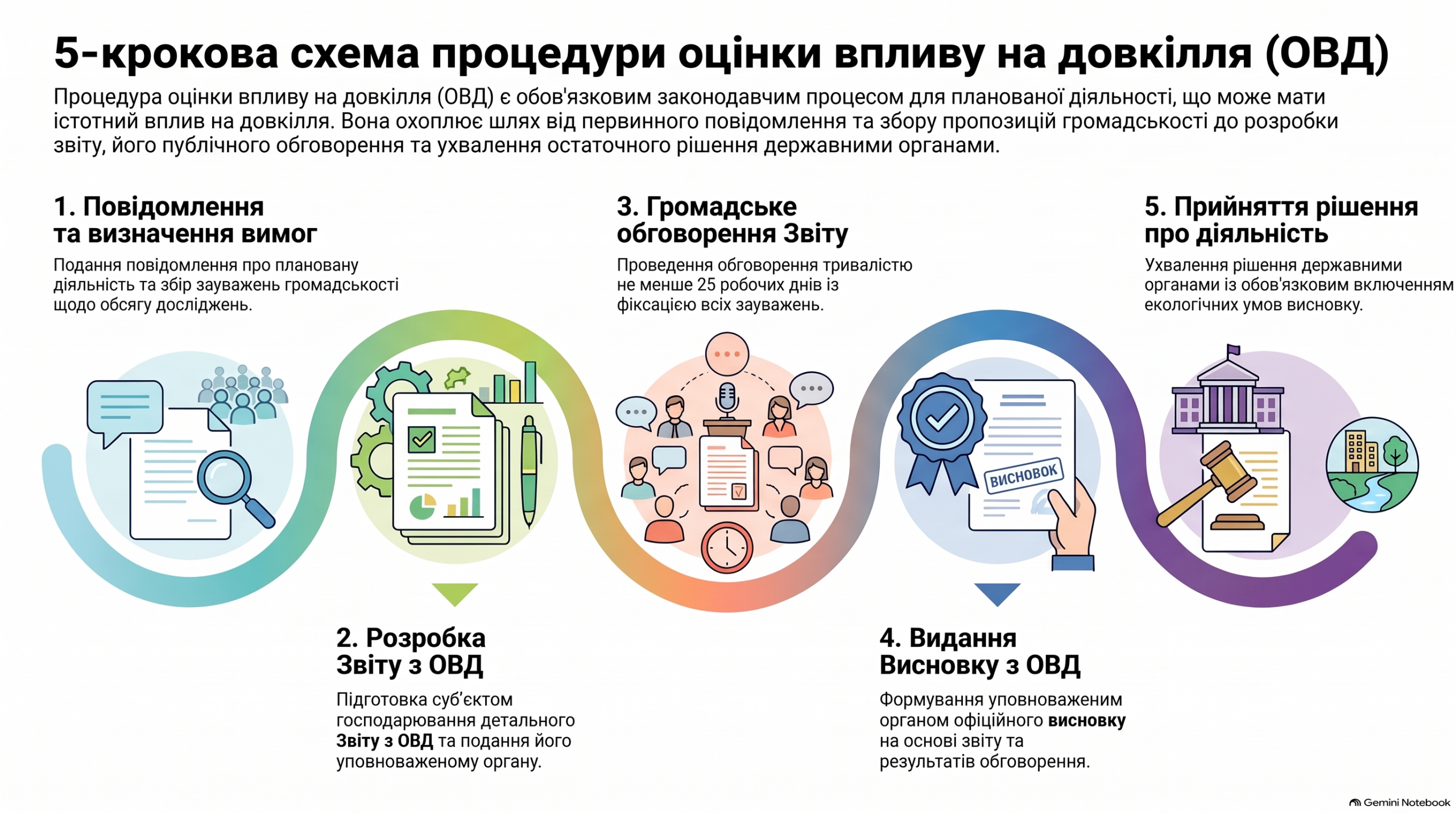
"Stumbling blocks" in the EIA procedure: where to expect them
We have previously highlighted the problems businesses face when undergoing EIA procedures. In their comments, company representatives and experts drew attention to the lack of clarity in the criteria for assessing reports, the unpredictability of decisions, and rejections due to technical shortcomings. In practice, this means a risk of additional costs and delays in project implementation for businesses.
At the same time, during our survey on necessary changes to the procedure, the experts were unanimous: the EIA should be retained, but significantly improved. Their proposals include clear grounds for rejection, proportionality of requirements in relation to the project’s impact, and the possibility of rectifying shortcomings without having to repeat the initial stages.
A whole range of issues with the EIA procedure have been highlighted not only by industry representatives and experts, but also by government officials. A year ago, the Audit Office conducted a compliance audit on the topic of ‘Environmental Impact Assessment’ and ‘Strategic Environmental Assessment — on the path to the “Green Transition”’. Officials noted that the EIA system is functioning, but has significant shortcomings in quality control, documentation and oversight.
The main obstacles to business
- Vague requirements and the decision being dependent on the official. When establishing the EIA procedure, legislators opened the door to widespread abuse from the outset by failing to set clear and transparent criteria for assessing reports, effectively leaving the decision — whether or not to issue an EIA conclusion — to the discretion of officials. Consequently, businesses cannot know in advance what scope of research will be sufficient, nor whether they will receive an EIA opinion after all the work has been completed. This complicates investment planning and creates risks of administrative pressure.
- Rejections due to technical shortcomings and the need to repeat the procedure. A technical inaccuracy may result in additional costs and a delay in the launch, even if there is no proven environmental risk associated with the project.
- Excessive or disproportionate requirements. If the scope of the procedure does not adequately reflect the actual level of impact, businesses spend time and money on an assessment whose complexity may be unjustifiably high for a particular site.
- A lack of source data and the difficulties of conducting research during the war. The inaccessibility of certain areas and gaps in environmental information make it difficult to prepare a well-founded report. For companies whose sites cannot be safely surveyed, this problem may prove decisive.
- The difficulty of defending against an unfounded refusal. Lengthy and costly legal proceedings do not provide businesses with a quick way to get a project off the ground.
It is important to realise that, whilst a qualified and experienced consultant will take the most thorough approach to preparing the documentation, they are powerless in the face of systemic problems with the procedure and current decision-making practices.
What can be delegated to a contractor and what remains the responsibility of the company
A consultant can take on a significant portion of the work: analysing documentation, organising research, engaging specialist experts, carrying out calculations and preparing a report. They can also assist with the submission of materials and monitor their consideration.
However, the client’s involvement is still essential. At the very least, three things are required of them:
- Provide the baseline data required to carry out an environmental impact assessment: information on technologies, equipment, raw materials, capacity and operating conditions.
- Approve documents for publication in the Register: the client’s staff must check whether the contractor has correctly described the planned activities and whether the parameters provided are in line with the design solutions.
We would like to emphasise that, pursuant to Article 6 of the Law of Ukraine ‘On Environmental Impact Assessment’, it is the enterprise itself that is responsible for preparing the report and for the accuracy of the information contained therein. Therefore, engaging an external contractor does not relieve the enterprise of this obligation and responsibility.
- Take part in the public consultation on the draft.
It is worth making a clear distinction between the roles of the consultant and the public authority. The contractor prepares the documentation and oversees the procedure, whilst the authorised body reviews it and issues its opinion. Therefore, if you are promised a guaranteed positive outcome, you should clarify exactly which obligations the contractor is prepared to set out in the contract.
What is included in the ‘turnkey EIA’ service?
Consultancy firms may define the scope of their comprehensive support services in different ways. To compare their proposals, it is worth obtaining a specific list of the services the provider offers.
It may include:
- registration of a company or sole trader in the Unified Register of Business Entities;
- analysis of the source documentation and identification of the required data;
- the preparation of a notification regarding planned activities, and the management of its submission and publication;
- the organisation of surveys, measurements and studies;
- impact assessments, evaluation of alternatives and the actual drafting of the report;
- preparing the notice of public consultation and assisting with the submission of materials;
- preparing presentations and taking part in public hearings;
- processing comments, preparing explanations and amending documentation;
- monitoring the processing of documents until the work is completed as specified in the contract;
- post-project monitoring.
It is worth clarifying separately whether laboratory tests, site visits, the involvement of external specialists and fees for public consultation have been included in the quotation. It is also necessary to agree on which documents and research results the client will receive.
Conducting business via the EIA: which companies can help with the process in Ukraine
At present, there is no single national register in our country of organisations that prepare environmental impact assessment reports, as this activity is not subject to mandatory certification. However, the Association of Environmental Professionals (PAEW) has introduced its own Register of Certified EIA Report Preparers. This register includes specialists who have completed the PAEW’s modular certification course and passed the qualifying examination.
EcoPolitika has identified publicly available offers from companies that state they prepare reports or provide support for EIA procedures. We list them here in alphabetical order. Please note that this list is not exhaustive. We have included only the largest companies that advertise their services on their own websites.
| Компанія | Фахівці присутні у Реєстрі PAEW |
|---|---|
| «Геологічна інвестиційна група» | Так |
| Група компаній «Екозахист» | Ні |
| «Еко Консалт Груп» | Так |
| «Екоменеджмент Групп» (EMGROUP) | Так |
| “Компанія Ліміт Плюс” | Ні |
| «Моноліт-Еко» | Так |
| «Науково-екологічний центр «Зелений квадрат» | Так |
| «НВП «Еконіс-центр» | Так |
| «НВП “Укргеологстром» | Ні |
| «НВП «Укрекопроект» | Так |
| «НВЦ «Запоріжгідропроект» | Так |
| «НВЦ «Техноекос» | Так |
| «НТВК «УКРАЇНА» | Так |
| «Український центр екології» | Так |
| «Укргеорозвідка» | Ні |
| «Центр зелених інновацій» | Так |
| «Центр Екології та Розвитку Нових технологій» | Так |
| «Центр Лтд» | Так |
| «MCL Group» | Ні |
| «SEC Ecology» | Ні |
How to choose a contractor to draw up an environmental impact assessment report and what to include in the contract
Before comparing prices, potential contractors must be provided with the same project description and source documents. Otherwise, one quotation may include research and follow-up on comments, whilst another may cover only the preparation of the report.
Next, there are a few questions that need to be clarified.
Experience in your sector
Ask them to list the projects in the open EIA register on which the contractor’s specialists have worked, and to explain their role in them. Experience with such projects will help you understand how familiar the team is with the technology and the specific factors affecting your type of production.
It is also worth looking at the comments on previous work: what issues arose during the review and how they were resolved.
The production team
It is important to know who will personally prepare the report, carry out the calculations and conduct specialist research. If some of the tasks are outsourced to subcontractors, it is necessary to establish who will verify their results and be accountable to the client.
Scope and completion of the work
The contract must specify when the contractor considers its obligations to have been fulfilled: upon submission of a report, submission of documentation, or completion of its review. If you expect ongoing support until a conclusion is reached, this must be expressly provided for in the contract.
It is also worth specifying the format for submitting documents, accounts and research materials.
Corrections and additional payment
A distinction must be made between the consultant’s correction of errors and new work arising from changes to the project. The terms of the contract must clarify who is responsible for paying for these, how additional cost estimates are agreed, and what happens in the event of materials being resubmitted.
Deadlines and communication with the client
It is advisable to attach a timetable to the contract. This should set out the contractor’s deadlines, the dates by which the company is to provide the source data, and the dates for the approval of documents.
It is worth agreeing separately on how the contractor will report on the progress of the work and any circumstances that might affect the schedule. This will enable the company to adjust its own plans in good time.
How much does an EIA cost and how long does it take?
The financial costs of carrying out this procedure in Ukraine comprise two main items:
- mandatory payment to the state for public consultation — varies between 15,876 UAH and 12,6730 UAH and depends on the category of the planned activity and the area of the enterprise’s impact;
- The commercial cost of preparing the EIA report and providing project support — is determined by the market rates charged by environmental consultancy firms.
There is no standard price for environmental impact assessment support. Experts determine the cost of this service on a case-by-case basis for each project. It depends on the scale of the impact of the planned activity (one region, several regions, or cross-border), the complexity of the project, the scope of the necessary research, the size of the project and the need for additional expert assessments. A rough estimate is from 100,000 UAH, but it is usually several times higher.
Consultancy firms indicate a very wide range for the duration — from 3 months to 2 years (if seasonal research and cross-border assessment are required).
Both figures are influenced by the scale and location of the project, the complexity of the technology, the availability of source data, the scope and seasonality of the research, and the need for further refinement of the documents. Therefore, the specific budget and timelines must be finalised once the contractor has familiarised themselves with the project.