Rio Tinto, Vale and BHP are major steel and mining companies with significant greenhouse gas emissions, totaling more than 1,508 million tonnes of CO2 equivalent.
Experts analyzed the total emissions of greenhouse gases of the largest companies in the industry in the world by their income in 2021, reports GlobalData.
It is becoming increasingly important for major industries to record emissions, as the International Council on Mining and Metals (ICMM) has committed to achieving zero Scope 1 and 2 emissions by 2050.
Rio Tinto has some of the largest greenhouse gas emissions and revenues of $63,495 million in 2021. Rio Tinto's total greenhouse gas emissions were 584.6 million tonnes of CO2-equivalent (Mt CO2-eq), while Scope 3's emissions were 553.5 million tonnes of CO2-eq. This represents 94.7% of Rio Tinto's total emissions in 2021. The company aims to reduce Scope 1 and 2 emissions by 50% by 2030.
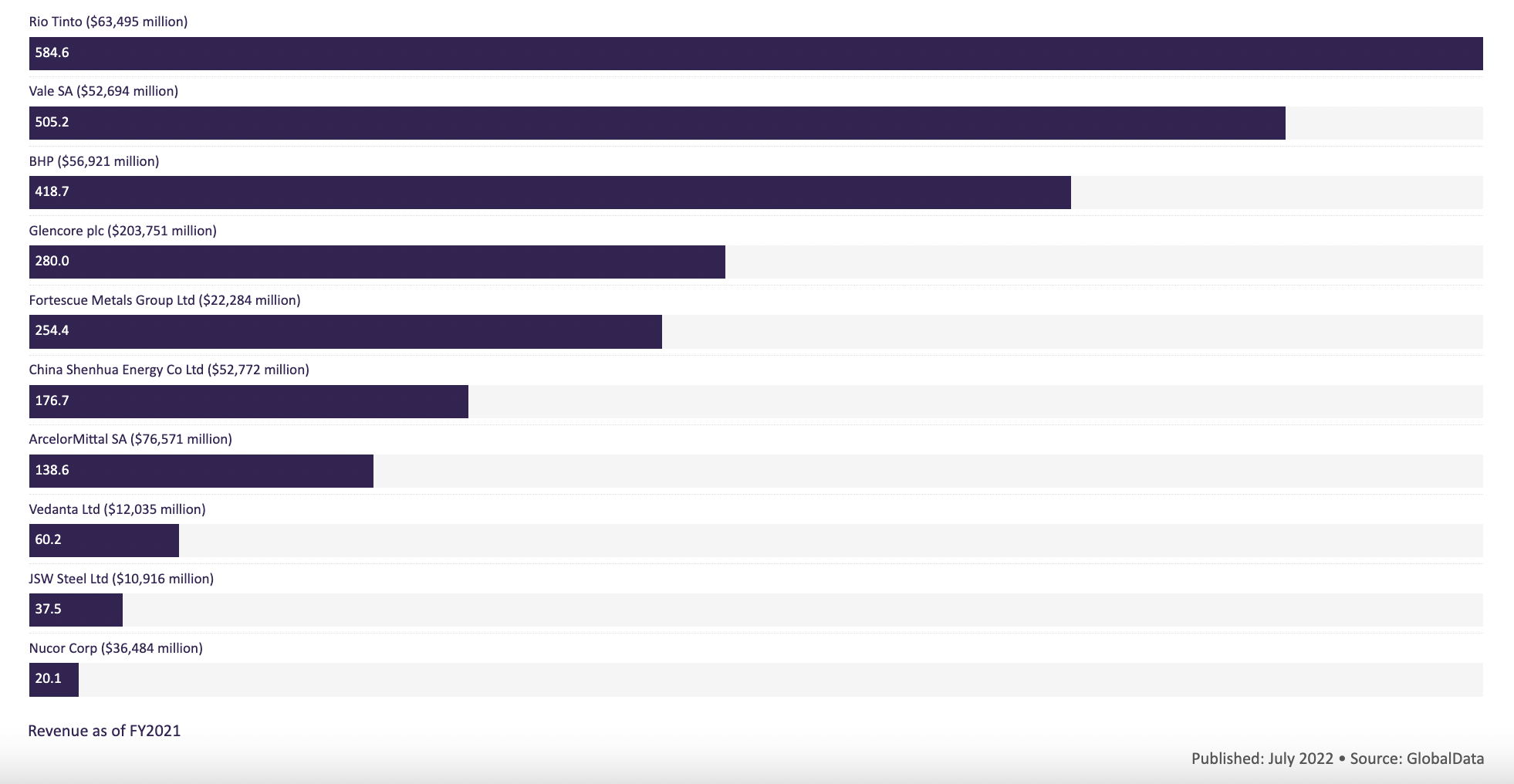
Total greenhouse gas emissions by major metallurgical and mining companies worldwide by revenue (2021, Mt CO2 eq.)
Vale is one of the largest emitters of greenhouse gases with revenue of $52,694 million in fiscal year 2021. Its total company GHG emissions were 505.2 Mt CO2-eq, with Scope 3 emissions predominating (98% of total GHG emissions). The company has set a goal of reducing Scope 1 and 2 emissions by 33% by 2030 and reducing Scope 3 emissions by 15% by 2035.
Natural resources company BHP had fiscal 2021 revenue of $56,921 million. Its total greenhouse gas emissions were 418.7 Mt CO2-eq, with the majority of total emissions coming from Scope 3 emissions. The company's goal is to reduce operational emissions by at least 30% by 2030 compared to the 2020 level. The company has set a long-term goal of achieving zero net operational emissions by 2050.
Greenhouse gas (GHG) emissions are one of the main causes of global warming, and the metallurgical and mining industry accounts for between 4% and 7% of global greenhouse gas emissions. A significant amount of greenhouse gases emitted from the use of fuel, electricity, etc., include CO2, methane and nitrogen oxides.
Classification of greenhouse gas emissions:
- Scope 1 is direct GHG emissions from assets managed by the company, such as fuel use, industrial processes and other secondary sources;
- Scope 2 – indirect GHG emissions, which take into account emissions from purchased or purchased electricity;
- Scope 3 – other indirect emissions of companies, which, in addition to direct activities, occur in the company's value chain, in particular, business trips, use of products and leased assets.
Earlier, EcoPolitic wrote, given that steel production accounts for at least 7% of global carbon emissions, now the pressure is intensifying on the industry to decarbonise.
As EcoPolitic previously reported, in the EU they developed a transparent methodology for the disaggregation of emissions and estimates of the emission intensity of specific production routes and process stages.