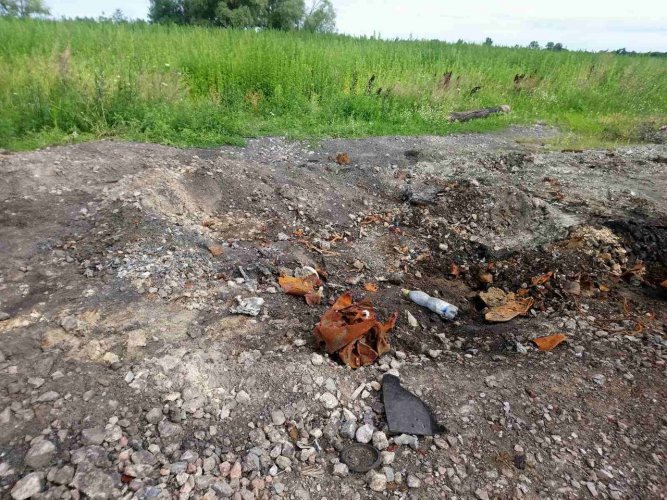
In Ukraine, the cost of surveying lands with a high risk of mine contamination and demining the affected territories, according to preliminary calculations by the Kyiv School of Economics (KSE), is estimated at $436 million.
The cost of further reclamation of lands with a damaged fertile soil layer may reach $39.6 million and last decades, reports ZN.UA.
It was noted in the material that quick and cheap amateur restoration of land plots without a scientific basis, in particular the wrapping of ravines, can lead to even more negative consequences. After all, the violation of the structure of the soil cover and the hydrological regime can lead to the acceleration of the processes of erosion and further degradation.
However, even before the full-scale war, Ukraine had a huge amount of land suffering from degradation due to intensive farming. That is why it is important to carefully survey and monitor damaged lands.
The director of the Institute of Soil Science and Agrochemistry, Svyatoslav Balyuk, noted that there is no full-fledged laboratory for the assessment of all soil pollutants in Ukraine at scientific institutes. Therefore, the scientific support of the leading countries will be necessary.
The most effective methods of land restoration are conservation, i.e. removal of land from economic use. Perennial grasses and trees are planted on such lands or the process of renaturalization is carried out, i.e. a gradual return to the natural state.
Soil recovery is a long-term process, because the natural rate of recovery of the fertile layer is one centimeter per hundred years.
"In agrarian Ukraine, this strategy seems unlikely, but at least partially, in certain regions most prone to erosion and degradation, conservation is necessary," the article says.
Also, damaged lands will lead to climate change. Soil retains carbon, which when damaged is released into the atmosphere and exacerbates the climate crisis.
Before the full-scale war, Ukraine was among the world leaders in terms of the rate of destruction of agricultural land with victorious 78.2%.
It was noted in the message that Ukraine's recovery plans include projects for systematic monitoring of soil conditions and conservation of polluted and degraded lands, which are currently being discussed in working groups under the Ministry of Agriculture and the Ministry of the Environment.
"Even before the full-scale war, the government of Ukraine expressed its readiness to preserve lands that were already degrading. Currently, it is absolutely impossible to do without it, having preserved the lands that were most affected by the war," the article noted.
The authors also emphasized that the condition of the soil is important for ensuring food security not only now, but also in the future, as well as for the ecological security of citizens and adaptation to climate change.
Earlier, EcoPolitic wrote, that a preliminary assessment of the impact of the war in Ukraine on the ecological situation showed that war is literally toxic, and future generations will live with a toxic legacy.
As EcoPolitic previously reported, 58% of Ukrainian soils due to climate change and Russian military aggression undergo degradation, which can lead to significant environmental and social problems.