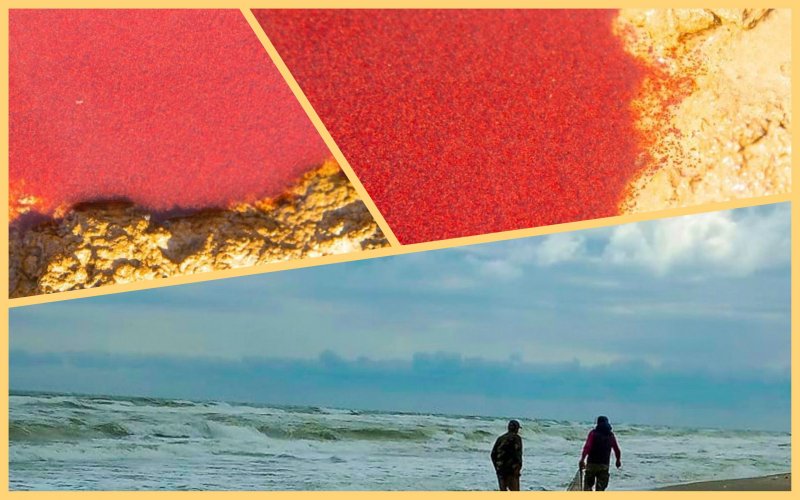
In Odesa, on the territory of the national natural park "Tuzlivski lymani", the Burnas estuary has become bright red.
The cause of this phenomenon was the reproduction of tiny crustacean daphnia, writes biologist Ivan Rusev of the "Tuzlivski lymany" NPP on Facebook.
He explained that daphnias have a unique nature. Thus, during the summer period, their population consists of females that reproduce without fertilization. When environmental conditions change, males emerge from parthenogenetic eggs.
"These changes can be different: the water temperature decreases, the daylight hours become shorter, there is little food, predators that feed on daphnia appear, there are too many daphnia in the reservoir. The male needs daphnia to survive all these difficulties," the biologist said.
He also added that after fertilization by males, very dense "winter eggs" are formed, which can survive freezing, drying up of a pond and even space travel.
These unique animals are common in arid steppe and desert areas with salt water.
Such large clusters of daphnia form at the end of August and at the beginning of September. These colonies look red due to the pigment in their blood - hemoglobin, which is similar to human blood.
As EcoPolitic reported earlier, in Odesa in the national natural park "Tuzlivski lymani" unique small protected lakes of Academician Yuvenalia Zaitsev have dried up.