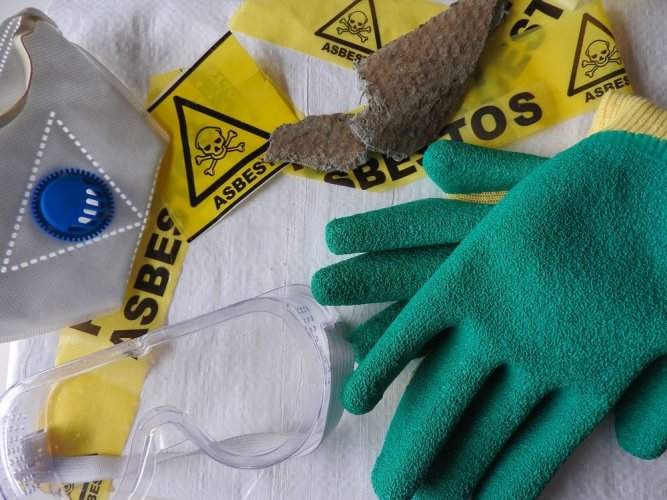
The Ministry of Ecology, together with international and national experts, is developing rules for managing waste containing or contaminated with asbestos.
This was reported by the Ministry of Environmental Protection and Natural Resources of Ukraine.
The rules include:
- a map of places where waste can be found;
- plans for their treatment, inspection, transportation, and destruction;
- control and monitoring mechanisms by the authorities.
It is believed that about 70% of the roofs of Ukrainian buildings are covered with corrugated asbestos-cement boards containing chrysotile asbestos.
It is not the asbestos products themselves that are harmful, but the small fragments and dust that are formed when they are destroyed. Most countries in the world have abandoned the use of asbestos.
In 2022, the Verkhovna Rada adopted Bill No. 4142 on public health, which, among other things, bans the use of asbestos in construction.
It should be noted that the legislation in the field of waste management is being gradually updated in Ukraine. In particular, the Ministry of Environment has created a new National List, which includes 20 groups and 895 types of waste. In the list, both waste classes and terminology meet EU requirements
The classifier differs from the European classifier by the presence of the category "Waste generated in connection with the damage (destruction) of buildings and structures as a result of hostilities, acts of terrorism, sabotage or carrying out work to eliminate their consequences."
Among these wastes are those that contain asbestos, and they require a special approach in both dismantling and disposal in order to reduce their impact on human health and the environment.
Currently in Ukraine, asbestos-containing waste is disposed of in landfills together with household waste, which is covered with a layer of soil to avoid spraying of small particles. However, according to European standards, there should be a separate disposal procedure for such waste at special landfills or sites, and the waste itself should be transported only in packaged form.
In the EU, there are rules for planned dismantling, which first determine whether there are asbestos materials and products, and then carry out a special procedure for their removal.
Management of asbestos-containing demolition waste requires special approaches based on European practice. This includes screening and risk assessment, laboratory analysis, development of asbestos management plans, remediation and verification, as well as the establishment of a system for measuring and interpreting data.
As Ecopolitics previously reported, the Global Compact Network in Ukraine called on the Verkhovna Rada to fulfill two European integration commitments: to completely ban the use of asbestos and to adopt the draft law No. 2207-1D "On Waste Management".