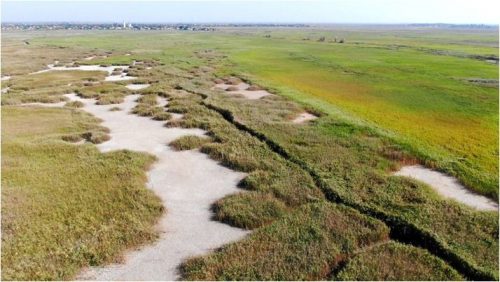
The Kakhovsky reservoir has turned into a solid desert

The Kakhovsky reservoir has turned into a solid desert shutterstock
Katerina Belousova

Deep cracks formed at the bottom

After the explosion of the hydroelectric power station, the water completely disappeared in the Kakhovsky Reservoir and it turned into a solid desert.

At the bottom of the former reservoir, stumps from the former collective farm garden, which were cut down in 1951 before flooding, are visible, NV reports in Telegram.

Kherson journalist Serhii Nikitenko filmed what the reservoir looks like now.

He said that the layer of sediment, the so-called silt, is not large, about 20 cm. Also, deep cracks formed at the bottom.

Nikitenko explained that the former reservoir was inspected to assess the possibility of supplying water to the town of Novovorontsovka in the Kherson region. After all, there are problems with water in the community.

"We are the first to walk here in the last 70 years, and you are the first to see the floodplain," he said.

Earlier, EcoPolitic wrote, that in the Kakhovsky Reservoir after the detonation of the hydroelectric power plant near the occupied Energodar the water has completely disappeared, and the territory turned into a desert. According to experts, there is currently no threat to Zaporizhzhya NPP.

Earlier, EcoPolitic spoke with the head of the ecomonitoring committee of the PAEW Association of Environmental Professionals, Maksym Soroka, regarding complex consequences for the environment from the Kakhovskaya HPP disaster.


Related
Fire causes nearly 15 billion hryvnias’ worth of damage: environmentalists detail the damage at the Danube Nature Reserve

The fire destroyed over 1,000 hectares of a unique floodplain ecosystem

Once every five years: due to the war, the pink flamingos in the Odesa region are not breeding

The birds are being scared off by constant explosions and drones flying overhead

Ukrainians should learn to conserve drinking water — says a scientist

Cities need to adapt to the new circumstances, in particular by building rainwater storage facilities

The authorities will address the issue of waste resulting from the destruction of warehouses and retail premises

The document will set out the procedure for identifying and inspecting such sites, as well as for determining locations for temporary storage