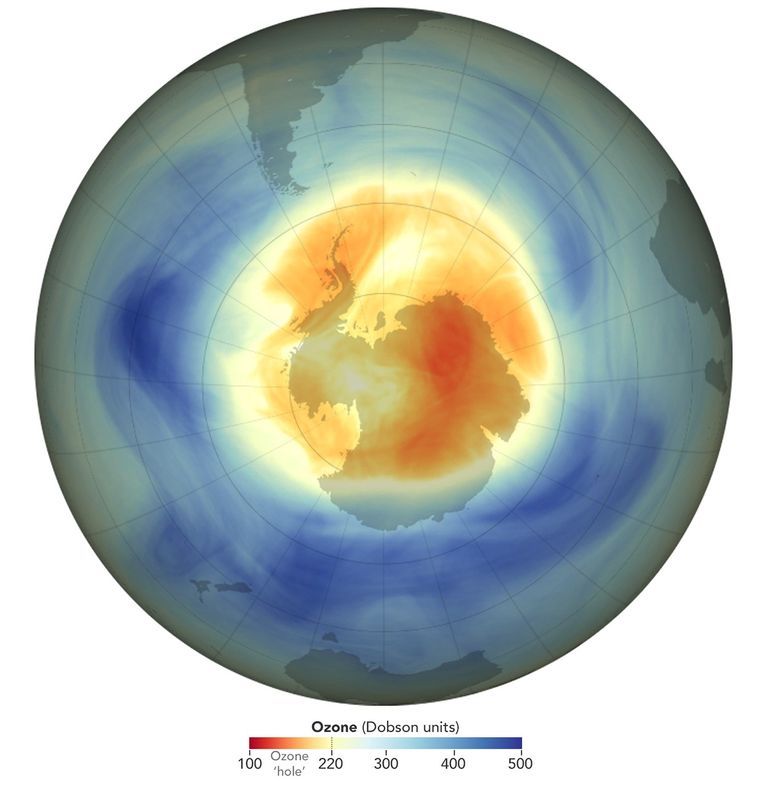
The hole in the planet's ozone layer is gradually recovering. According to NASA research, in 2025, its size became one of the smallest since 1992.
NASA predicts that at the current rate, the planet's protective layer will be fully restored by the end of the 2060s.
The ozone hole is now twice the size of the continental United States, covering 18.7 million km2. It reached its largest size on September 9, covering 22.9 million km2. However, even this peak value is 30% smaller than the largest hole in recorded history, which was recorded in 2006.
“As predicted, we are seeing a trend towards smaller ozone holes compared to the early 2000s. They are forming later in the season and dissipating earlier. But we still have a long way to go before it recovers to the 1980s levels,” said Paul Newman, leader of the ozone research group at NASA’s Goddard Space Flight Center.
Source: science.nasa.gov
Why does humanity need the Earth's ozone layer?
The layer with a high concentration of ozone is located in the stratosphere. It acts as a kind of sunscreen for the planet, blocking a significant portion of ultraviolet radiation.
This type of radiation in large quantities is extremely harmful to all living things. Its effects include damage to plant crops and skin cancer in humans.
What destroys the planet's protective layer
Man-made substances containing bromine and chlorine cause the destruction of ozone molecules. Under the influence of ultraviolet radiation, the substance itself is destroyed, chlorine and bromine are released, and chemical reactions begin that destroy the molecular bonds in O3.
The main source of these deadly compounds are substances from air conditioners, refrigerators, and aerosols. They were once used quite widely, but in 1987, their use was restricted by the Montreal Protocol. The document came into force on January 1, 1989.
Slow-acting "poison"
Even a complete ban on the use of bromine- and chlorine-containing compounds cannot restore the ozone layer instantly. These substances remain in the atmosphere for decades.
At the same time, significant reserves of compounds harmful to atmospheric ozone have not disappeared anywhere. They are found in building insulation and in landfills around the world.
However, emissions of these substances are gradually decreasing, so in about 40 years, at the end of the 2060s, we can expect the ozone holes to disappear completely.
EcoPolitic previously reported that Ukraine is preparing to ratify the Kigali Amendment to the Montreal Protocol. It provides for a phased reduction in the production and consumption of hydrofluorocarbons (HFCs).
EcoPolitica previously reported that Ukraine continues to prepare for the ratification of the Kigali Amendment to the Montreal Protocol. It provides for a phased reduction in the production and consumption of hydrofluorocarbons (HFCs).