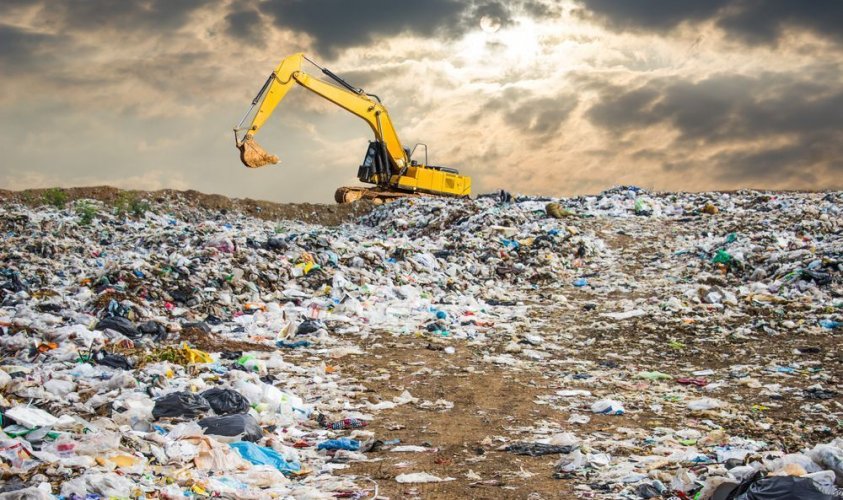
The amount of generated solid household waste by 2050 can almost double, and the cost of handling them will become uncontrollable and exceed $640.3 billion.
This is stated in the UN Global Waste Management Forecast, published jointly with the International Solid Waste Association (ISWA).
This study provides an update on global waste generation and expenditure and management since 2018.
Solid household waste generation is projected to rise from 2.1 billion tonnes in 2023 to 3.8 billion tonnes in 2050.
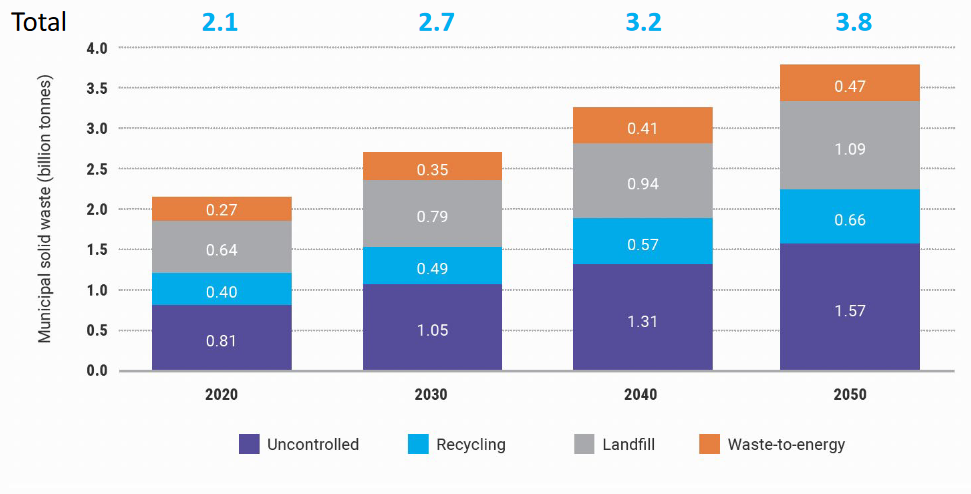
Source: unece.org.
In 2020, the global direct costs of waste management were estimated at $252 billion. When the hidden costs of pollution, health deterioration and climate change caused by poor waste disposal practices are included, the cost rises to $361 billion.
If urgent waste management measures are not taken, these global annual costs could nearly double to a staggering $640.3 billion by 2050.
Experts investigated the factors that affect the amount of generated waste. They found that consumption growth due to higher incomes has twice as strong an impact on waste generation as population growth.
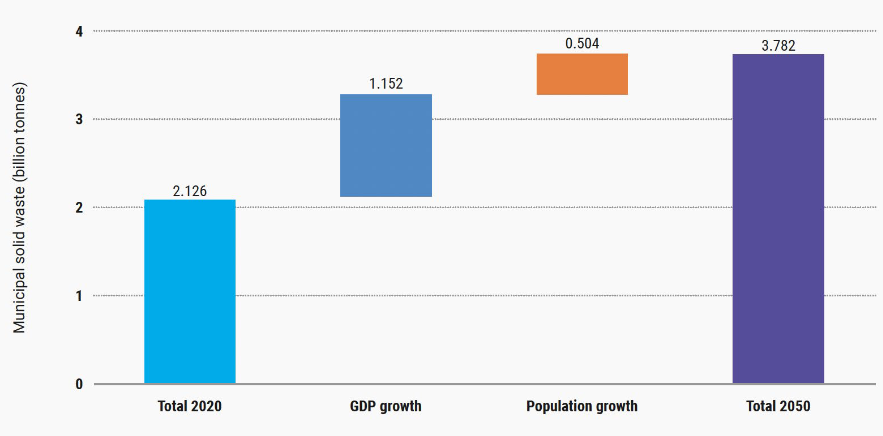
Source: unece.org.
Higher-income countries generate more waste per capita, meaning economic growth and waste generation remain closely linked:
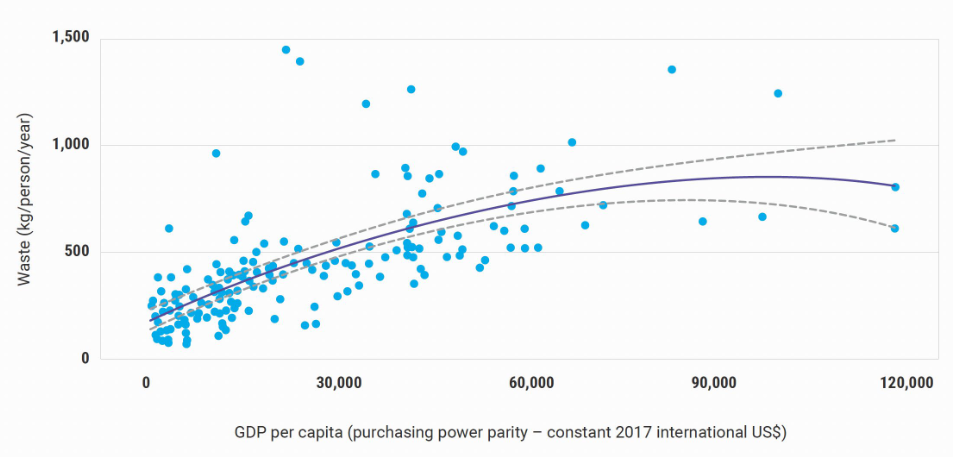
Source: unece.org.
The authors of the document investigated what the world could gain or lose in the following three scenarios:
- Continuing to act in the usual way.
- Taking half measures.
- Fully transitioning to zero-waste societies and circular economies.
The results obtained regarding the increase or decrease of the negative impact are clearly displayed in the following graph:
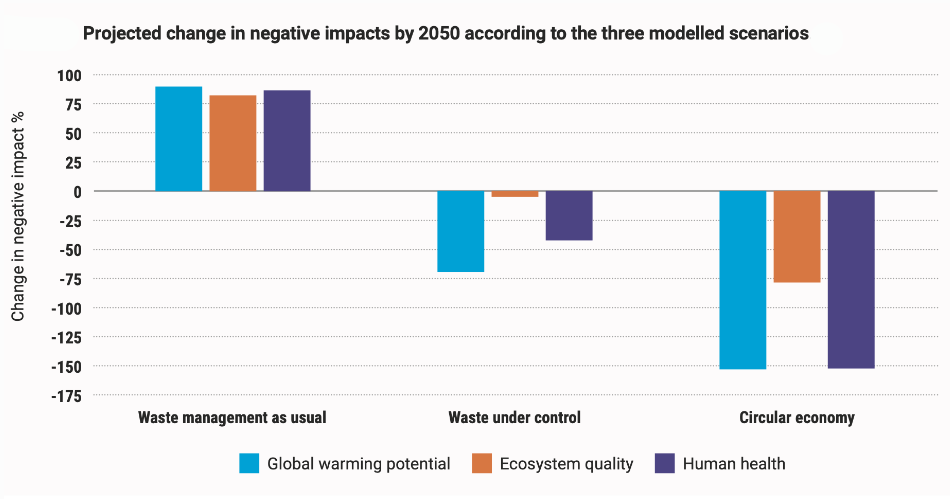
Source: unece.org.
In the first scenario – business-as-usual waste management – the negative impact almost doubles by 2050.
In the second scenario – where waste is partially under control – small positive improvements occur.
In the third scenario – in the case of the introduction of a circular economy – the improvement occurs even in comparison with the base level of 2020.
Modeling in the report shows that bringing waste under control through waste prevention and management measures could limit net annual costs to $270.2 billion by 2050. However, projections show that a circular economy model in which waste generation and economic growth combined through waste avoidance, sustainable business practices and total waste management, could actually result in a net profit of $108.5 billion per year.
Researchers are convinced that for a livable future, it is urgent to stop the current model of linear use of resources and implement zero-waste and circular economy strategies. According to the researchers, the materials should be used as long as possible and with the maximum return. Recyclability and accountability also need to be improved. Crime related to waste should decrease.
“Urgent changes are needed to prevent waste costs from spiraling out of control. All stakeholders – public, private and civil society – must work together to reduce waste, reduce its complexity and reduce the leakage of legacy pollutants into the environment,” they say.
Earlier EcoPolitic wrote that according to Anum Sheikh, a political analyst at the Cambridge Institute for Sustainable Leadership, the EU is far from achieving its goal – double the level of circularity until 2030.