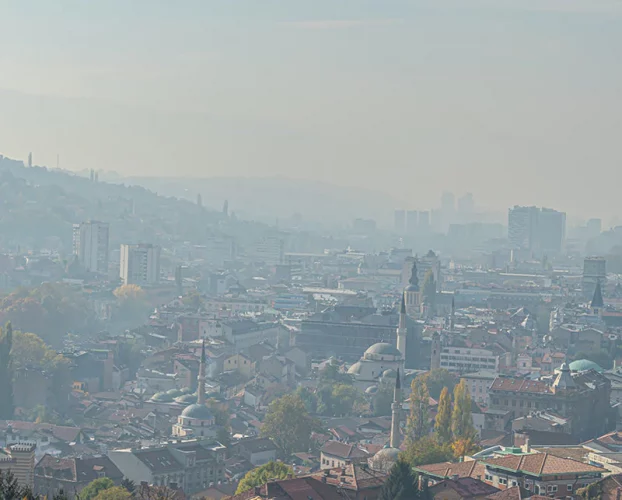
Since May this year, Europe has been facing the most severe heatwave in recorded history. In some countries in the west and south of the continent, temperatures have risen to 42°C. This consequence of climate change, in addition to its devastating impact on nature, health and the economy, directly exacerbates environmental pollution.
IQAir explains how this works.
What are heatwaves and how do they form?
A heatwave is a period of extremely high air temperatures. Sometimes the heat can be combined with high humidity.
Although Europe most often suffers from this phenomenon in summer, it can occur at any time. A heatwave begins with a high-pressure system. It acts like an invisible dome, trapping the heated air close to the surface.
During such periods, there are usually no clouds or wind, allowing the sun to heat the ground unhindered. The stagnant air prevents the heat from dissipating.
Consequently, the longer the high-pressure dome persists, the higher the temperature rises.
Connection to pollution
The physics of a heat wave itself contributes to air pollution. Specifically, the following mechanisms are involved:
- atmospheric stagnation. The absence of wind and “conservation” of air inhibits the dispersion of pollutants. As a result, industrial emissions, exhaust gases, and smoke remain close to the ground, where people breathe them in;
- catalyst for chemical reactions. Intense sunlight combined with heat accelerates ozone formation, which is a major component of smog;
- promotion of new emissions. Dryness and heat dehydrate soils, creating ideal conditions for dust storms and wildfires. These, in turn, saturate the air with fine particulates PM2.5 and PM10.
Painful synergy
The combination of heat and pollution poses a significant threat to human health. The highest risks are faced by the following groups: children, the elderly, pregnant women, athletes, people working outdoors, the sick, and those without air conditioning.
Fine particulate matter PM2.5 is a microscopic pollutant that can enter the bloodstream and internal organs. It is associated with the onset of cardiovascular and respiratory diseases. Heat only accelerates these harmful effects.
In the short term, such a combination can worsen respiratory insufficiency, lead to heat stroke, and even cardiovascular overload. In the long term, this impact may cause chronic lung disease, decrease cardiovascular function, or even premature death.
EcoPolitic reported that the latest heat wave caused thousands of deaths in the European Union. It is also associated with an increase in the scale of wildfires, for the containment of which countries are compelled to call in rescuers from neighboring states.