The cost of energy from renewable sources in 2025 showed uneven trends. Due to economic and political factors, solar and wind generation became more expensive, but battery prices reached a historic low. Batteries are essential for stabilizing clean energy systems and reducing dependence on fossil fuel power plants.
This is evidenced by an analysis by BloombergNEF.
Analysts note key challenges in the development of renewable energy, such as geopolitical changes, supply chain disruptions, and higher financing costs. However, according to BNEF, balanced electricity production costs will still fall significantly by 2035:
- by 30% for solar energy;
- by 25% for battery storage;
- by 23% for onshore wind;
- by 20% for offshore wind.
Battery prices are at an all-time low
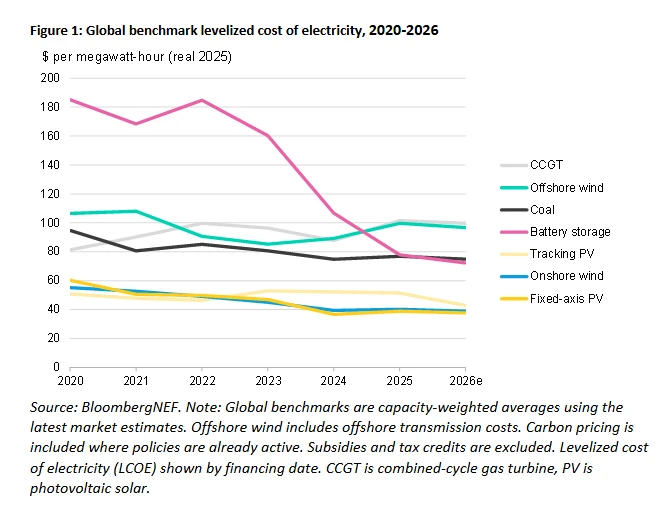
BNEF began tracking prices in this segment in 2009. Since then, 2025 has shown a record low. For a four-hour battery project, the cost of 1 MWh of energy was $78, which is 27% lower than in the previous year, 2024.
Analysts cite the following reasons for the fall in prices:
- cheaper battery modules;
- increased competition among manufacturers;
- improved system solutions.
In turn, the decrease in battery costs has accelerated the development of combined projects in the renewable energy sector. Specifically, during 2025, 87 GW of solar generation capacity with storage was commissioned. The cost of 1 MWh of energy for such projects averages $57.
For comparison, analysts provide 2025 prices per 1 MWh of energy for different types of renewable energy: $39 for standard PV plants (+6%), $40 for onshore wind (+2%), $100 for offshore wind (+12%).
“As costs continue to fall, we expect battery storage to strengthen revenues from solar projects, support greater deployment of renewables, and accelerate the shift towards balancing systems based on energy storage rather than fossil fuel-based peaking capacity,” said Amar Vasdev, lead author of the report and senior energy economics associate at BloombergNEF.
Source: BloombergNEF
Fossil fuel-based generation is becoming more expensive
The cost of electricity from combined cycle gas turbine plants showed annual growth of 16%. Thus, 1 MWh of energy from this type of generation reached a record high of $102, primarily due to the global increase in equipment prices.
In the near future, according to BNEF projections, the cost of gas generation will also remain high. Analysts attribute this to the rapid expansion of data center networks.
Regional differences in wind energy prices
Цhina retains its price advantage in this segment. Outside of China, in 2025, generation costs decreased by 4%. However, due to colossal wind projects in the People’s Republic of China (PRC) located in regions with weak wind, the average global price indicator increased by 2%. In offshore energy, prices actually rose by 12%. The main reason for this is supply chain constraints.
In the United States, for the first time since 2023, wind generation has become cheaper than gas-fired generation. This is primarily due to high demand for gas equipment to power data centers, which led to higher prices for such equipment. This opens a window of opportunity for renewables in the US-combined solar power plants (SPP) with four-hour storage systems can cover a significant share of data centers’ electricity consumption at a lower cost than gas. Meanwhile, in the solar-rich states, notably California and Texas, solar power generation is even more competitive.
“New solar power plants are already undermining new coal or gas projects in nearly all Asia-Pacific markets, while wind has displaced gas as the cheapest source of new generating capacity in the US and Canada. Solar power consistently outperforms fossil fuel alternatives in Southern Europe, and wind does so in Northern Europe,” adds a BloombergNEF analyst.
EcoPolitic previously reported that China is ramping up new wind and solar capacities faster than all the Group of Seven countries combined. The total capacity of its new projects amounts to 1,500 GW, compared to 520 GW across the seven most developed economies.