Miscanthus is a three-meter-tall herbaceous perennial from Africa and Asia. But its popularity today is not due to its decorative properties. This plant is bioenergetic, so it has attracted the attention of all supporters of the "green transition." It is grown in Europe, and the first fields are already appearing in Ukraine.
DW explains the energy "magic" of this plant.
From experiments to widespread use
The Institute of Bioenergy Crops in Kyiv began heating its building with miscanthus 15 years ago as an experiment. For this purpose, plants of the "Prometheus" variety are grown on a local plantation.
"When the Institute decided to switch to biofuel, we saved three times as much as we would have with gas heating. Today, if we compare the cost of gas for budgetary institutions, the savings are about 1.7–1.8 times," said Alexander Ganzenko, a representative of the Institute.
The scientific institution is convinced that heating with miscanthus pellets can be used on a large scale in Ukrainian communities.
European experience
Miscanthus fuel is considered carbon neutral: plants absorb more carbon dioxide than is released into the atmosphere after they are burned. This has attracted the interest of European Union countries.
The largest areas of this plant-based bioenergy crop are in Germany, Ireland, Great Britain, and France. However, due to a lack of low-yielding land, they prefer to import it, including from Ukraine.
Ukrainian miscanthus fields
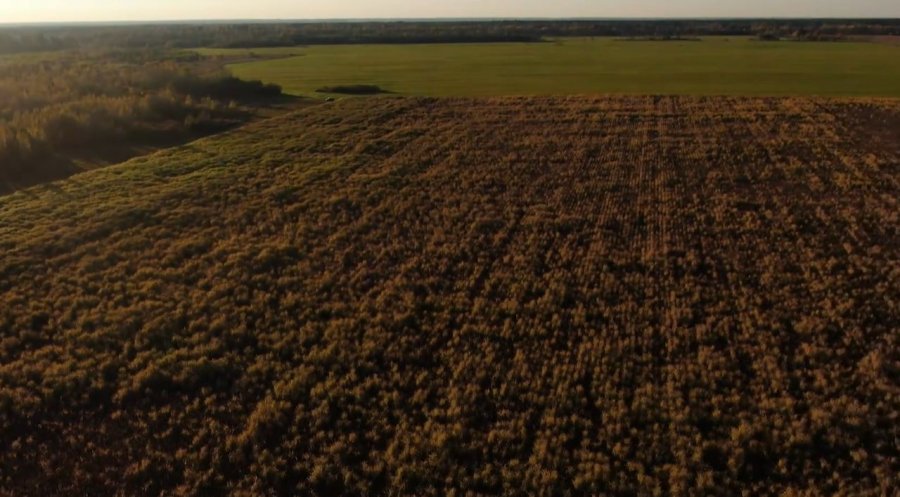
Up to 80% of the production of one of the agricultural enterprises in the Zhytomyr region is exported. Despite the full-scale invasion in the spring of 2022, Vadym Krychkovsky planted miscanthus on a 65-hectare field. Now the grass covers more than 200 hectares, making the farm one of the largest plantations in Ukraine.
"Three years ago, everyone smiled and said that nothing would come of it. But today, there are real customers all over Ukraine, primarily to supply their own production. Ukrainian agricultural holdings are now paying attention and calculating the transition to this crop for heating their factories," Vadym Krychkovsky, co-founder of Miscanthus Technology LLC, told DW.

Photo: DW
The potential of a miracle plant
After harvesting, pellets or chips are made from dry tops. When burning one ton of miscanthus, 20% more energy is released than from the same weight of wood. In terms of gas, one ton of miscanthus can replace the energy from burning 500 cubic meters of gas.
Miscanthus does not need fertile soil. On the contrary, it thrives on depleted land. And in the process of its plant life, it saturates the soil with organic residues and adds useful substances to it.
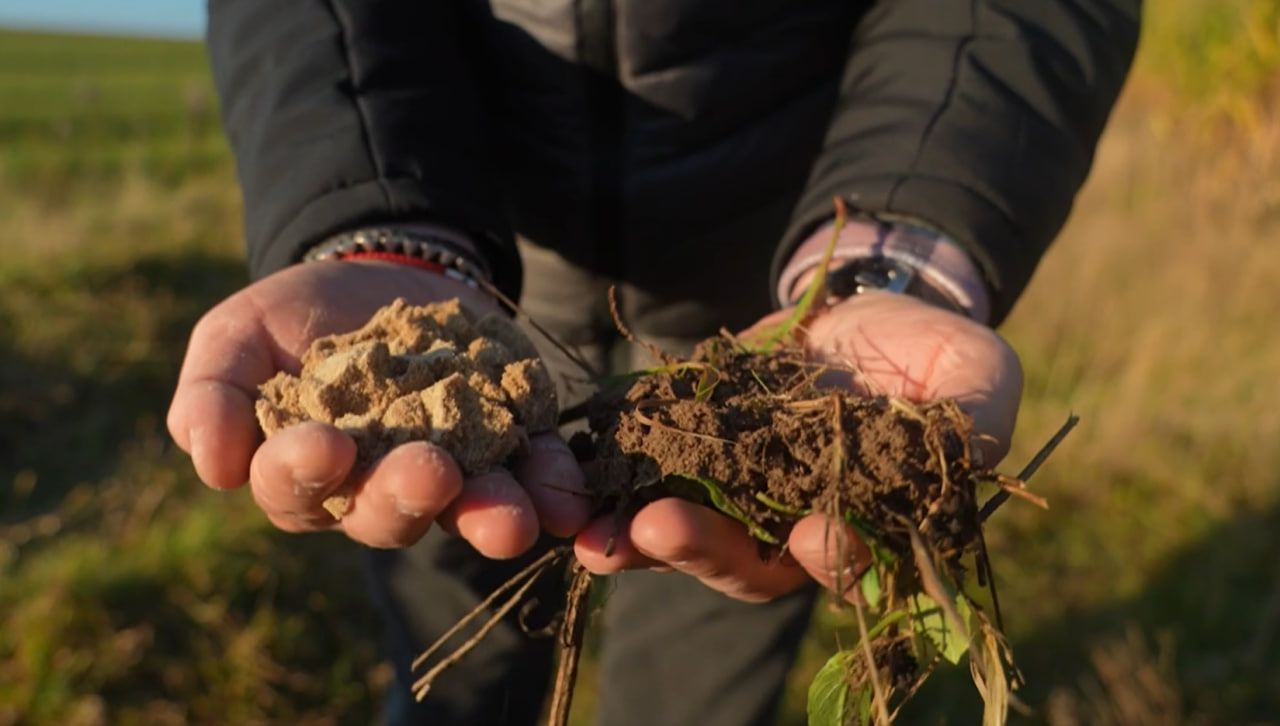
Photo: DW. Soil before planting miscanthus and two years after its cultivation
As previously reported by EcoPolitic, Ukraine planned to exempt companies that use biofuel from eco-tax.