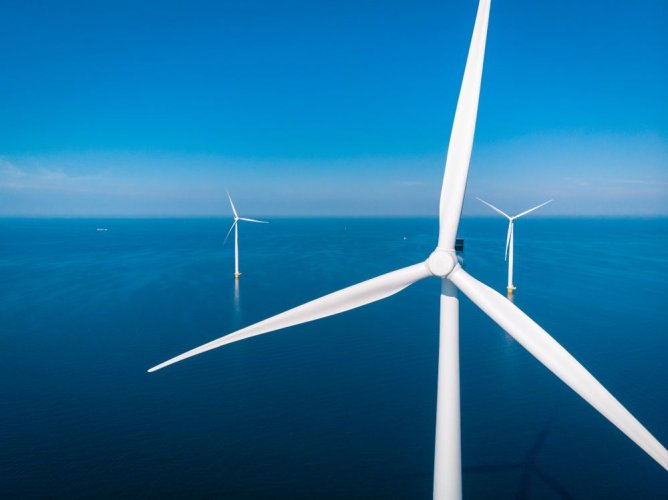
Global warming is making European summers less windy, which could affect wind energy production.
Euronews writes about this with reference to a study published in the journal Environmental Research Letters of the University of Illinois at Urbana-Champaign.
Scientists explain that this phenomenon is worsening due to the warming of the land and the troposphere, the layer of the atmosphere closest to the Earth's surface. According to the study, the decrease in wind speed will be less than 5% between 2021 and 2050.
But even a small decrease in wind speeds could affect the continent's ability to generate energy as Europe increasingly relies on renewable sources, scientists say.
The Intergovernmental Panel on Climate Change predicts weaker winds in the coming decades. According to their data, by 2100, the average annual wind speed may decrease by 10%. Other studies suggest that the impact of global warming on global wind speeds will become statistically significant in the second half of this century.
A dangerous trend
According to the researchers, in the summer and fall of 2021, Europe experienced a so-called “wind drought” when wind speeds were about 15% lower than the annual average.
In the UK, this “drought” was one of the least windy periods in the last 60 years. This led to a sharp drop in wind power and forced the country to restart 2 closed coal-fired power plants to cover the energy shortfall.
Will this be a problem for renewable energy?
Despite the availability of a number of studies, the potential impact of slowing wind speeds in Europe on renewable energy in the long term is still unclear.
In 2024, wind power accounted for 17% of the EU's electricity mix, and its capacity continues to grow. Despite numerous delays in new projects across the bloc, wind energy is still cheaper than fossil fuels.
Even a 5 percent drop in wind speeds can lead to significant fluctuations in wind energy production, lead researcher Gang Zhang, a climate scientist and professor at the University of Illinois at Urbana-Champaign, told Bloomberg.
“The energy system is a marginal market. This means that if you change the margin by 5-10%, the price reaction can be huge,” he said.
Zhang suggests that in the future, Europe will have to be more creative in producing renewable energy to deal with the problems that lower wind speeds can cause.
As EcoPolitic wrote earlier, China has become the undisputed leader among the world's countries in the construction of wind and solar power plants. It accounts for more than 70% of the current construction of industrial solar and wind power plants in the world – more than 416 GW.