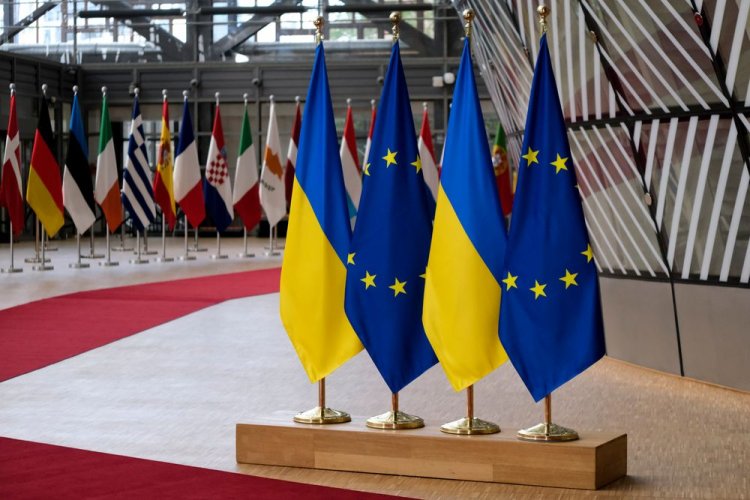
Ukraine is consistently and productively moving towards membership in the European community. Its progress was confirmed by the results of the report within the 2025 Enlargement Package. However, alongside positive assessments, the European Commission also provided a number of recommendations for improving legislation, particularly environmental legislation.
The Cabinet of Ministers has given this year's report an extremely positive assessment.
“This is our best result in three years on the path to accession. And most importantly, we have never received a negative assessment of ‘backtracking’,” emphasizes Prime Minister Yulia Svyrydenko.
The European Commission's report also noted Ukraine's confident and decisive steps towards European integration. In particular, the state has successfully completed the screening of legislation and made significant progress in key reforms. However, the report aims not only to confirm interim successes, but also to provide a vector for further work.
“Enlargement is a merit-based process. Our package contains specific recommendations for all our partners,” said European Commission President Ursula von der Leyen.
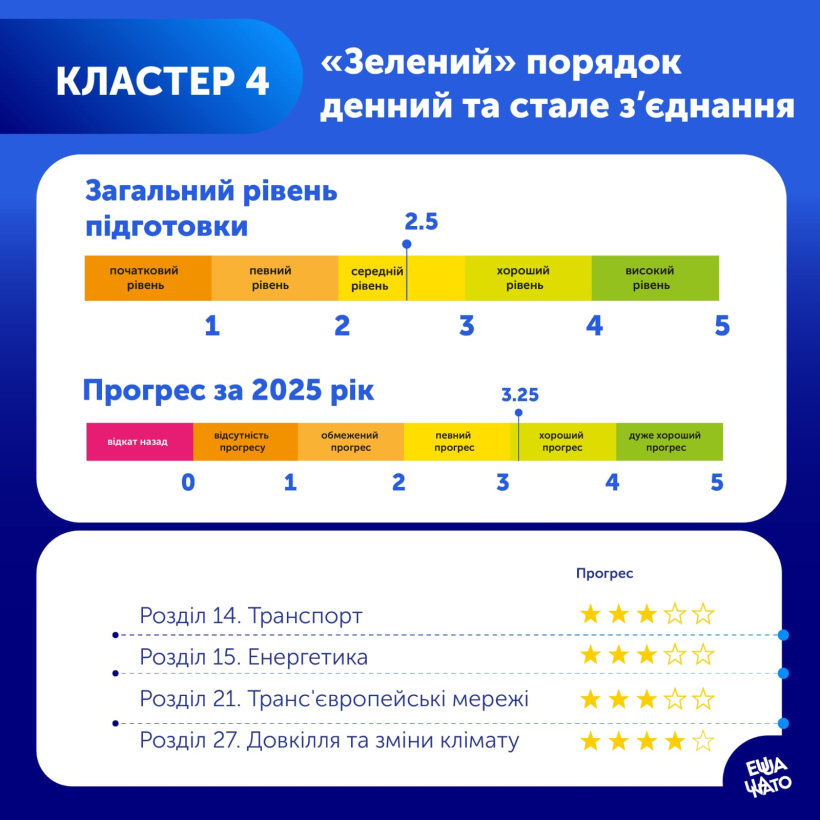
Photo: Government Portal
Homework in environmental and climate work
The European Commission's report notes the positive steps Ukraine has already taken toward European environmental awareness. In particular, it mentions the ratification of the Aarhus Convention, the adoption of the National Waste Management Plan, and the framework law on state climate policy. However, the harmonization of legislation in all sectors is still partial, and in some areas, such as environmental protection, it is only in its initial stages.
For example, Ukraine needs to update its Low Carbon Development Strategy, ratify the Kigali Amendment, adopt EU rules on the Eco-Management and Audit Scheme (EMAS) and European Ecolabel, update its National Energy and Climate Plan, and introduce rules for asbestos waste management, among other things.
A number of institutional and geopolitical obstacles are hindering the harmonization of environmental legislation. The report mentions, in particular, a lack of funding, weak institutional capacity, and delays in adopting legislative changes. Ukraine needs to make additional efforts to ensure accountability and control, as well as to fight corruption.