In 2022, employment in the green economy in the EU increased by an average of 9.5% compared to 2021.
These data are provided by Eurostat.
The indicator was measured in full-time equivalents (FTE). The three leaders in this indicator are:
- Italy – 1,153,508 FTE;
- Germany – 844,546 FTE;
- France – 777,755 FTE.
The lowest values are in the following countries:
- Cyprus – 13,023 FTE;
- Iceland – 4,099 FTE;
- Malta – 3,577 FTE.
Growth varied greatly by country, ranging from 2.8% in the Czech Republic to 38% in Greece, while Malta, Lithuania, and Slovakia saw employment decline over the same period.
What businesses and organizations belong to this sector?
The Environmental Goods and Services Sector (EGSS), also called the ecological economy or eco-industry, in the EU includes producers of goods and services aimed at protecting the environment and managing natural resources. The main goals of their activities are
- preventing or minimizing pollution, degradation, or depletion of natural resources;
- eliminating damage to air, water, biodiversity and landscapes, as well as waste and noise;
- reducing, eliminating, cleaning up and managing pollution, degradation and depletion of natural resources;
- other activities such as measurement and monitoring, control, research and development, education, training, information and communication related to environmental protection or resource management.
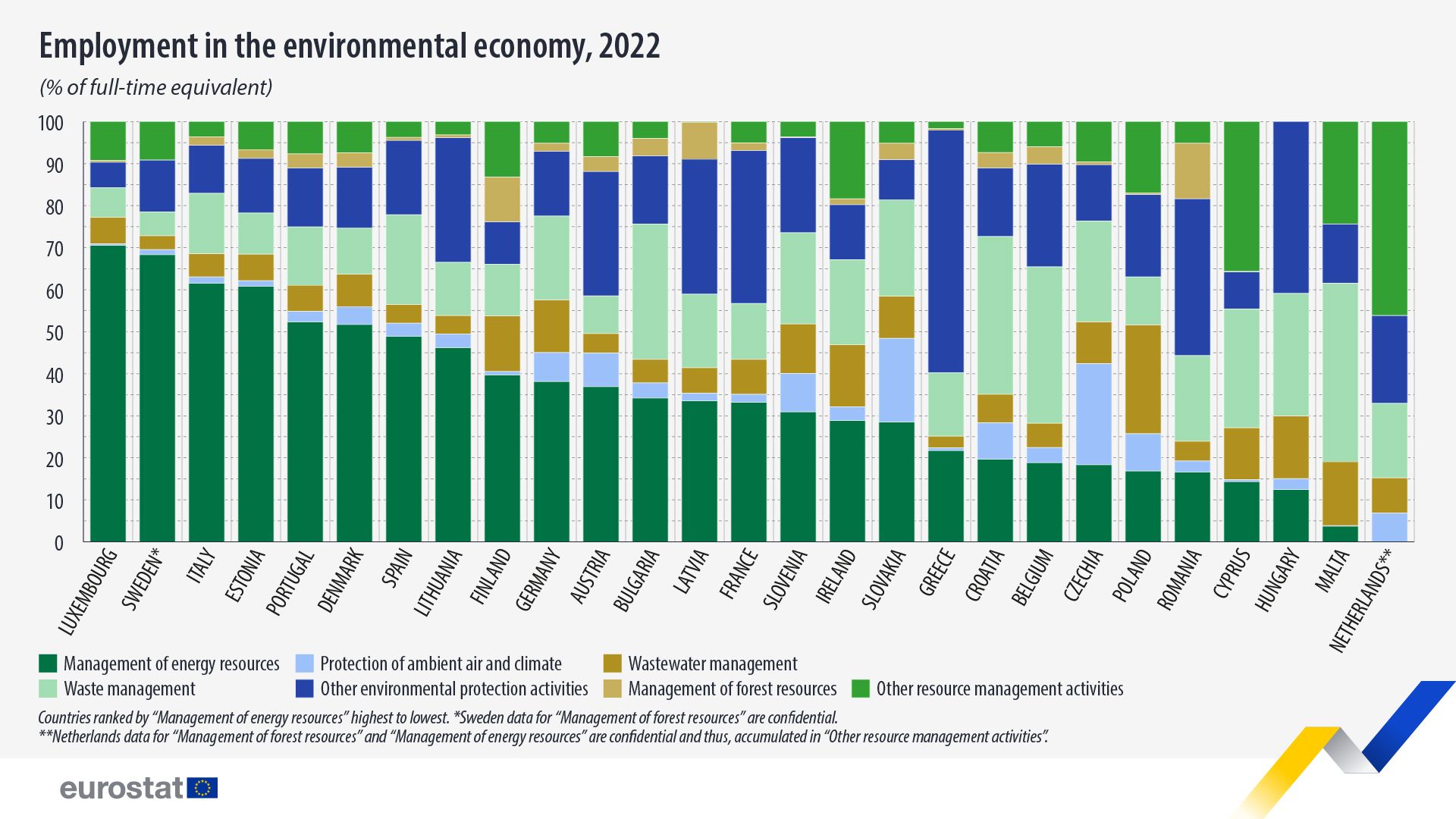
The distribution of employment in the ecological economy by different sectors in each EU country is shown in the diagram:
Source: ec.europa.eu.
In Italy, Germany and Portugal, there was a significant increase in employment in energy management (+73%, +34% and +48%, respectively) in 2022 compared to the previous year. In the waste management sector, employment in Italy decreased by 2.5%, while in France and Germany it increased by 1.6% and 4.6%, and in Spain it remained stable.
In EU countries, the largest share of employment in the ecological economy is related to energy management (34.8% on average). However, this share varied significantly from country to country. It was highest in Luxembourg (70.5%), followed by Sweden (68.3%) and Italy (61.5%). Instead, Malta recorded 3.7%, Hungary – 12.7%, and Cyprus – 14.3% of employment in this part of the ecological economy.
Earlier, EcoPolitic wrote about the main dilemma of the European Union, which should be solved by the Clean Industry Agreement published by the European Commission on February 26.