One of the issues currently of greatest concern to Ukrainian businesses is the transparency of environmental impact assessment (EIA) procedures and their impact on investment projects.
At a working meeting at the Ministry of Economy, Environment, and Agriculture of Ukraine on March 13, representatives of business associations, industry groups, and think tanks once again raised this issue with officials. They complained that the lack of clarity regarding the EIA procedure limits investment, delays project implementation, and, consequently, the creation of jobs and tax revenue—which is critical for Ukraine amid the war.
Is the EIA fulfilling its primary mission—protecting the environment? What problems with the application of this mechanism do experts and industrialists see? EcoPolitics decided to investigate and reached out to them for comments.
We also sent a request to the Ministry of Economy asking them to share their perspective on the EIA situation, but we never received a response from the ministry’s public relations and media department.
Why the issue is being discussed again
Victoria Karpets, Manager of the Industrial Ecology and Sustainable Development Committee at the European Business Association (EBA), told us that in the nearly nine years since the adoption of the Law “On Environmental Impact Assessment,” despite the multi-stage nature and length of the EIA process, companies have become accustomed to its intricacies and have thoroughly studied its legal and organizational foundations.
“Despite years of business experience with EIA matters, in recent months companies have reported difficulties during the procedure and, as a result, have received decisions denying the issuance of conclusions,” the expert says.
Viktoria Karpets emphasized that even a short delay in the EIA process slows down the start of planned activities and, as a result, can hinder the implementation of investment projects, the creation of new jobs, and budget revenues.
In a situation where the country needs reconstruction and recovery, such delays are a significant obstacle to this.
“The current model partially discredits the environmental impact assessment tool itself. If this is not changed, we risk losing not only investments but also trust in environmental policy as such,” emphasized Lyudmyla Tsyganok, President of the Association of Environmental Professionals (PAEW).
Corruption built into the very foundation of the procedure
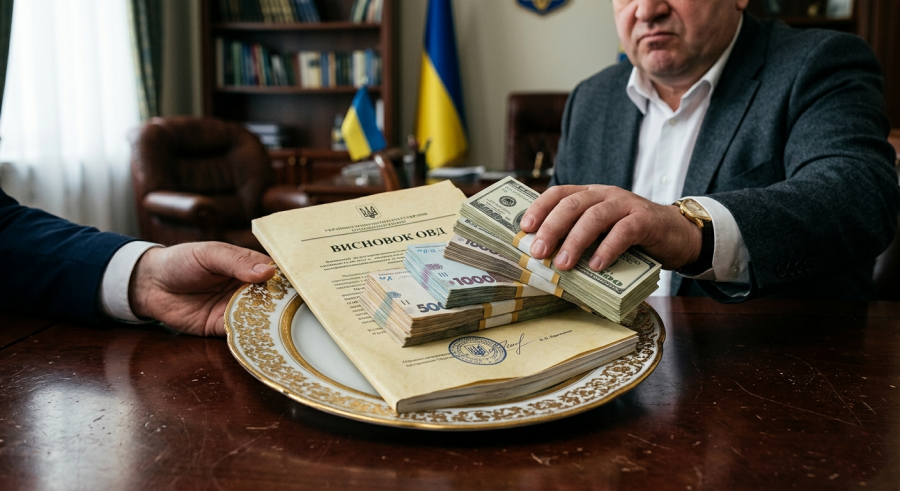
Most of the experts we interviewed agree that the key problem with the EIA procedure in Ukraine is that it was designed from the outset as a mechanism for corruption rather than as an objective tool for environmental oversight.
Experts say that Ukrainian environmental officials were given ample room for abuse from the very start when clear and transparent criteria for evaluating reports were not established, and, in essence, the decision to issue or not issue an EIA conclusion was left to the discretion of officials. Officials are happily taking advantage of this.
As a result, companies regularly complain about the lack of transparency and unpredictability of the procedure, whilst officials involved in EIA proceedings are periodically suspected of, and face criminal charges for, illicit enrichment.
Moreover, the high likelihood of rejection for reasons beyond the manufacturer’s control leads to self-censorship within the business sector and acts as a brake on the country’s economy. Experts say that some companies simply do not submit projects for the EIA procedure. They do not want to spend a lot of time and money, only to receive a negative response, the sole reason for which is the subjective assessment of an individual official or their desire to receive a financial reward for a positive decision.
When the main purpose of the EIA is overlooked
Many experts have pointed out another issue: the procedure fails to fulfill its primary purpose of protecting the environment.
“The current situation with obtaining EIA opinions indicates that the system is not functioning as originally intended. The problem is not only with lengthy timelines or refusals; the main issue is that the procedure often loses touch with its core goal – preventing environmental harm,” explained Liudmyla Tsyhanok.
Industrial representatives also share this view.
“Businesses note that in some cases, the EIA requirements in Ukraine are stricter than those in EU countries, yet they do not actually improve the condition of the natural environment,” says Viktoriia Karpets.
The scourge of the procedure – a highly manual and corruption-prone architecture
This creates a “gray zone” for decision-making and gives officials the opportunity to arbitrarily block or approve projects at their discretion. The lack of specific criteria results in unpredictable outcomes when reviewing environmental impact assessment reports.
Vladyslav Antypov, General Director of the Limited Liability Company "Center for Ecology and New Technologies Development" (CERN), explains that out of all projects undergoing the EIA procedure, roughly 10% are projects that can never be approved due to clear and direct violations of the law, about 10% are those that must not be refused since there are no real violations, while nearly 80% fall into the “gray zone,” where approval or refusal is at the discretion of the authorities. According to the CERN director, this is where the main corruption potential lies, since decisions are essentially left to the sole judgment of the EIA management office.
In addition, officials often use evaluative rather than legally defined wording in refusals, such as “it appears,” which are not clear legal criteria: “it appears to be impossible to assess,” “it appears that it may be…”.
“In other words, a decision may be based not on proven facts, but on a subjective impression of the official,” says Vladyslav Antypov.
The absence of clear criteria and certainty was also emphasized in his commentary by Andriy Hlushchenko, an analyst at GMK Center. He also agrees that the current legislation is rather vague; for example, it does not define what constitutes a “significant”/“substantial” impact on the environment, nor does it specify what evidence is sufficient to confirm or refute the presence of such an impact.
“This allows for broad interpretation of existing regulations, which ultimately leads to prohibiting activities based on formal criteria. It is always easier to ban than to take responsibility for issuing a permit for new activities,” the expert summarized.
According to Liudmyla Tsyhanok, when businesses spend half a year undergoing the procedure and receive a refusal, it means the system does not work at the entry stage.
“It does not provide clear and understandable criteria, does not establish predictable rules, and in fact shifts the risk of uncertainty onto the applicant. This is a sign not of strict oversight, but of weak institutional capacity,” the expert is convinced.
Specialists note that, as a tool for refusing to issue Environmental Impact Assessment (EIA) conclusions, officials also make use of internal contradictions within the legislative framework underpinning the procedure, and the resulting conflicts. For example, the legislation requires approval of sanitary protection zone projects by the State Service of Ukraine on Food Safety and Consumer Protection, even though the State Service for Food Safety and Consumer Protection (SSUFSCP) itself is effectively deprived of such authority.
Formalism that kills
Applicants often receive refusals in obtaining EIA conclusions due to insignificant, technical, or secondary shortcomings, rather than due to any objective environmental risk of the project under review.
“Even minor, technical, or formal errors often become grounds for complete refusal. It could be an incorrect figure, a typo, an inaccurate name, or a formal inconsistency in the details. Instead of being able to rectify such a minor mistake, the business entity receives a refusal or is forced to restart the process,” explains Vladyslav Antypov.
Disproportionateness and excessive rigidity
As business representatives have previously noted, domestic EIA legislation is sometimes stricter than its European counterparts. The director of CERNY agrees with them.
“In some respects, the Ukrainian EIA Law is harsher than the European Directive 2011/92/EU on the assessment of the effects of certain public and private projects on the environment, even though it was supposed to be an instrument of harmonization, not complication,” he explains.
Liudmyla Tsyhanok also draws attention to critical disproportionality, as the EIA is often applied equally to projects with fundamentally different levels of impact.
“As a result, we face a situation where substantial resources are spent on procedures for facilities with a minimal environmental effect, while focus on truly risky projects becomes blurred. This does not enhance environmental protection. It weakens it,” the expert believes.
She provides an example where an EIA is required for activities aimed at damage remediation, such as cleaning up burnt areas after fires. In such cases, according to the PAEW president, the procedure not only fails to add environmental value, but it also directly delays environmental recovery and requires hundreds of thousands of hryvnias in budget expenditures.
“This is no longer about environmental policy. This is about losing sight of logic in the application of the tool,” summarizes Tsyhanok.
Vladyslav Antypov also noted that the scope of application for the EIA procedure in Ukraine is too broad.
“There are types of activities that fall under the EIA requirement in Ukrainian law, even though the Directive does not include them or allows member states to determine the need for assessment themselves. This creates artificial barriers to the implementation of projects in areas that should not undergo the full EIA procedure,” he says.
Actual lack of business protection
During the procedure, entrepreneurs risk receiving comments from interested parties and local authorities at a stage when it is no longer possible to make corrections. If it wishes, the EIA authority can use these comments as grounds for refusal. In such situations, business representatives are effectively left without procedural protection, since defending their position in court is lengthy and costly.
“Judicial protection does not work as a real mechanism to influence and correct the system. Most companies do not go to court because it takes longer, costs more, and is less effective than going through the EIA again or finding another work-around. Even winning in court often does not solve the problem systematically-it only wastes time and adds costs. As a result, judicial practice does not provide sufficient deterrence against abuses by the authorized authority,” shares Vladyslav Antypov about the real situation.
Disappointing results
What are we left with? Corruption exists, barriers for business exist, but there is no real protection of the environment.
“In the end, a system is created that both creates obstacles to development and fails to provide adequate environmental benefits. This is the worst possible scenario, where regulation is burdensome but ineffective,” summarizes Liudmyla Tsyhanok.
We have identified the list of problems. What solutions have experts and stakeholders proposed? Read about this in our next article, coming soon.