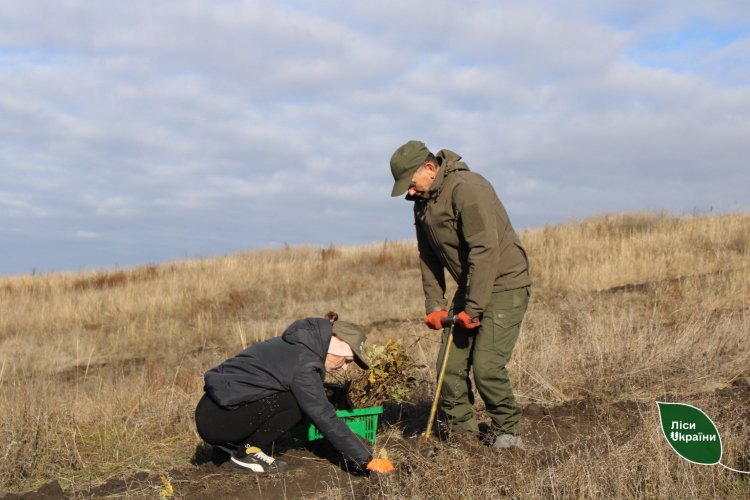
In Chernihiv region, within the Sribne community, 5 hectares of steppe are being planted with oak and walnut trees. The State Enterprise “Forests of Ukraine” considers this initiative to be part of the presidential program “Green Country” and is implementing it within the framework of the FOREST RECOVERY project, which involves European partners. However, the creation of a forest will spell the end for the steppe, which is a violation of legislative norms.
This point of view was expressed by the Ukrainian Nature Conservation Group (UNCG).
Recently, the State Enterprise “Forests of Ukraine” reported that the Northern Forest Office had started its autumn planting campaign. There is already talk of planting 12,500 seedlings on the territory that the Sribnyanska village council has transferred to the Varvinsky forestry.
"The area has steep slopes that agricultural machinery cannot access. But this is not an obstacle for foresters: we create forests wherever there is free land," the state-owned enterprise said in a statement.
However, environmentalists have a different opinion about this “free land.” They emphasize that it is a steppe area. Therefore, its afforestation will disrupt the existing biological balance and harm rare plants.
The environmental group also highlights the inconsistency of Yuriy Bolokhovets, head of the state-owned enterprise “Forests of Ukraine.” According to UNCG, he declared that steppe areas would not be used for afforestation.
Everything has its place
Steppe and forest biomes are home to various species of flora and fauna. Therefore, destroying one to create another is prohibited by a number of national and international acts. The Ukrainian Nature Conservation Group refers to the Forest Code of Ukraine, the Red Book, and the Rules for Forest Regeneration.
Also, according to Resolution No. 3 of the Bern Convention, states must protect species that are on the verge of extinction. And the red-listed hairy feather grass grows in the afforested area, according to environmentalists.
Environmentalists have announced that they have already appealed to the Chernihiv Regional Environmental Inspection with a request to conduct an inspection and calculate the damage. The appeal has also been sent to the Chernihiv Regional State Administration. In it, the UNCG emphasizes the need to create a special working group “so that steppe areas and places where rare species grow are not destroyed by foresters.”
Earlier, EcoPolitic reported how Ukraine’s nature reserves have sabotaged the protection of existing forests from off-roading.