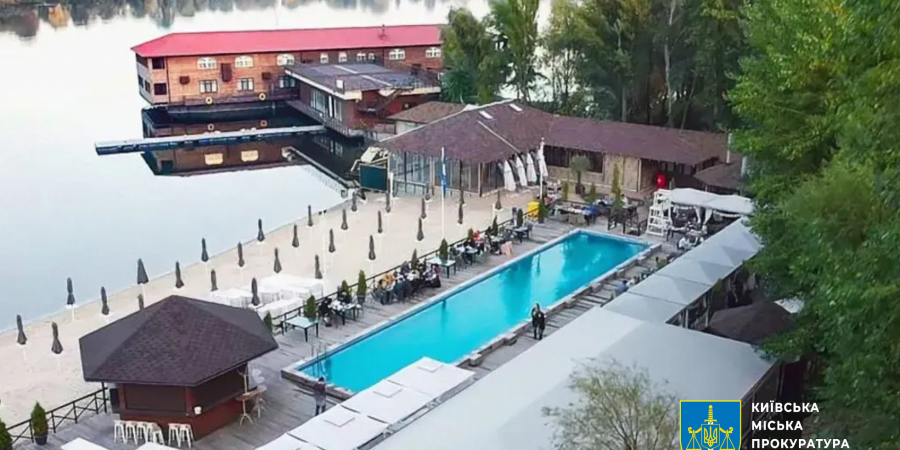
The Northern Commercial Court of Appeal has ordered a commercial entity to demolish an unauthorized hotel and restaurant complex at 35 Naberezhno-Korchuvatska Street in Kyiv and return the land plot on which it is located to the local community.
This was reported by the press service of the Kyiv City Prosecutor's Office.
This complex is known as Galera Resort. It is located within the coastal protection zone of Galera Bay, in the Holosiivskyi district of Kyiv, and occupies a plot of 0.5 hectares. The cost of this hotel and restaurant complex is estimated at UAH 3.2 million.
The prosecutor's office reminded that since the land plot under it belongs to the water fund, it is under special state protection and construction on it is prohibited.
Prosecutors found that the individual, based on a later canceled district court decision, registered ownership of the unauthorized hotel and restaurant complex and transferred it to the company's authorized capital.
This became a prerequisite for the company to obtain a land plot for lease in 2018 bypassing the land auction procedure. Subsequently, the company violated the terms of the lease agreement and the requirements of land and water legislation by continuing the illegal development of the leased land plot. It has restricted unimpeded access to the Dnipro river bank and is using the leased land plot for commercial purposes. By doing so, the company violates the special regime for the use of water fund lands, prosecutors explained.
Despite these circumstances, in 2024, the Kyiv City Council renewed the lease agreement for the land plot for another 15 years. After that, the Kyiv City Prosecutor's Office filed a lawsuit and obtained a decision to demolish the unauthorized construction and return the land to the community.
On April 2, it became known that prosecutors had served a notice of suspicion to the private entrepreneur who built Galera Resort on the fact of unauthorized construction of a restaurant complex on an unauthorized land plot within the Dnipro coastal protection zone (part 4 of Article 197-1, part 4 of Article 190, part 2 of Article 209, part 3, part 4 of Article 358 of the Criminal Code of Ukraine). The investigation established that the suspect had forged documents on the existence of civil law relations with another person and applied to the court to register his ownership of the constructed real estate. In this way, he wanted to acquire the right to use this land plot.
EcoPolitic also recently reported that activists had a court order canceling a construction permit for the Osokorky Ecopark in Kyiv.