According to the State Tax Service of Ukraine, Ukrainian companies have paid over 1.5 billion hryvnias in environmental taxes since the beginning of the year. Compared to the previous year, revenue has increased by 6.8%. But has the environment felt the positive impact of these increased funds? Let’s take a closer look.
Where the funds are going
The total amount of revenue collected through the environmental tax is distributed as follows:
- 45% goes to the general fund of the state budget. These funds are non-earmarked-they simply fill the state budget, like most taxes.
- 55% goes to local budgets. This stream is further split into two: 30% is received by regional budgets, and 25% goes to the budgets of rural, settlement, and city territorial communities (an exception is made for Kyiv and Sevastopol, which receive the entire 55%).
Eco-payments for CO2 emissions and for the generation and temporary storage of radioactive waste are fully allocated to the special fund of the state budget.
How local authorities are turning the eco-tax into a "catch-all fund"
While the 45% share is straightforward-it serves a purely fiscal function-do the 55% really work where they're supposed to?
On paper, the domestic environmental tax seems logical: the polluter pays for degrading the local environment, and communities receive funds to improve the ecological situation in their own territories.
However, if we look at how this money is spent at the regional and community level, that logic starts to fall apart. A series of materials by EcoPolitics clearly demonstrates that, locally, eco-payments often lose their main function and become just another source of funding for absolutely anything at the discretion of local authorities.
It is very common for officials to fund utility works or urban improvement projects under the guise of environmental expenditures. Sewer reconstruction, wastewater network repairs, and engineering infrastructure upgrades are rather popular items financed from the environmental tax. Technically, these can be "tied" to ecology, but in practice such expenditures do not reduce emissions, purify the air, or address systemic environmental problems.
There are even more striking cases where funds are allocated to obviously non-environmental purposes-such as road equipment, dog parks, or even mobilization work (!!!).
This creates a paradox: enterprises pay for pollution, yet these funds do not help reduce the negative effects of this pollution. In our view, there are two main reasons for such poor use of the environmental tax budget at the community level. First is the local authorities’ desire to cover budget “holes” in this way, and second is the low level of environmental awareness among officials, when anything even remotely related to the environment is perceived simply as “ecology.”
Instead of serving as a tool for environmental policy, the environmental tax at the local level essentially acts as an “additional budget” used to cover any local needs. This is one of the fundamental issues with the system: there is money, but it does not benefit the environment.
How the state manages environmental payments
The situation at the local level is discouraging. Perhaps at the national level, the environmental tax funds are used more efficiently?
To keep pace with the European Union in matters of the “green” transition, in Ukraine, during 2024, a budget program was created – “Decarbonization and Energy Efficiency Transformation Fund.” This program now accumulates part of the collected tax on carbon emissions. The implementing agency is the State Agency on Energy Efficiency and Energy Saving of Ukraine. For fund management, the agency involved its subsidiary, JSC “Decarbonization Fund of Ukraine” (DFU).
It would seem that the process of eco-modernization of domestic enterprises should now accelerate. However, the problem is that, contrary to its name, the Fund focuses on energy efficiency rather than decarbonization. The main beneficiaries are central executive authorities (CEAs) and communities, not the enterprises that pay the CO2 tax.
In its report for 2024–2025, the DFU presented the use of carbon emissions proceeds as follows:
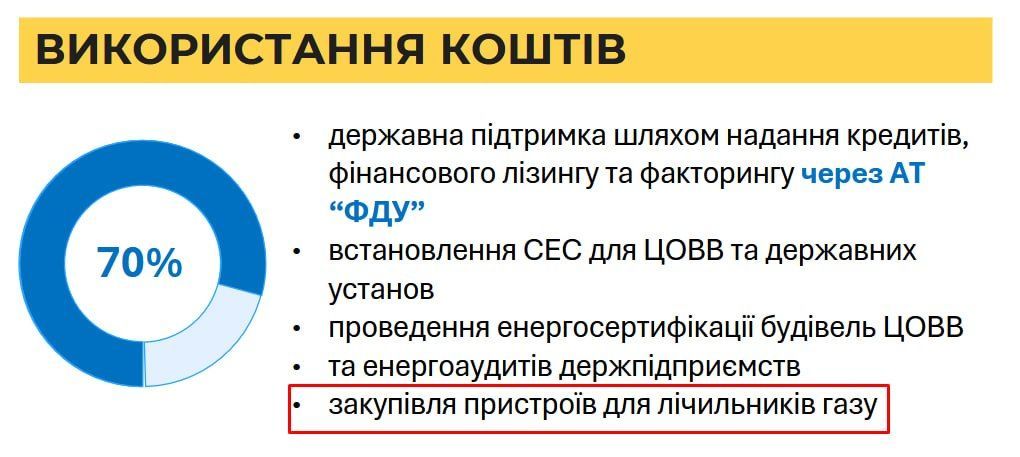
Source: fdu.com.ua
Even back then, in December of last year, EcoPolitica journalists were very surprised by the last item. It has nothing to do with either decarbonization or energy efficiency. Recently, a possible explanation appeared in the media: the creation of a corruption scheme. The “ANTIKOR” portal claims that several high-ranking officials, including the head of the State Agency on Energy Efficiency and Energy Saving Hanna Zamazaieva and general director of JSC DFU Olesya Mishchenko, are profiting from these procurements.
According to the publication, after the formal disruption of the tender, the purchase worth UAH 192 million from the budget was awarded to a "friendly" contractor through a negotiated procedure – without changing the terms, without alternative offers, and without reducing the price.
“Next [after the purchase – Ed.], the equipment is transferred to the gas distribution networks, where, through a system of contracts and controlled contractors, it reaches consumers as a paid service or as part of a tariff. As a result, the state finances the purchase, while sales and profits go to other entities. This model allows the same resource to be paid for from the budget initially and then resold to the public,” the journalists report.
Here is another example of the non-targeted use of Decarbonization Fund resources. At the end of January, the Cabinet of Ministers of Ukraine allocated financing from the fund for 10,000 portable charging stations for children with disabilities. For this purpose, the government specifically amended the procedures for using the Fund's resources. Of course, this is a very important initiative, but how is it related to decarbonization?
There is a Decarbonization Fund, but no decarbonization itself
The European Union has established several funds to help European industry reduce the carbon footprint of its products. In Ukraine, there is only one such specialized fund, and it gives out money for anything except projects that have a tangible impact on reducing carbon emissions.
And large enterprises – the main payers of the environmental tax – do not receive anything from this “feast of life.” Instead, the main beneficiaries are communities, the public sector, and corrupt officials in power.
In these extremely challenging times, Ukrainian business is simply losing financial resources that could have been used for its own decarbonization projects. Full-scale war results in excessive expenses and risks, catastrophically reduces companies' chances of attracting foreign investment, and the state is in no hurry to help them.
When the rational use of the funds available to businesses becomes a matter of competitiveness and survival for national producers, officials can hardly afford to treat this issue lightly.