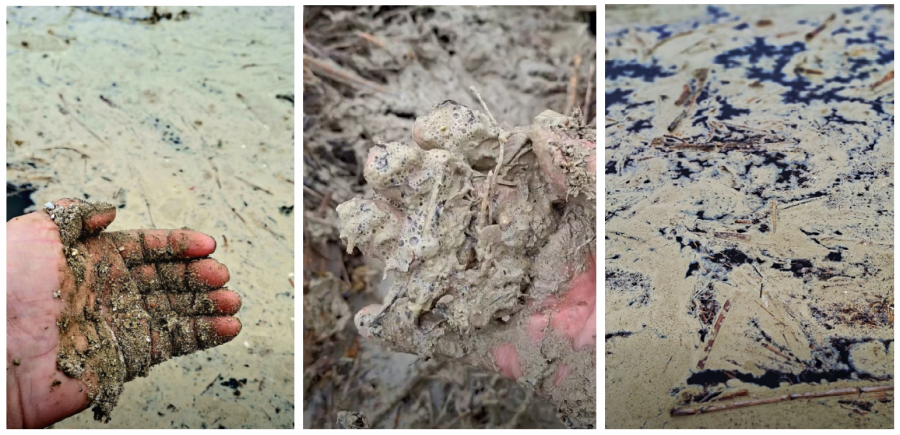
Due to strong easterly winds, the Black Sea has once again washed a large amount of sunflower oil onto the sandbar of the Tuzly Estuaries National Nature Park in the Odesa region. The oil entered the water on April 26 following a Russian attack on the port of Chornomorsk.
This was reported on Facebook by Ivan Rusev, head of the park’s scientific department.
The scientist noted that in the early days, the area of the sandbar contaminated with vegetable oil was approximately 10,000 square meters. However, on May 12, employees of the “Tuzly Estuaries” reserve discovered renewed contamination on various sections of the park’s beaches and shores. By the evening of that day, the total area of contamination had significantly increased, reaching several tens of thousands of square meters. An oily film covered various sections of the sandbar, including the national park’s protected zone.
How the disaster occurred
According to information from Ivan Rusev, on April 26, about 6,500 t of oil spilled into the waters of the Black Sea due to Russian damage to storage tanks at the Chornomorsk port. The resulting film covered 200 sq. km, stretching along the coastline from Odesa to Serhiyivka.
A week after the spill, the slick had halved in size but shifted closer to the Tuzly Lagoons.
It is still unknown whether the park's fauna has suffered. Researchers have not yet found contaminated birds. However, near Chornomorsk, where the spill occurred, several cormorants and swans have been found contaminated with oil along the shore.
This is not the first time sunflower oil has entered the sea and reached the Tuzly Lagoons as a result of Russian attacks on ports. The previous incident occurred at the end of December last year. Even two months later, oil slicks still remained on the shores of the national park.